
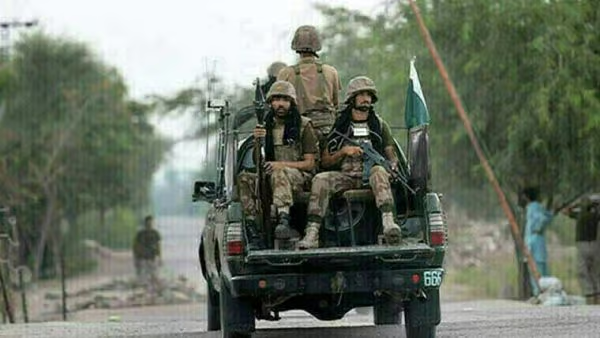
A Decisive Strategy Against Terrorism Is the Need of the Hour
By: Professor Imran Ismail Chohan

For more than two decades, Pakistan has been fighting a long, painful, and costly war against terrorism. Thousands of soldiers, police officers, and innocent civilians have sacrificed their lives in this struggle. From the tragedy of the Army Public School in Peshawar to attacks on mosques, marketplaces, schools, and public spaces, terrorism has left scars on every segment of society. It would be difficult to find a family in Pakistan that has not, directly or indirectly, experienced the pain caused by this menace. Terrorism, therefore, is not merely a security issue; it is a question of national survival.
In recent years, Pakistan has witnessed another rise in terrorist attacks. Pakistani authorities have repeatedly expressed concerns that some militant groups operate from across the border and use external safe havens to plan or facilitate attacks inside Pakistan. They have consistently maintained that no country’s territory should be allowed to serve as a launching pad for terrorism against another state.
One fact remains beyond dispute: terrorists have no religion, nationality, or humanity. Their objective is to spread fear, weaken state institutions, and create instability within society. Experience from different parts of the world suggests that dialogue or temporary arrangements with armed groups cannot succeed unless those groups renounce violence and accept the authority of the state and the rule of law. Effective intelligence, strong institutions, and a consistent national security policy remain the most reliable tools in countering terrorism.
At the same time, an important distinction must always be maintained between terrorists and ordinary civilians. Counterterrorism efforts should be conducted in accordance with the law and with respect for human life. Innocent civilians—whether in Pakistan or Afghanistan—often suffer the greatest consequences of conflict. Protecting non-combatants is both a legal obligation and a moral responsibility for every state.
Military measures alone, however, cannot eliminate terrorism. Lasting peace also depends upon educational reform, economic development, employment opportunities for young people, and the promotion of a national narrative that rejects extremism. When young people are offered education, hope, and meaningful opportunities, extremist organizations find it far more difficult to recruit them.
Pakistan’s security forces have made extraordinary sacrifices in the fight against terrorism. Thousands of officers and soldiers have laid down their lives to restore peace and stability. Their sacrifices demand that the country’s counterterrorism policy remain clear, consistent, and free from ambiguity. The state has both the right and the responsibility to protect its citizens through lawful and effective measures against those who threaten public safety.
Diplomacy is equally important. Pakistan and Afghanistan share a long border and face many common security challenges. Constructive cooperation between the two countries can help prevent militant groups from exploiting border regions and can contribute to lasting peace and stability across the region. Sustainable security can only be achieved when neighboring states work together against their common threats.
It is equally important to remember that terrorism does not discriminate. Its victims include people from every province, ethnicity, language, and community. Whether one is a Pashtun from Khyber Pakhtunkhwa, a Punjabi, a Sindhi, a Baloch, a resident of Gilgit-Baltistan, or a Kashmiri, every Pakistani has an equal right to live in peace and security. Terrorists do not target a particular ethnicity; they target the stability and future of the nation itself.
For this reason, terrorism must never become a subject of political division. Political leaders, state institutions, religious scholars, civil society, the media, and ordinary citizens all have a shared responsibility to stand united against this threat. National unity remains one of the strongest weapons against extremism.
Peace is the aspiration of every nation, but peace cannot survive through hope alone. It requires capable institutions, the rule of law, effective intelligence, timely decision-making, and unwavering national resolve. Whenever armed groups deliberately attack innocent civilians or state institutions, every sovereign state has the responsibility to respond within the framework of its laws to safeguard its people and preserve its sovereignty.
The challenge of terrorism demands patience, wisdom, determination, and national unity. Emotional reactions may fade with time, but the responsibility to protect the country remains permanent. Pakistan’s future depends upon creating a society where children can attend school without fear, people can worship freely, businesses can flourish, and every citizen feels secure.
The sacrifices made by thousands of Pakistanis—both civilians and members of the armed forces—should inspire the nation to remain steadfast in the pursuit of peace and security. The fight against terrorism is not the responsibility of the military alone; it is a collective national duty. Only through unity, justice, and a comprehensive strategy can Pakistan achieve lasting peace, stability, and prosperity.
Comments are closed, but trackbacks and pingbacks are open.