
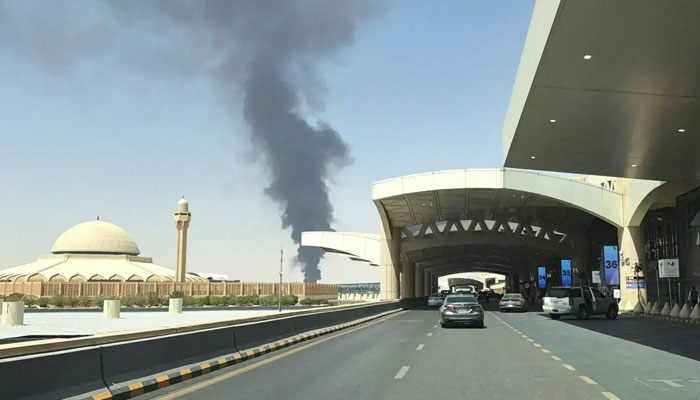
Riyadh Airport Partially Reopens Despite Fresh Houthi Threats, Missile Attacks
Two terminals at King Khalid International Airport are open again, but few flights are operating and the Houthis say the airport is still a target.

Riyadh airport partially reopens after a deadly attack earlier this month. Saudi Arabia said two terminals at King Khalid International Airport started working again on Sunday.
The news comes at a tense time. The Houthis in Yemen have warned that the airport is still not safe, and the attacks on the kingdom have not stopped.
Late on Saturday, the airport shared its plan. Terminal 1 will handle domestic flights. Terminal 2 will handle international flights, but only those run by national carriers.
This means the airport is not back to normal yet. Only a small part of its usual service has returned.
Flight tracking data from Flightradar24 showed little traffic at the airport on Sunday. Even with the announcement, the skies above Riyadh looked quiet.
Many airlines and travellers may still be waiting to see if the airport is safe enough to use.
Early on Sunday, Houthi military spokesperson Yahya Saree repeated his warning. He told airlines, airport staff and travellers not to use the airport.
He called it a “military target” and said it would “never be safe.” The Saudi government has not directly answered these statements.
The airport stopped all operations on October 10. A Houthi-claimed attack that day killed 13 people and wounded more than 300.
It was the deadliest attack in Saudi Arabia in more than a decade.
The Saudi-led coalition also said the Houthis carried out 20 attacks on the airport between October 1 and October 11.
More missiles and drones on Sunday
The danger did not end with the reopening. Saudi civil defence teams sent emergency alerts to Riyadh, Abha, Khamis Mushait, Jazan and Najran. Minutes later, they said the danger had passed.
The coalition said two drones and a ballistic missile were fired towards Riyadh. A cruise missile was also fired towards Khamis Mushait.
Later, it said it stopped 10 ballistic missiles that were aimed at southern Saudi Arabia.
The Houthis said they attacked the airport and Saudi oil facilities on Saturday.
Saudi Arabia is the world’s largest oil exporter. Any threat to its airports and oil sites can worry the wider world.
The conflict is also adding pressure to the larger war involving Iran. The US-Israeli offensive against Iran has made Saudi Arabia, a close US ally, a key pressure point.
Fighting near the Red Sea
Saudi Arabia has increased its strikes on the Houthis. This came after the group took important land along the Red Sea coast last month.
That move brought the Houthis closer to the Bab el-Mandeb Strait. It is a major shipping route used by Gulf oil producers.
The strait sits on the other side of the Arabian Peninsula from the Strait of Hormuz.
The new fighting has broken a truce that was arranged by the United Nations. That truce had mostly held since 2022.
Saudi Arabia joined Yemen’s civil war in 2015. It leads a coalition that backs the internationally recognised government. The war began after the Houthis took the capital, Sanaa, a year earlier.
For now, the partial reopening is a small step. It shows Saudi Arabia wants to restart air travel in its capital.
But the Houthis keep sending threats, and the attacks continue. Whether airlines return in large numbers will depend on how safe the skies feel in the coming days.
Comments are closed, but trackbacks and pingbacks are open.