
Trump Threatens Intervention in Cuba, Warns Iran of New Military Action
US Military Buildup Raises Fears of Fresh Strikes Against Iran

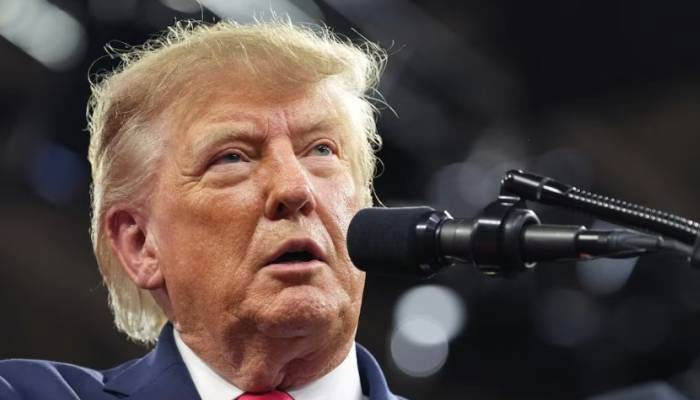
WASHINGTON: (News Desk) – US President Donald Trump has renewed his threats of intervention in Cuba, suggesting that American warships returning from the Middle East could stop near the island after a possible new military operation against Iran. Speaking at a rally in South Florida on Friday, Trump indicated that Washington could intensify pressure on Havana, reviving earlier remarks that Cuba could become the next target of American intervention.
Responding to a question from the audience, Trump said US warships could pass close to Cuba on their return from the Iran conflict, with one vessel stopping near the island’s coastline. He suggested that Secretary of State Marco Rubio could then become involved in efforts to secure an agreement with the Cuban government. His remarks came just days before the November 3 midterm elections, with rising fuel and grocery prices emerging as major concerns for American voters.
Trump and Rubio have repeatedly taken a hard line against Cuba’s socialist leadership. In May, the president suggested that he could become the first US leader in decades to order military intervention on the island. The administration’s position has hardened further following criminal charges announced against former Cuban leader Raúl Castro. Although Washington has indicated a preference for a peaceful resolution, Rubio has questioned whether a diplomatic agreement with Cuba’s current government is achievable.
Shortly after Trump’s rally speech, Rubio posted on social media that the time had come for action on Cuba. Addressing those seeking political change on the island, he urged them to seize the opportunity through what he described as a partnership with the CIA. His remarks renewed questions about Washington’s intentions, although he did not publicly outline any specific intelligence operation.
In a previous interview with Fox News host Sean Hannity on September 29, Rubio described Cuba’s economy as dysfunctional and argued that its political leadership continued to rely on an outdated revolutionary ideology. He said the administration would not allow Cuba to become a base for foreign adversaries or a threat to American national security. Meanwhile, US and Cuban officials have held discussions in recent months aimed at exploring possible improvements in bilateral relations, but the talks have reportedly produced little progress, with Washington imposing additional sanctions.
Addressing the United Nations General Assembly last month, Trump said Rubio was deeply involved in negotiations with Cuba. The president subsequently expressed confidence that the two countries could reach an agreement, adding that military intervention might not be necessary. However, tensions continued at the United Nations this week as Washington sought support against an annual resolution condemning the longstanding US economic embargo on Havana.
Cuba has faced a severe economic and energy crisis since 2020. The country’s economy has contracted, while its population of approximately 10 million has endured prolonged power outages, food shortages and rising prices. Repeated public protests and the departure of hundreds of thousands of Cubans, many of whom have migrated to the United States, have further highlighted the country’s growing difficulties.
US Military Preparations Raise Fears of Renewed Strikes on Iran
Meanwhile, growing signs of American military preparations in the Middle East have raised concerns that Washington could resume large-scale attacks against Iran after the US midterm elections. Although neither side has launched major attacks against land-based targets since early September, both countries remain engaged in a tense confrontation involving commercial shipping and control of strategic maritime routes.
The United States has been enforcing a blockade of Iranian ports, while Tehran has sought to strengthen its control over the strategically important Strait of Hormuz. Analysts warn that the current situation is becoming increasingly difficult to sustain, with the blockade placing additional economic pressure on Iran and requiring Washington to commit substantial naval resources to the operation.
Suzanne Maloney, director of the foreign policy programme at the Brookings Institution, said renewed American strikes could become more likely shortly after the November 3 elections. She pointed to the movement of additional military assets and personnel to the region, warnings issued to American citizens and heightened Israeli military readiness as possible indicators of further escalation.
Maloney also noted that Trump had publicly indicated he would not launch new attacks before the midterm elections. With the US-Israeli war against Iran contributing to higher fuel prices and facing considerable opposition among American voters, a fresh military campaign could create additional political difficulties for the president and his Republican Party.
Speaking on Friday, Trump warned that Washington could launch another operation under the name Epic Fury if Iran failed to reach an agreement. Epic Fury was the name given to the US military campaign launched in late February. However, he did not specify when another operation might begin.
Jason Campbell, a senior fellow at the Middle East Institute, said recent developments suggested that renewed strikes were possible, although the preparations could also reflect concerns about potential attacks by Iran or its Houthi allies in Yemen.
Campbell highlighted plans to deploy the USS Theodore Roosevelt to the Middle East, a move that could temporarily increase the number of American aircraft carrier strike groups in the region to three. He also pointed to the planned deployment of another Marine Expeditionary Unit, recent Israeli military exercises simulating previous operations against Iran and US Defense Secretary Pete Hegseth’s meeting with Israeli Prime Minister Benjamin Netanyahu.
However, Campbell cautioned that the timing of any renewed offensive remained uncertain. He argued that Washington’s military options had become more restricted following damage to American bases in the region, making a potential ground operation particularly challenging because of the difficulty of safely positioning the thousands of troops such an operation might require.
Maloney warned that most of Iran’s conventional military facilities had already suffered extensive damage during earlier attacks. As a result, any new campaign could increasingly target civilian infrastructure and facilities affecting ordinary Iranians, potentially deepening the humanitarian consequences of the conflict.
Despite the possibility of further military escalation, both analysts questioned whether additional strikes would produce a decisive outcome. Maloney argued that the conflict could not be resolved through continued escalation, while Campbell said further attacks resembling the initial weeks of the war were unlikely to fundamentally change the Iranian government’s strategic position.
Their assessments suggest that, despite mounting military pressure and renewed threats from Washington, a lasting resolution will remain difficult to achieve without a broader diplomatic agreement between the United States and Iran.
Comments are closed, but trackbacks and pingbacks are open.