
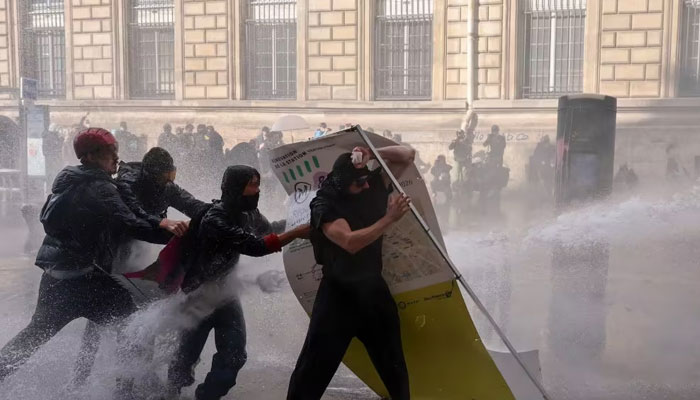

To apprehend the deeper disquiet of a society, it is not invariably sufficient to examine the deliberations of its governing chambers, the proceedings of its legislatures, or the indices by which its economic condition is conventionally measured. At times, the shattered glass of a shopfront upon an opulent commercial thoroughfare, the merchandise scattered in disarray, and the spectacle of plunder disclose, with an immediacy that statistical abstractions cannot attain, those underlying contradictions which the imposing facades of aggregate prosperity may obscure. Reports of disturbances in France and of the pillaging of establishments belonging to internationally celebrated luxury houses accordingly invite reflection upon a question of considerable political and moral consequence: to what extent have modern states succeeded in reconciling economic advancement with social justice and the enduring contentment of their citizens?
France is not merely a constituent nation of Europe; it occupies a distinguished place in the historical imagination as one of the principal embodiments of liberty, equality, and fraternity. The French Revolution, which unfolded in the closing years of the eighteenth century, inaugurated a far-reaching intellectual and political challenge to hereditary privilege, absolutist authority, and entrenched distinctions of social rank. Its reverberations extended well beyond the frontiers of France, helping to shape the vocabulary of modern democratic thought and the subsequent evolution of political institutions throughout the world. Yet history offers a caution of equal importance: when the emancipatory aspirations proclaimed by a revolution fail to acquire durable expression in the institutional arrangements of society, their moral authority remains vulnerable to recurrent scrutiny. The contemporary unease discernible in France must therefore be considered within its wider historical and sociological setting, although intellectual exactitude requires that no particular episode of protest be equated directly with the French Revolution itself. Historical analogy may illuminate a problem; it cannot, without sufficient evidence, establish an identity between events separated by their circumstances, causes, and consequences.
The reports under consideration refer to demonstrations in Paris and other French cities, alongside grievances concerning economic pressures and the provision of public amenities. Should inflation, the erosion of purchasing power, deficiencies in public services, and the unequal distribution of economic advantage constitute among the causes of such discontent, these phenomena would hardly be peculiar to France. Numerous economies across the contemporary world confront analogous difficulties: escalating housing costs, the burden of energy prices, insecurity of employment, and the growing struggle to satisfy elementary material requirements. An increase in gross domestic product may undoubtedly testify to an expansion of economic activity; nevertheless, the more searching criterion of prosperity lies in the distribution of its benefits. The magnitude of national wealth, considered in isolation, reveals comparatively little about the condition of the citizenry unless it is accompanied by an inquiry into the proportion in which that wealth, and the opportunities arising from it, are made accessible to different sections of society.
Economic inequality, moreover, cannot adequately be comprehended as a mere disparity between the incomes of the affluent and the indigent. Its ramifications extend into the unequal possession of opportunity, the accessibility of education and healthcare, the security of habitation, the availability of social protection, and the prospects of advancement which individuals may reasonably entertain for their future. When conspicuous symbols of extraordinary affluence occupy one portion of the social landscape, while another portion remains persistently preoccupied with the satisfaction of elementary needs, a profounder consciousness of deprivation may take root. Such deprivation is not exclusively material; it may also acquire a psychological and moral dimension, particularly when individuals perceive that the prevailing distribution of advantage is incompatible with their understanding of fairness. Nevertheless, intellectual fairness forbids us to attribute a single, uniform sentiment to an entire population. Social responses are differentiated by class, locality, political conviction, and individual circumstance; no society can be reduced, without distortion, to one collective consciousness.
Names such as Louis Vuitton, Hermès, and Rolex signify more than commercial enterprises engaged in the sale of expensive commodities. Within the architecture of the global marketplace, they also represent the accumulated prestige of established brands, the social communication of status, and the culture of luxury consumption. The prices commanded by their products may reflect not only craftsmanship and material quality but also the reputation of the house, the relative scarcity of particular goods, the distinctiveness of their design, and the social prestige attached to their possession. Reports of such establishments being targeted during disturbances may consequently possess a symbolic dimension. Yet symbolism, however suggestive, must not be mistaken for conclusive evidence of motive. The plundering of an expensive boutique cannot, merely by virtue of the identity of its owner or the value of its merchandise, be pronounced an act of conscious rebellion against capitalism. Opportunism, organised criminality, the contagious psychology of a crowd, or a plurality of unrelated motives may equally contribute to such conduct. The interpretation of any particular incident must therefore remain contingent upon corroborating evidence and the findings of relevant investigations.
At this juncture, a distinction of fundamental importance must be preserved: public protest and criminal pillage are not interchangeable phenomena. In a democratic polity, citizens must be afforded the opportunity to express opposition to economic injustice, administrative incompetence, or governmental policy. The protection of peaceful dissent is not an ornamental concession bestowed by the state upon its subjects; it is an indispensable condition of legitimate democratic life. Yet the right to protest confers no moral or legal licence to destroy the property of others, despoil commercial establishments, or imperil the safety of fellow citizens. Equally, it would be a grave miscarriage of justice to infer from the criminal conduct of particular individuals or groups that all demonstrators are themselves culpable. The genuine test of the rule of law resides in the state’s capacity to protect peaceful disagreement, to proceed against those implicated in violence in accordance with lawful procedures, and to accord equal consideration to the rights and security of every citizen. Justice is compromised both when criminality is excused under the pretext of political grievance and when legitimate dissent is indiscriminately criminalised in the name of public order.
The text attributed to Reuters in the material supplied for consideration refers to approximately 1,800 arrests and injuries sustained by hundreds of police officers. Before these figures are attached to a particular date or episode, however, their provenance and contextual accuracy require verification against the original report. A numerical assertion may lend a narrative an appearance of precision and dramatic force, but neither quality constitutes proof of its reliability. The journalistic worth of a statistic depends upon its accuracy, its temporal and circumstantial context, and the credibility of the source from which it derives. The same evidentiary discipline must govern assertions concerning the demands of demonstrators, the origins of violence, and the character of the official response. Where verification remains incomplete, intellectual honesty requires restraint rather than conjecture, and qualification rather than the manufacture of certainty.
The broader lesson to be drawn from the French predicament is that economic stability cannot be adequately defined by the vitality of markets, the magnitude of commercial profits, or the concentration of wealth in the hands of a limited section of society. It must also encompass the confidence citizens repose in public institutions, their effective access to essential services, the fairness of the opportunities available to them, and the accountability of those entrusted with authority. Governments would therefore be ill-advised to construe public grievances exclusively as disturbances of law and order while neglecting the economic and social conditions that may contribute to them. The symptoms of disaffection cannot be permanently remedied if their underlying causes remain unexamined. Conversely, those who take to the streets in pursuit of legitimate demands bear a corresponding responsibility not to permit their claims to be discredited, or their moral purpose extinguished, by violence and plunder. A just grievance does not sanctify every means adopted in its name, just as the occurrence of disorder does not invalidate every grievance voiced amid it.
Ultimately, the measure of a nation’s advancement is not to be found in the number of luxury boutiques adorning its boulevards, nor in the splendour of the commodities displayed behind their windows. It resides, rather, in the degree to which its citizens enjoy security, agency, dignity, and reasonable satisfaction with the conditions of their collective existence. When the ostentation of wealth becomes detached from social responsibility, and when public protest transgresses the boundaries of moral restraint, the equilibrium upon which a stable society depends is impaired from opposing directions. The former threatens to deepen the perception of exclusion; the latter risks undermining the very civic order within which grievances may be expressed and redressed. Neither development offers a sustainable foundation for social concord.
A state worthy of enduring confidence is one that binds economic progress to human dignity, liberty to responsibility, and the administration of law to impartiality. Such a state neither confuses material abundance with universal well-being nor mistakes the suppression of visible disorder for the resolution of underlying discontent. Its legitimacy is strengthened when prosperity is accompanied by fairness, when authority is exercised with restraint, and when citizens can seek redress without being driven towards despair or disorder. These principles possess relevance for France, with its distinctive republican inheritance and contemporary social challenges, but their significance extends far beyond its borders. They concern every polity that aspires to transform the abstract promise of prosperity into the tangible experience of public well-being, and every society that recognises that the ultimate purpose of economic and political institutions is not the glorification of wealth or power, but the advancement of human flourishing under conditions of justice, security, and mutual responsibility.
Comments are closed, but trackbacks and pingbacks are open.