
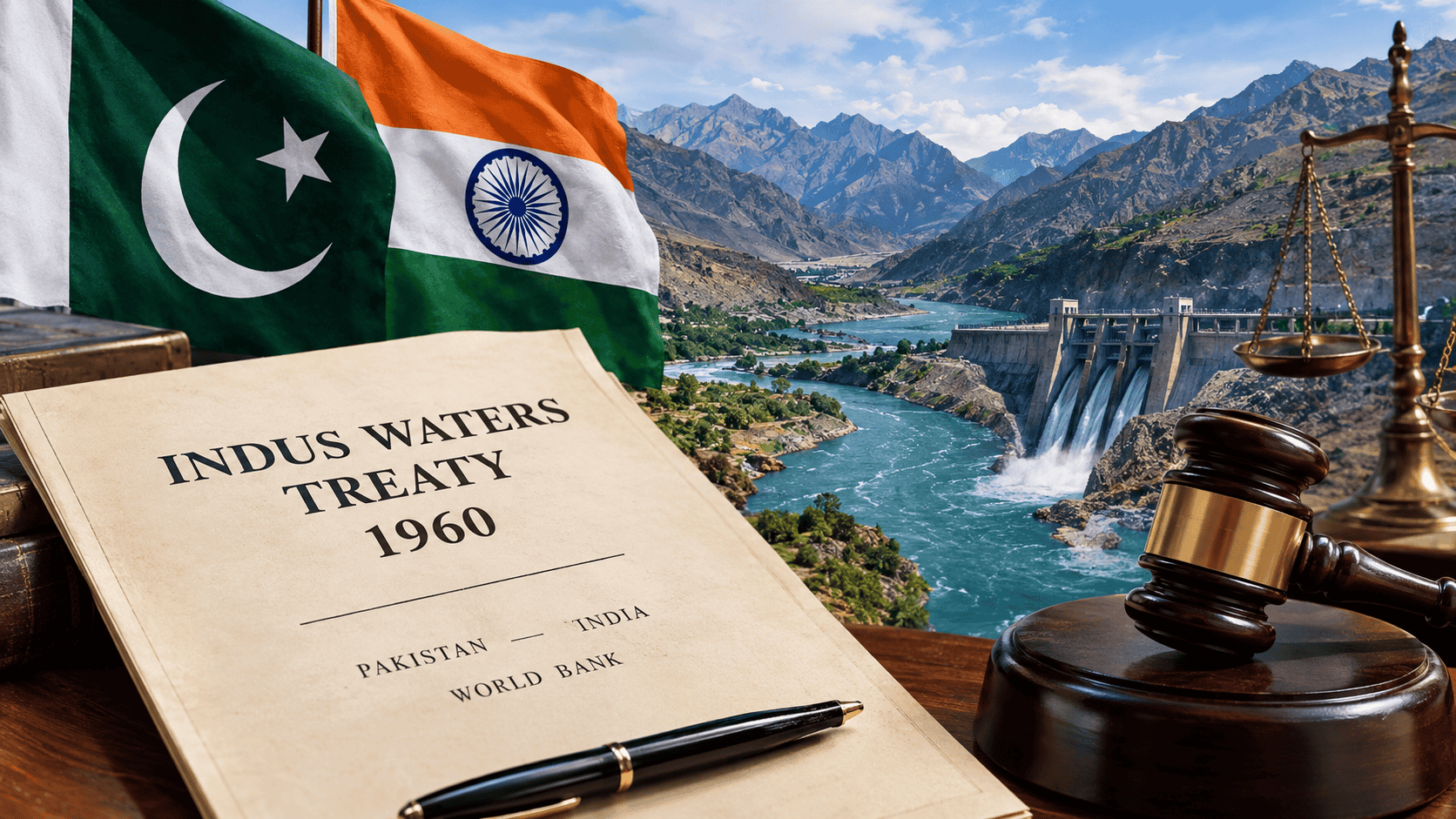
India’s Violations of the Indus Waters Treaty Under International Law and the Hague Arbitration
By Syed Faiz Naqshbandi

The Indus Waters Treaty (IWT) of 1960 is one of the most significant bilateral water sharing agreements in the history of international law. Negotiated with the assistance of the World Bank, the Treaty establishes a comprehensive legal framework governing the use of the Indus river system, comprising the Indus, Jhelum, Chenab, Ravi, Beas and Sutlej. Its central arrangement allocates the Eastern Rivers; Ravi, Beas and Sutlej principally for India’s use, while the Western Rivers; Indus, Jhelum and Chenab are allocated principally for Pakistan’s use, subject to the rights and conditions expressly provided by the Treaty.
For more than six decades, the Treaty has provided a legal framework for the management of one of the world’s most important trans-boundary river systems. Its significance extends beyond water allocation: it is a binding international agreement incorporating detailed provisions concerning cooperation, information exchange, water use and peaceful dispute settlement.
The Indus Waters Treaty (1960) imposes binding obligations on both India and Pakistan, including India’s obligation to let the waters of the Western Rivers; Indus, Jhelum and Chenab flow to Pakistan in accordance with the Treaty. But Indian certain projects including Kishenganga and Ratle, maximum pondage and other actions violate the Treaty.
Key Violations by India
- Exceeding Treaty limits on the Western Rivers. India had exceeded the use of the Indus, Jhelum and Chenab and must remain within the rights and conditions established by Article III of the Treaty.
- Non-compliant hydroelectric project designs. The design of Indian run-of-river hydroelectric projects is against the Paragraph 8 of Annexure D, including requirements governing storage, pondage and other technical features.
- Indian Excessive pondage. India had maintained more water storage capacity than permitted under the treaty, particularly in relation to its use of the western rivers. The Court of Arbitration has specifically addressed the legal and technical basis for determining maximum pondage under Paragraph 8(c) of Annexure D. Its May 2026 Award addressed the calculation of maximum pondage in relation to a project’s anticipated load.
- Indian Interference with Pakistan’s downstream interests.The Indian projects must operate consistently with Pakistan’s rights under the Treaty, including its existing agricultural and hydroelectric uses. The arbitration has also considered circumstances in which minimum-flow obligations may arise under the Treaty and applicable customary international law.
- Unilateral “abeyance” of the Treaty.India’s April 2025 announcement that the Treaty would be held in “abeyance”. This is a big question mark under international law. The Court subsequently addressed the issue in its Supplemental Award on Competence of 27 June 2025 and, on 31 August 2026, issued an Award concerning the status of the Treaty in respect of India’s decision on abeyance. Any party to a bilateral treaty cannot unilaterally suspend or alter the operation of that treaty.

- Dispute-settlement obligations. India had failed to comply the dispute settlement mechanism established by Article IX and Annexure G. The Permanent Court of Arbitration (PCA) records that India has not participated in the current arbitration proceedings, although the Court has continued to consider the issues before it.
Pakistan had played legally with the framework of international law and treaties. In legal terms, Pakistan’s central contention has been that India has exceeded its limited rights under the IWT that exceed the Treaty’s express conditions and undermine rights protected for Pakistan.
Pakistan does not dispute that India possesses treaty based rights to use the Western Rivers for specified purposes. The Treaty permits India to construct certain run-of-river hydroelectric plants subject to detailed conditions. The fundamental question is whether those projects have been designed and operated in accordance with the precise requirements of Annexure D and whether India’s conduct preserves the rights secured to Pakistan. This question has been examined by the Court of Arbitration constituted under the Permanent Court of Arbitration (PCA) pursuant to Article IX and Annexure G of the Treaty. On 8 August 2025, the Court issued its Award on Issues of General Interpretation of the Indus Waters Treaty, addressing questions concerning Article III and Paragraph 8 of Annexure D. The Permanent Court of Arbitration (PCA) has stated that awards of the Court are final and binding on the Parties.
The legal foundation of Pakistan’s position also rests upon the fundamental principle of pacta sunt servanda, the principle that international agreements must be performed in good faith. Article 26 of the Vienna Convention on the Law of Treaties expresses this principle, while Articles 27 and 31 address the relationship between treaty obligations, domestic law and treaty interpretation. Although the Indus Waters Treaty predates the Vienna Convention, these provisions reflect important principles of international treaty law.
The basic proposition is clear: a State cannot simply disregard an international obligation because circumstances have become politically difficult or because it prefers a different interpretation of its commitments. Consequently, Indian action is against the treaty, therefore a violation.
The International Court of Justice has repeatedly emphasized the importance of good-faith performance of treaties. In Gabčíkovo-Nagymaros Project (Hungary/Slovakia), the ICJ addressed the continued force of treaty obligations and required the parties to negotiate and implement their treaty in good faith.
International watercourse law provides an additional legal context. In Pulp Mills on the River Uruguay (Argentina v. Uruguay), the ICJ examined the obligations of States sharing an international river, including cooperation and procedural requirements. In the Silala case, the Court reaffirmed the customary principles of equitable and reasonable utilization and the obligation of riparian States to respect the corresponding rights of other States and take appropriate measures to prevent significant trans-boundary harm.
These principles reinforce the legal context of Pakistan’s concerns. Pakistan’s position is not that India has no rights over the Western Rivers. Rather, Pakistan maintains that India’s rights are limited and conditional, and cannot be interpreted in a manner that defeats the corresponding rights expressly secured to Pakistan.
With regard to India’s April 2025 decision to place the Indus Waters Treaty in “abeyance”, The Hague proceedings subsequently addressed this issue. In its Supplemental Award on Competence of 27 June 2025, the Court determined that India’s April 2025 position did not deprive the Court of competence. The Permanent Court of Arbitration subsequently recorded the issuance, on 31 August 2026, of an Award concerning the status of the Treaty in respect of India’s decision on abeyance, together with an Order concerning interim measures relating to the Ratle Hydroelectric Plant.
The earlier Kishenganga Arbitration provides another important chapter in the legal history of the Treaty. Pakistan invoked arbitration concerning India’s Kishenganga Hydroelectric Project and the proceedings demonstrated the importance of using the Treaty’s established dispute settlement mechanisms to address disagreements concerning projects on the Western Rivers.
The central issue, therefore, is the observance and interpretation of binding international legal obligations. Pakistan’s legal position is clear and reasonable: The principles of pacta sunt servanda, good faith performance, treaty interpretation, equitable and reasonable utilization of international watercourses, prevention of significant trans-boundary harm, cooperation and peaceful dispute settlement provide an important legal framework.
The Indus Waters Treaty is not merely a political understanding or diplomatic arrangement. It is a binding international legal instrument governing vital water rights. Any attempt to undermine, reinterpret or suspend those rights unilaterally by India is a raises serious violation under international treaty law and the principles governing international watercourses. The principle is fundamental: when sovereign States enter into a binding international treaty, its obligations cannot simply be set aside through unilateral action.
Syed Faiz Naqshbandi is senior leader of All Parties Hurriyet Conference (APHC) and legal expert of international law. He can be reached at faiz.naqshbandi@gmail.com & at WhatsApp number +923335145416.
Comments are closed, but trackbacks and pingbacks are open.