

AI Humanitarian Aid Trucks Reach Danger Zones Safely
How AI Aid Delivery in Sudan Is Changing the Way Relief Reaches People in Crisis

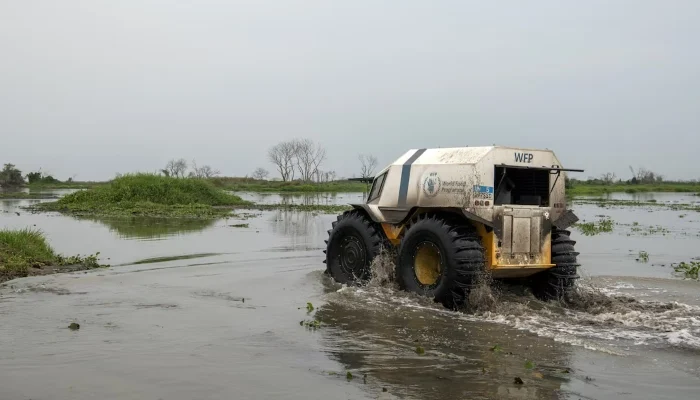
AID – (Special Correspondent/Web Desk) – AI humanitarian aid is quickly becoming one of the most talked-about tools at this year’s AI for Good summit in Geneva. Among the many displays, one stood out the most — a giant, white, remote-controlled truck built to carry food and supplies into places too dangerous for human drivers.
The vehicle, known as a Sherp, was built in Ukraine. It looks a bit like a Mars rover, fitted with cameras, sensors, and even a small landing pad for drones. These trucks can float on water, push through swamps, and climb over obstacles as tall as one metre.
The United Nations World Food Programme is now testing a smarter version of this truck. Their goal is simple but powerful: reach people who are currently impossible to reach safely.
Bernhard Kowatsch, who leads WFP’s innovation team, called the project a possible game-changer. He believes this technology could finally open a path to communities cut off by conflict or unsafe roads.
Why AI Aid Delivery Sudan Matters
WFP already uses Sherp vehicles with human drivers in Sudan, South Sudan, and Uganda. But the job has come at a heavy cost. Several drivers have lost their lives while trying to deliver food through extremely risky terrain.
To reduce this danger, WFP partnered with the German Aerospace Centre to build AI-powered controls into these trucks. The idea is simple. A driver sits safely inside a control room, often built from a shipping container, and steers the truck remotely through the most dangerous final stretch of the journey.

Armin Wedler, who leads the project, explained that older remote-control systems relied on basic mathematics. But today’s version needs AI to handle the huge amount of real-time data these missions create.
Even with all this technology, the team insists a human must always stay in control. Wedler pointed out that aid trucks often get swarmed by crowds of hungry people the moment they arrive. No AI system, he said, can safely manage that kind of unpredictable, human situation.
Beyond Trucks: Other AI Tools Helping Refugees
AI humanitarian aid trucks were not the only highlight at the summit. The UN refugee agency showcased a new AI legal assistant designed to help lawyers understand refugee rights faster. According to UNHCR’s lead data scientist, faster legal support can be life-saving for many families.
Another initiative, called Disha, uses AI to study anonymised mobile phone data. This helps track sudden population movements during disasters, showing humanitarian teams exactly where people are fleeing to.
A separate tool compares satellite images taken before and after disasters, including last month’s earthquakes in Venezuela. This helps teams quickly understand which buildings were damaged and where help is needed most.
The bigger goal behind all these tools is the same. Give humanitarian workers accurate information fast enough to make smart decisions, so they never waste time heading to the wrong place while people elsewhere wait for help.
As testing continues in Uganda through 2028, AI humanitarian aid trucks may soon become a real lifeline for communities that have long been out of reach.
Comments are closed, but trackbacks and pingbacks are open.