
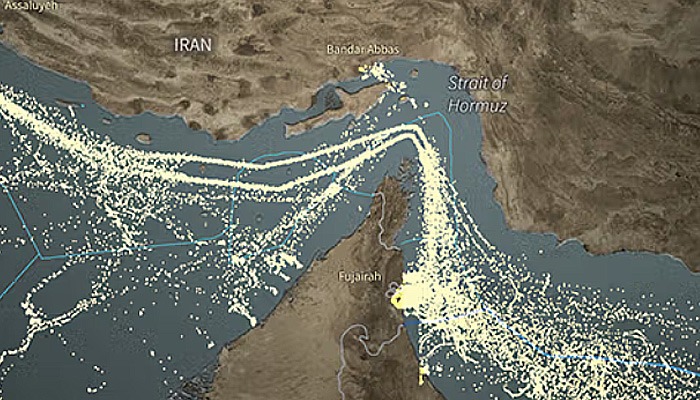

The closure of Strait of Hormuz in February 2026 has reduced oil flows, drive freight costs across global shipping networks and disrupted supply chains from East Africa to East Asia. This is the most significant geographic chokepoint in decades. Consequently, oil prices rose sharply and then became volatile, driving up costs for every household and country in the world as well as for every humanitarian sector running vehicles, cold chains or generators. The Chokepoint thinking started with the geography of military power Sun Tzu’s The Art of War places significant emphasis on controlling terrain, in particular narrow passes, gorges and key positions that function as chokepoint.
The line from the Art of War is how the International Federation of Red Cross Red Crescent Societies Solferino Academy’s paper open its argument, and it is the one that stuck. Humanitarian Sector is fighting on two fronts. One is Natural & Manmade Disasters. The other is the hemmed-in ground, the single road we bet everything on. That is what the report means by a “Chokepoint World”. A chokepoint, it says, is any path, route, system that carries something critical and when it fails, the damage spreads far beyond it.
The report points out that humanitarian sector has no integrated analytical understanding of the corridors, critical nodes, and mechanism it work depends on and therefore no common framework for anticipating which combinations of failure would cost the greatest harm, or for whom. The report also describes that humanitarian sector has invested heavily understanding needs i.e. vulnerability, food security monitoring, displacement tracking and health surveillance and other form of assessments. However, it has invested far less in understanding the chokepoint of system itself. Climate Change is now compounding these older disruption types. Extreme heats, sea level rise, and shifting storm patterns are pushing pressure on coastal port infrastructure across multiple regions, the report argues. While talking about the risks the report further says that, risks are studied in isolation: funding risks, supply chain risks and access risks are analyzed separately by different teams using different methods, with no systematic assessment of how a failure in one category makes failures in others more likely or more severe and impact assessment is partial and says only few organizations know how many people depend on which supplies, or what the consequences would be of losing anyone mechanism.
I have seen responses lose days because one form got stuck in compliance while several villages lost access to humanitarian aid. The report does not stop at roads and ports. It talks about narrow mountain passes where armies were trapped. Nonetheless, our passes look different today, and the report lists them. Some chokepoints are made of concrete while others are made of paper and politics. The effect is the same: people who need help cannot get it, and people trying to give it cannot move. Sometimes it’s the highway buried under a landslide. Sometimes it is a sanction and sometimes it’s one undersea cable cut off the coast of the country that kills the internet.
The report then moves to reasons, and this part stings. It lays out how the world has spent thirty years designing for speed and cost. The world has concentrated 90% of the planet’s advance chips at one place. In addition, routed a quarter of all soybeans through four Brazilians port and 99% of intercontinental data ran through 560 cables on the ocean floor. Because it was efficient and cheap until one link snapped. The report does not just assert that- it reminds us of March 2021. One ship in the Suez Canal, six days and $9.6 billion in global trade lost per day. That is the cost of one chokepoint and report connects that to us. It is also worth remembering that when the world trade arteries clog, humanitarian arteries clog too. For instance, COVID did not just bring a virus. It brought port closures; flight bans and frozen funding. Similarly, Ukraine did not just bring a war. It brought blocked Black Sea, which brought bread riots in places that had never heard of Odessa. The report is blunt about Middle East: it’s not just rocket. Its shipping insurance spikes, fuel delays and aid-budget cannibalized to pay for diplomatic fall out. It names the Strait of Hormuz. The closure of strait, entire response in Yemen, Gaza, and many others starts to suffocate. One strait and aid is cut. That is not hypothetical, that is geography meeting politics, and the report forces us to look at it.

The part of the report that hit me the hardest was not about oil tankers and chips. It was the section on the chokepoint we (humanitarian sector) built ourselves. The report says it plainly: “Many of Chokepoints are produced by political and economic choices we made within the humanitarian system itself”. The humanitarian sector built them, when they concentrated decisions in three capitals, funds in five donor accounts and supplies in two mega warehouses, because it looks good on spreadsheet. We built them when we decided that localization was funding line instead of an insurance policy. Therefore, every time humanitarian sector route everything through one hub, one system, one approval chain. We are laying track for the next cascade. The single signature/approval from head office that takes a week. The budget line that needs three donors to sign off. The centralized procurement that saves money until one port it depends on choked. The reporting format that takes two days to fill when you have two hours after an earthquake. These chokepoints were not made by anyone else; we mad them.
The report redefines risk. It says the biggest risk is not that a district team misuses thousand dollars. The biggest risk is that our approval chain leaves forty kids without treatment. The biggest risk is that we put all our stock in one warehouse and it floods. The biggest risk is we tied our entire fuel supply to that of Strait of Hormuz, and one headline stops the response. The report argues that trust, proximity, and redundancy are infrastructure, you cannot see them on satellite image, but they are the only reason a response keep going that the port closes after the communication dies.
So when the report talks about solutions. It does not give us another mapping exercise. It says the answer is not just to map chokepoints better. It’s to depend on them less. The report circles back to Sun Tzu “Resort to Stratagem”- think your way out instead of forcing your way through. As the report suggest, Stratagem does not look like a strategy document. It looks like a district manager who does not have to call Geneva to spend fifty thousand in the first 72 hours of a disaster. It looks like three suppliers for tents instead of one. It looks like a community that trust the Red Cross on your vest more than letterhead on your access permit.
Where does the report leave us? It does not promise that we (humanitarian Community) can clear every chokepoint, widen Suez, and force Hormuz to open. Nevertheless, the report insists we can make sure humanity is not dependent on any single one of them-especially the ones we built ourselves. The job is not to wait for the road to reopen, the payment to clear, Hormuz to cool down or the permit to arrive. The job is to be the reason the work continues anyway.
The chokepoint world this report describes, the alternative route is not a detour. It is the strategy and the most reliable alternative route, the report points to has a heartbeat. It is a local volunteer who does not wait for approval, a district branch with authority to spend, a community that already decided they were not going to wait to be rescued.
*(The writer is Communication Manager and Spokesperson at PRCS AJK)*
Comments are closed, but trackbacks and pingbacks are open.