
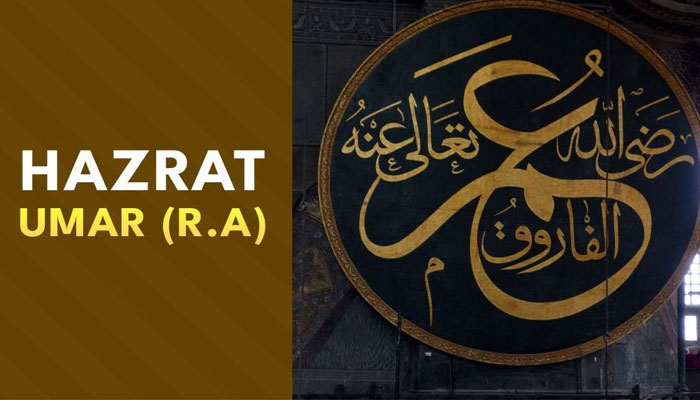

Among the greatest personalities in Islamic history, Hazrat Umar ibn al-Khattab (R.A.) occupies a unique and prominent place. Known for his bravery, wisdom, and commitment to justice, he played a pivotal role in strengthening Islam and building one of the most successful systems of governance in history. His life offers valuable lessons in leadership, accountability, and public service that remain relevant even today.
Hazrat Umar (R.A.) was born in 583 CE in Makkah and belonged to the respected Quraysh tribe. From an early age, he was known for his strong character, intelligence, and leadership qualities. He worked as a caretaker of camels and developed skills in horse riding, wrestling, and warfare. At a time when literacy was uncommon, he was among the few people in Makkah who could read and write. Because of his confidence and influence, he was widely respected in Quraysh society.
Initially, Hazrat Umar (R.A.) strongly opposed Islam. However, the Holy Prophet Muhammad (S.A.W) prayed that Allah strengthen Islam through either Umar ibn al-Khattab or Abu Jahl. Allah accepted this prayer, and Hazrat Umar (R.A.) embraced Islam in the sixth year of Prophethood. His acceptance of Islam marked a turning point for the Muslim community, which gained confidence and strength from his support. Recognizing his commitment to truth, the Prophet (S.A.W) gave him the title “Al-Farooq,” meaning the one who distinguishes between truth and falsehood.
Furthermore, Hazrat Umar (R.A.) remained a close companion of the Prophet Muhammad (S.A.W) and participated in most of the major battles (Ghazwaat). His daughter, Hazrat Hafsa (R.A.), later married the Prophet (S.A.W), strengthening his bond with the Prophet’s family. The Prophet (S.A.W) greatly valued his faith and character, and his opinions often reflected deep wisdom and sincerity.
Following the passing of the Prophet Muhammad (S.A.W), Hazrat Umar (R.A.) played an important role in supporting Hazrat Abu Bakr (R.A.) as the first Caliph. During Abu Bakr’s caliphate, he served as a trusted advisor and close companion. Before his death, Hazrat Abu Bakr (R.A.) nominated Hazrat Umar (R.A.) as the second Caliph of Islam.
As Caliph, Hazrat Umar (R.A.) established an exemplary system of governance based on justice, consultation, and accountability. In his first address, he invited people to correct him if he ever deviated from the teachings of Islam. This reflected his belief that leadership was a responsibility rather than a personal benefit.
During his ten-year caliphate, the Islamic state expanded significantly, reaching Iraq, Persia, Syria, Palestine, Egypt, and parts of Central Asia. Alongside these achievements, he introduced important administrative reforms. He established the Bayt al-Mal, organized the judiciary and military departments, introduced the Hijri calendar, conducted population censuses, and developed roads and canals. He also ensured salaries for teachers, judges, and public officials.
In 23 Hijri, Hazrat Umar (R.A.) was martyred by Abu Lu’lu’a al-Majusi. Before his passing, he appointed a committee of senior companions to select the next Caliph, demonstrating his commitment to consultation and stability.
Today, Hazrat Umar (R.A.) is remembered as a symbol of justice, integrity, and effective governance. His life continues to inspire leaders and societies seeking fairness, accountability, and service to humanity.
Note: The writer is a freelance journalist based in Lahore, can be reached at rashid.vapk@gmail.com
Comments are closed, but trackbacks and pingbacks are open.