

US to host Israel-Lebanon talks as strikes threaten Iran ceasefire deal
A fragile ceasefire, a city under fire, and a world holding its breath

Lebnon – (Web Desk) – The United States is scrambling to hold things together. Israel and Lebanon are set to meet in Washington next week, with the State Department confirming the talks amid growing fears that Israel’s relentless bombing campaign could shatter an already fragile US-Iran ceasefire.
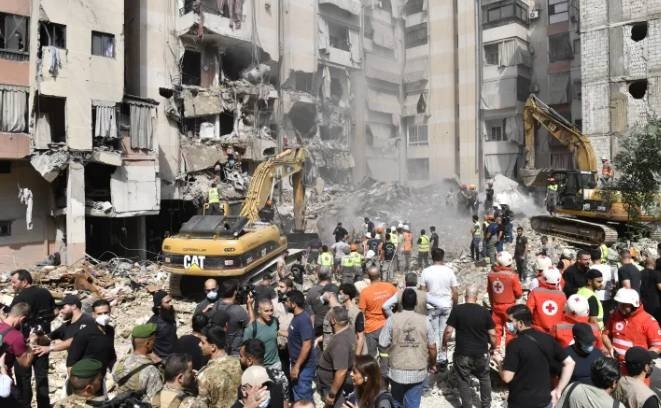
The timing couldn’t be more tense. Israel’s heaviest strikes on Lebanon since the war with Hezbollah began in early March killed hundreds on Wednesday — rattling the uneasy truce between Washington and Tehran less than 48 hours after it took effect.
On the ground, the situation is grim. Lebanese authorities reported that Israeli strikes killed at least 303 people and wounded 1,150, while Hezbollah claimed its fighters were engaged in close-quarters combat against Israeli forces in southern Lebanon.
The damage from Israel’s devastating strikes on Beirut on Tuesday is coming into focus now that the smoke has cleared, revealing mounds of rubble and burnt buildings.
Al Jazeera’s @JustinSalhani visited one neighbourhood that was hit especially hard. pic.twitter.com/QNytWb0noe
— Al Jazeera English (@AJEnglish) April 9, 2026
The two-week truce was meant to create breathing room — a window for US and Iranian negotiators to work toward ending a conflict that has already killed thousands and sent shockwaves through the global economy.
But that window is closing fast. Iranian officials declared Israel’s strikes had made the upcoming Pakistan talks “meaningless,” insisting that Lebanon was an “inseparable part of the ceasefire.”
Despite the turbulence, Vice President JD Vance is still expected to lead the US delegation on Saturday, joined by special envoy Steve Witkoff and Jared Kushner.
A group of UN ambassadors has condemned recent attacks on peacekeepers in Lebanon, calling for accountability.
The statement comes amid escalating Israeli strikes across the country, which have increased risks for UN personnel.
Al Jazeera’s Gabriel Elizondo reports. pic.twitter.com/MBF8g8zQYe
— Al Jazeera English (@AJEnglish) April 10, 2026
The talks in Islamabad hit a raw nerve when Pakistan’s Defence Minister posted a blistering condemnation of Israel’s strikes, calling Israel “evil and a curse for humanity” and expressing outrage that a genocide was unfolding in Lebanon while peace negotiations were underway.
Israel’s Prime Minister’s office fired back, calling the remarks “outrageous” and questioning Pakistan’s credibility as a neutral mediator.
Beyond Lebanon, the deeper tension simmers over the Strait of Hormuz. Trump took to social media to accuse Iran of doing a “very poor job” of allowing oil through the strait, warning that blocking the waterway was a breach of their ceasefire agreement.
Pakistan’s Diplomacy Earns IMO Chief’s Praise at London Meeting
There was a small glimmer of progress: a Gabon-flagged tanker became the first non-Iranian oil vessel to pass through the strait since the ceasefire was announced.
Iranian state TV has read out a message from new Supreme Leader Mojtaba Khamenei which says Iran ‘does not want war’ but will ‘not renounce legitimate rights’ in the face of threats from the US and Israel. pic.twitter.com/g9VwguIiUA
— Al Jazeera Breaking News (@AJENews) April 9, 2026
German Chancellor Friedrich Merz warned plainly that the destruction in Lebanon risked causing “the peace process as a whole to fail.” British Prime Minister Keir Starmer was equally direct, saying Israel was simply “wrong” to insist Lebanon wasn’t covered by the ceasefire.
As UK PM Starmer arrived in Doha as part of a Gulf tour spanning Saudi Arabia, the UAE, Bahrain and Qatar, he discussed efforts to secure the US-Iran ceasefire and reopen the Strait of Hormuz. pic.twitter.com/mfPNGpunJa
— Al Jazeera English (@AJEnglish) April 10, 2026
For now, the world watches — and waits.
Comments are closed, but trackbacks and pingbacks are open.