

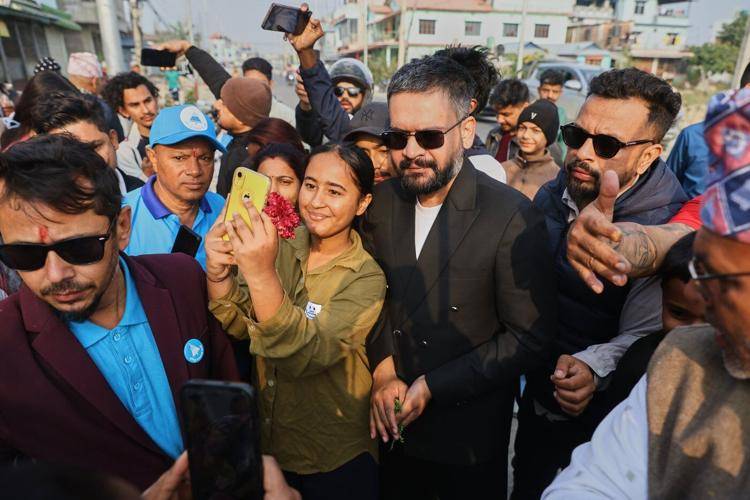
Nepal’s political rivals intensify campaign on last election day
Nepal heads to crucial elections as young voters challenge veteran politicians amid last year’s deadly anti-corruption protests.

Nepal Election Campaign – (Web Desk) – Nepal’s election campaign enters its final day on Monday, six months after deadly anti-corruption protests toppled the government, with rival leaders making a last push in a tightly contested race.
The Himalayan republic will elect a new parliament on Thursday, replacing the interim government that has led the country of 30 million people since the September 2025 uprising in which at least 77 people were killed.
Sushila Karki, who is serving as interim prime minister until the March 5 vote, has said the election will “draw the future of the country”.
Two weeks of campaigning have showcased a wave of younger candidates promising to tackle Nepal’s woeful economy, challenging veteran politicians who have dominated for two decades and argue that their experience guarantees stability and security.
Among the key figures is KP Sharma Oli, the 74-year-old Marxist leader ousted as prime minister last year.
He faces a high-profile challenge in his home constituency from former Kathmandu mayor Balendra Shah, a 35-year-old rapper-turned-politician widely known as Balen.
Their constituency of Jhapa-5 — a mix of towns and farming settlements in Nepal’s eastern plains, with the world’s highest peaks on the horizon — has emerged as a crucial battleground.
A local defeat for either man would likely end his bid to become prime minister.
“I will vote for Balendra Shah because those who governed the country for over three decades did not do anything satisfactory for us and corruption was very high,” said Nirmala Shrestha, 40, as she attended Shah’s rally in Kathmandu on Saturday.
“The turning point was the protest (last year) where young kids were killed with bullets. Thinking about that day always makes me feel sad and brings me to tears.”
Oli, speaking to AFP, blamed “anarchic forces” for the violence that led to his removal and denied ordering security forces to kill protesters during the unrest.

Shah, from the centrist Rastriya Swatantra Party (RSP), has cast himself as a symbol of youth-driven political change.
“Gen Z’s number one demand is good governance, because there is a high level of corruption in the country,” Shah told AFP.
But he is not the only one wooing the youth vote.
Gagan Thapa, 49, who recently became the leader of Nepal’s oldest political party, the Nepali Congress, told AFP he aims to break the “old guard” cycle of veteran leaders dominating politics. A former health minister, Thapa says he brings voters a “balanced mix of energy and experience.”
Nearly 19 million registered voters are set to choose 275 members for the House of Representatives, the lower house of parliament—165 directly elected and 110 through party-list proportional representation. Analysts predict it will be difficult for any single party to secure a clear majority.
Over 3,400 candidates are contesting in direct elections, with 30 percent under the age of 40. Last September’s youth-led protests, sparked by a short-lived social media ban, reflected deeper frustrations over economic stagnation and a political elite seen as increasingly disconnected from the younger generation.
The World Bank estimates 82 percent of Nepal’s workforce is in informal employment, with GDP per capita at $1,447 in 2024.
Eleven International Flights Stranded at Pakistani Airports
Over two days in September, 77 people were killed, scores were injured, hundreds of buildings set on fire — including parliament, courts and a Hilton hotel.
It was the country’s worst violence since a decade-long civil war ended in 2006.
Karki, a former chief justice, has said her government “will leave no stone unturned to conduct the election in a clean, fair, fearless, and peaceful manner”, and has urged “all citizens to exercise their voting rights with confidence and without any fear.”

Comments are closed, but trackbacks and pingbacks are open.