
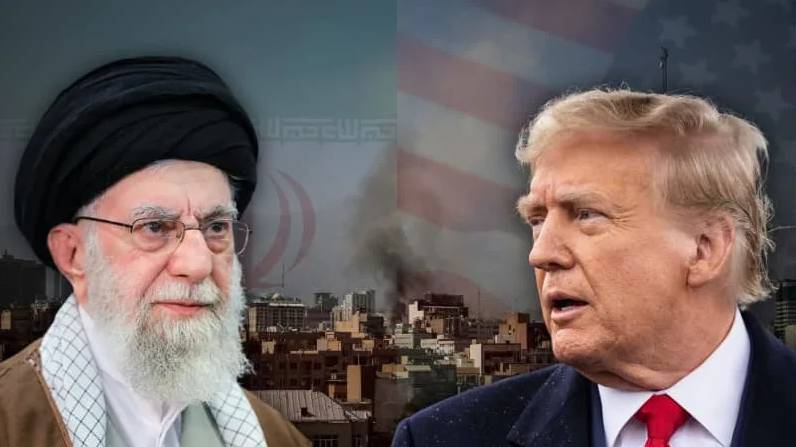
Trump hopeful of Iran deal despite Tehran’s regional war warning
Trump signals hope for Iran deal as tensions rise over protests, war warnings, nuclear talks, and growing international concern.

US – Iran – (Web Desk) – US President Donald Trump said on Sunday that he remains hopeful about reaching an agreement with Iran, despite a strong warning from the country’s supreme leader that any American military strike would spark a wider regional conflict.
Tensions have risen after Iranian authorities used force to suppress anti-government protests that erupted last month. In response, Trump has warned of possible military action and ordered a US aircraft carrier group to be deployed to the Middle East.
Iran’s supreme leader, Ayatollah Ali Khamenei, described the recent unrest as an attempted “coup,” accusing protesters of attacking police, government offices, banks, religious sites, and security installations. He said the situation had been brought under control and cautioned Washington against any aggressive move.
“The Americans should understand that if they start a war, it will not remain limited,” Khamenei said, urging Iranians not to be intimidated by Trump’s statements.
Reacting to the warning, Trump told reporters that such remarks were expected but stressed his preference for diplomacy. “Hopefully, we’ll make a deal,” he said. “If we don’t, then we’ll see whether he was right or not.”
The protests initially began over rising living costs but later evolved into widespread demonstrations against the government. Iranian leaders have blamed the unrest on foreign interference, particularly from the United States and Israel.
⚠️ IRAN WARNS U.S. ATTACK WOULD IGNITE ‘REGIONAL WAR’
U.S.– Iran tensions escalated after Supreme Leader Ayatollah Khamenei warned that any American strike would trigger a wider regional conflict as US naval forces move to close in on Iran. pic.twitter.com/rYBIPxnQHH
— Coin Bureau (@coinbureau) February 2, 2026
Iranian authorities nonetheless ordered the release of detained 26-year-old protester Erfan Soltani on bail, his lawyer said on Sunday, after Washington warned he was on death row and threatened an attack if any anti-government demonstrators were executed.
He was arrested in January for what Iran’s judiciary said were charges of propaganda against Iran’s Islamic system and acting against national security.
Washington had warned he was due to be executed, though Tehran said he had never been sentenced to death and that the charges against him did not carry the death penalty.
As tensions heightened between Iran and the United States, Tehran’s Foreign Minister Abbas Araghchi on Sunday said he was concerned about “miscalculations” but said he believed Trump was “wise enough to make the correct decision”.
He said Iran has lost trust in the United States as a negotiating partner, adding that some countries in the region were acting as intermediaries to rebuild trust.
“So I see the possibility of another talk if the US negotiation team follows what President Trump said: to come to a fair and equitable deal to ensure that there is no nuclear weapons,” he said in an interview with CNN.
Tehran has acknowledged thousands of deaths during the protests, and on Sunday the presidency published a list of 2,986 names out of the 3,117 that authorities said were killed in the unrest.

Of the total, 131 have yet to be identified but their details will be released soon, it said in a statement.
Authorities insist most were members of the security forces and innocent bystanders, attributing the violence to “terrorist acts”.
However, the US-based Human Rights Activists News Agency said it has confirmed 6,842 deaths, mostly protesters.
The response prompted the European Union to list the Islamic Revolutionary Guard Corps (IRGC) as a terrorist organisation, with Iranian lawmakers retaliating on Sunday by slapping the same designation on European armies.
Lawmakers wore the green uniform of the Guards in a display of solidarity at the legislative session, where they chanted “Death to America”, “Death to Israel” and “Shame on you, Europe”, state television footage showed.
It remained unclear what immediate impact the decision would have.
The step matched similar classifications enacted by the United States, Canada and Australia.
Firouzeh, a 43-year-old homemaker who declined to give her full name, said the recent tensions had left her “very worried and scared”.
“Lately, all I do is watch the news until I fall asleep. Sometimes I wake up in the middle of the night to check the updates,” she said.
IRGC official Ahmad Vahidi was quoted by the Mehr news agency as saying “enemies” sought to create a “war atmosphere”.
But Ali Larijani, head of Iran’s Supreme National Security Council, said on Saturday: “Contrary to the hype of the contrived media war, structural arrangements for negotiations are progressing.”
Khamenei warns US against imposing war on Iran
Trump also confirmed that dialogue was taking place, but without withdrawing his earlier threats, adding “we’ll see what happens”.
The US president previously said he believed Iran would make a deal over its nuclear and missile programmes rather than face military action.
Tehran, meanwhile, has said it is ready for nuclear talks if its missile and defence capabilities are not on the agenda.
Comments are closed, but trackbacks and pingbacks are open.