
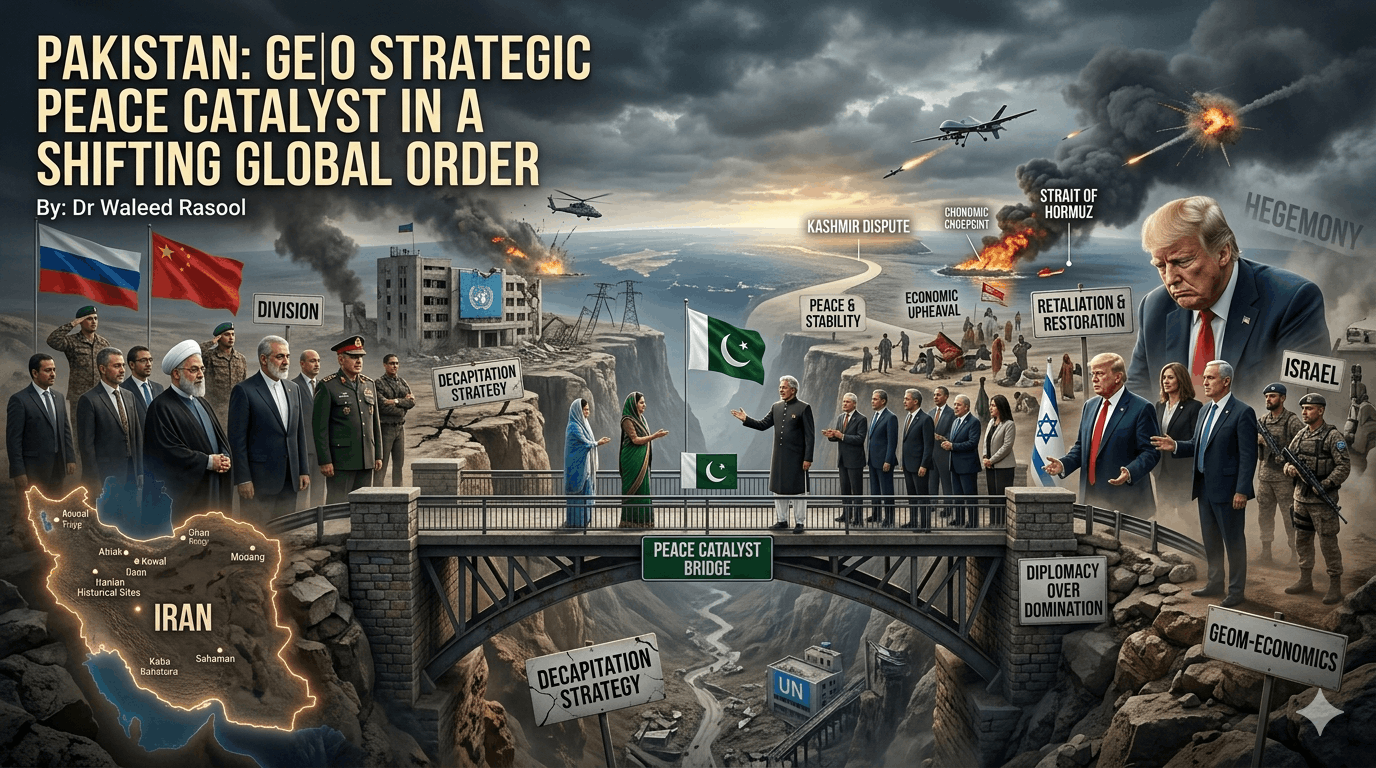
US-Iran, Islamabad talks: “Successful effort of Pakistani political and military leadership…”
(Asghar Ali Mubarak)

The diplomatic efforts to reduce tensions between the US and Iran are credited to the Pakistani leadership.
In his message, Iranian Foreign Minister Abbas Araqchi has especially paid tribute to the tireless efforts of Prime Minister Shehbaz Sharif and Field Marshal Asim Munir.
Pakistani Prime Minister Shehbaz Sharif has invited delegations from both countries to come to Islamabad on Friday, April 10, 2026, so that direct negotiations can be held for the final resolution of all disputes.
According to senior Pakistani diplomatic correspondent Asghar Ali Mubarak, it has become necessary to recognize that the war will not resume after a two-week ceasefire. “The world is watching and knows the truth; all the F-35s in the world will not win for the price of a barrel of oil.” Inside details of Pakistan’s relentless diplomatic efforts to broker a ceasefire between Iran and the US have emerged, revealing how the country’s civil and military leadership worked day and night to save the world from a major catastrophe. According to sources, the previous day was extremely difficult and nerve-wracking for the Pakistani leadership, as on one hand the clouds of war were deepening and on the other hand time was running out. In this critical situation, Pakistan simultaneously laid a network of contacts with the US, Iran, Saudi Arabia, and other Gulf countries. Sources say that during this process, contacts were made with global powers like China and Russia three times a day to build a strong global consensus. Two important phases were set to complete this mission, in which the first phase started on Tuesday morning and continued till 10 pm, while the second phase started at 6 pm and continued till 9:30 pm. However, the most important and decisive contacts began at 11:45 pm and continued continuously until 4:00 am the next morning. In all these contacts, Prime Minister Shahbaz Sharif, Foreign Minister Ishaq Dar, and Field Marshal Asim Munir were directly present and were talking to the leadership of different countries. In this entire mission, the Ministry of Foreign Affairs and the national security institutions played the role of the backbone and brought all matters to a conclusion with utmost responsibility and secrecy. The only purpose of these continuous efforts of the Pakistani leadership was to prevent the fire of war from spreading further in any way. This was a mission in which there was no room for error, and every step was taken with great fanfare. Finally, these sincere efforts of Pakistan bore fruit, and the world breathed a sigh of relief when the parties agreed to a ceasefire. Government circles say that this is clear proof of Pakistan’s growing diplomatic importance at the global level, as so many big powers are trusting Pakistan’s mediation.
As a result of Pakistan’s successful diplomatic efforts, a two-week temporary ceasefire has been agreed between the US and Iran, which is being hailed as a major diplomatic achievement for Pakistan globally. Iranian President Masoud Peshmerga has officially confirmed his participation in the Islamabad talks in a telephonic conversation with Prime Minister Shahbaz Sharif. Key leaders from the Trump administration, such as JD Vance, Steve Witkoff, and Jared Kushner, are expected to attend.
This ceasefire will be effective in every place where the interests of the two countries directly clash, including Lebanon.
Pakistan played a key role in conveying the US’s 15-point peace plan to Iran.
A major part of the talks in Islamabad will be based on the 10-point plan presented by Iran, which includes reopening the Strait of Hormuz and economic guarantees.
Global recognition: The European Union and other world powers have appreciated Pakistan’s conciliatory role.
This diplomatic development has had positive effects on the global level. There has been a significant decline in oil prices in the global market. Iran has announced that it will provide safe passage to ships for two weeks during the negotiations. These negotiations can prove to be a very important turning point for the establishment of lasting peace in the region.
As a result of Pakistan’s successful diplomatic efforts, the US and Iran have agreed to a ceasefire for two weeks, after which delegations of both countries will now hold direct talks in Islamabad on Friday, April 10. Prime Minister Shehbaz Sharif, announcing this important development on Wednesday, wrote on the social media platform ‘X’ that Iran and the US have agreed to an immediate ceasefire everywhere, including their allies. I invite them to come to Islamabad for a final agreement.
The Prime Minister expressed hope that talks between the Iranian and US delegations on Friday, April 10, 2026, in Islamabad will lead to lasting peace in the region. This development occurred shortly after US President Donald Trump gave Iran a Wednesday morning deadline (April 9, 2026) to open the Strait of Hormuz, just an hour before both sides accepted a Pakistani proposal for a temporary ceasefire.
President Trump said in his social media post that the US has achieved its military goals and is now very close to a long-term agreement.
It should be remembered that the details of the 10-point peace plan presented by Iran have come to light, after which US President Donald Trump postponed the decision to bomb Iranian bridges and power plants for two weeks. The development comes at a time of heightened regional tensions, but the focus of the talks will now be on Islamabad. Although no official version of the 10-point plan has been released, the summary issued by Iran’s Supreme National Security Council includes the following demands:
The Strait of Hormuz is to be reopened “with the cooperation of the Iranian Armed Forces.”
The war against “all elements” of Iran’s so-called axis of resistance is coming to an end.
US forces will withdraw from “all bases and deployment points within the region.”
The establishment of a “safe transit protocol” in the Strait of Hormuz.
Full compensation to Iran.
The lifting of all primary and secondary sanctions, as well as resolutions of the International Atomic Energy Agency’s Board of Governorsand the Security Council.
The recovery of frozen Iranian assets and properties abroad.
Although President Trump has called the plan “unacceptable,” he has temporarily halted military action, recognizing it as a viable basis for negotiations.
Observers say the plan contains several points that contradict decades of US foreign policy, especially the withdrawal of US troops from the region and the payment of compensation. However, experts are calling it an important step towards preventing a major catastrophe.
US media have claimed that indirect contacts have taken place between Iran and the US, in which Iran has expressed its willingness to provide all necessary guarantees along with the right to peaceful use of nuclear technology.
Key conditions:
Complete lifting of sanctions on Iran.
Protection of national interests and sustainable proposals.
Not just a ceasefire, but a complete end to the conflict is under consideration.
Will these talks pave the way for lasting peace in the Middle East? The US president’s announcement of a ceasefire with Iran shocked the Israeli government. According to the report, the dreams of those who were preparing to play the wedding flute to destroy Iran’s civilization have been shattered. The civilization called Iran existed 1,500 years before Trump and will remain for 1,500 years after that. It should be remembered that April 8 has historical significance in Iran regarding nuclear technology, which is usually celebrated as “National Nuclear Technology Day”. The US President had given Iran a deadline of Wednesday morning on April 8, 2026, to open the Strait of Hormuz, just an hour before the end of which the two sides agreed to the Pakistani proposal for a temporary ceasefire. The day of the threat to destroy Iran was chosen due to Iran’s historical achievements in national nuclear technology. It should be remembered that in the current situation, where Iran’s nuclear material and its technology are being considered a fundamental part of any possible peace agreement in the Islamabad talks after the tension between Iran and the United States, there have also been reports of bombing incidents near the Bushehr nuclear power plant recently, on which Iran had written a letter to the International Atomic Energy Agency and registered a protest. On April 9, 2006, which is Farvardin 20 in the Iranian calendar, Iranian scientists announced that they had successfully completed a full cycle of uranium enrichment at the laboratory level for the first time, making Iran one of the few countries that has indigenous technology to enrich uranium for peaceful purposes. Iran unveils its new nuclear achievements on this day every year. The day has seen significant activity in recent years, with more than 100 new scientific breakthroughs announced in areas such as new types of centrifuges, laser technology, and radiopharmaceuticals. The day is celebrated as a symbol of “national resistance and scientific self-reliance” against global sanctions imposed on Iran. President Trump said in his social media post that the United States has achieved its military goals and is now very close to a long-term agreement. On the other hand, Iranian Foreign Minister Seyyed Abbas Araqchi thanked Pakistan’s leadership and said that if attacks on Iran are stopped, our forces will also stop defensive operations. We have given two weeks for negotiations, which can be extended by mutual consent.
Iran’s Supreme National Security Council has clarified that the passage of ships through the Strait of Hormuz for the next two weeks will be possible through coordination with Iranian forces. Prime Minister Mohammad Shahbaz Sharif also spoke to Iranian President Masoud Peshmerga on Wednesday afternoon. During the conversation, which lasted for about forty-five minutes, the Prime Minister appreciated the insight and wisdom of the Iranian leadership for expressing readiness for a ceasefire and accepting the offer to host talks between Iran and the United States in Islamabad this weekend. The Iranian President thanked Prime Minister Shahbaz Sharif and praised the sincere efforts of the Pakistani leadership regarding a temporary ceasefire between Iran and the United States. He expressed his best wishes to the people of Pakistan and formally confirmed that Iran will fully participate in these important talks to be held in Islamabad. The two leaders reiterated their commitment to remain in close contact with each other in the future to advance the process of sustainable peace in the region. High-level delegations from both sides are expected to attend the Islamabad Dialogue between Iran and the United States. Iran will be represented in the talks with the United States by Parliament Speaker Mohammad Baqer Qalibaf, while the American delegation is likely to be led by Vice President J.D. Vance. Experts are looking at these talks from a different perspective. These talks in Islamabad may have failed, but now the situation has completely turned around. The failure to use force has reduced the impact of US military threats, which has created a new wave of diplomacy between the US and Iran. Washington can still threaten war, but after a failed war, such threats feel hollow. According to Trita Parsi, an expert on Iranian affairs, the US is no longer in a position to impose its own decisions, so any agreement will now be possible only on the basis of real compromise and transaction. The importance of these talks has also increased because they are taking place at a time when the economy and the peace of the world are at stake. This news is important for the common man because if this meeting in Islamabad is successful, it will not only dispel the clouds of war but also stabilize the prices of petrol and other commodities. Iran has made it clear that these talks will discuss the nuclear program as well as the lifting of US sanctions imposed for 45 years. White House Press Secretary Caroline Lutt has also confirmed that preparations are underway in Washington for these important talks. Pakistan’s mediation is being appreciated globally because the war that began on February 28 not only caused a large loss of human lives but also jeopardized the global economy and energy supply. Now the eyes of the whole world are fixed on Islamabad, where the talks starting on Friday could become the basis for a permanent end to this devastating conflict. Due to the talks between Iran and the United States, local holidays have been declared in the federal capital, Islamabad, on April 9 and 10 (Thursday and Friday). A notification has also been issued in this regard. After a decline of about 15 percent in the prices of crude oil in the global market, petrol and diesel are likely to become cheaper in the country. Due to the ceasefire in the region, the prices of crude oil in the global market have fallen. In this regard, the government of Pakistan has started reducing the prices of petroleum products in the country. According to sources in the petroleum industry, crude oil prices have fallen by 15 percent in the global market. This decline could have a direct impact on the price of petrol by Rs 60 to 70 per liter, while the price of diesel per liter is also expected to fall by about Rs 110. On the other hand, US Secretary of War Pat Hegseth claimed in a press briefing after a two-week ceasefire with Iran that the US has severely damaged Iran’s military capability and that it is no longer capable of fighting for a long time. US Secretary of War Pat Hegseth and Chairman of the Joint Chiefs of Staff General Dan Kaine described the operations against Iran as successful and clarified that the ceasefire is not permanent but a temporary pause. Secretary of War Pat Hegseth has said that Iran was a threat to the US for 47 years, which is no longer the case. The US and Israel have achieved all the goals set in the joint attacks and have completely paralyzed Iran’s military capability. President Trump has made history, and no American president has achieved such successes before.
Pete Hegseth, claiming Iran’s defeat, said that we used only 10 percent of our power against Iran and hit 800 targets. He said that Iran’s navy has been completely destroyed, while the air defense system has also been eliminated; now they only have underground bunkers left. Iran’s missile program has also been practically destroyed and is no longer a threat to us or anyone. US military objectives in Iran have been achieved; however, the current ceasefire should not be considered a permanent peace but a temporary pause. US forces are ready and can resume operations if necessary. It should be noted that world leaders have also called the mediation of Pakistan, Turkey, and Saudi Arabia helpful in reducing tensions. After the announcement of a two-week ceasefire between the US and Iran, goodwill messages have been pouring in from around the world. The international community has appreciated the mediation efforts of Pakistan and other countries and has called this development an important step towards peace in the Middle East. UN Secretary-General Antonio Guterres has appreciated the efforts of Pakistan and other countries to achieve a ceasefire. He has urged all parties to fulfill their responsibilities and fully abide by the terms of the ceasefire agreement. In a statement issued by his spokesperson, it was said that the implementation of the agreement is of utmost importance. The Saudi Foreign Ministry has also appreciated the extension of the ceasefire and the announcement of talks between the US and Iran, while praising the mediation efforts of Prime Minister Shahbaz Sharif and Field Marshal Syed Asim Munir. The statement issued by the Saudi Foreign Ministry said that the end of the ongoing tension between the US and Iran is welcome, and the ceasefire and the start of talks between the two countries are a very necessary and important step. US Vice President JD Vance, speaking during a ceremony in Hungary, said that President Trump has instructed him and his team to prepare for a good cause. Australian Prime Minister Anthony Albanese called the ceasefire “positive news” and expressed hope that this development would lead to a permanent reduction in tensions and an end to the conflict. He criticized the US President’s previous statements and said that targeting civilian infrastructure in Iran was unusual. Japan’s Chief Cabinet Secretary Munoro Kahara also described the announcements by the US and Iran as positive progress. He said that the most important thing now is for the situation to truly de-escalate, especially ensuring safe passage through the Strait of Hormuz. The Iraqi Foreign Ministry said in a statement that it considers this development important, which can help reduce tensions in the region, increase stability, and strengthen security. In addition, the Egyptian Foreign Ministry said that this ceasefire provides an excellent opportunity for diplomacy. According to analysts monitoring the situation in the region, although this two-week ceasefire is an initial step, the parties must continue negotiations with full seriousness for lasting stability in the region. Malaysian Prime Minister Anwar Ibrahim has stressed the establishment of lasting peace in the region. He said that Iran’s 10-point proposal should be implemented and transformed into a comprehensive peace agreement, and an agreement should be made that would bring stability not only to Iran but also to Iraq, Lebanon, and Yemen. Meanwhile, the Indonesian Foreign Ministry has said that the parties should respect sovereignty, territorial integrity, and diplomacy. The German Foreign Minister has said that the ceasefire between the US, Israel, and Iran should be an important first step towards lasting peace. The Indonesian Foreign Ministry has also appealed to the United Nations to investigate the killing of peacekeepers. The German Chancellor says that the German government is grateful to Pakistan for brokering an important agreement for a ceasefire. Now, the focus should be on negotiations for a complete end to the war. The German government supports diplomatic efforts. According to diplomatic sources, the talks in Islamabad will focus on resolving long-standing issues and restoring mutual relations. The international community expects that these talks will not only reduce tensions in the region but also pave new paths for peace around the world. Meanwhile, Oman, which has been playing a key mediating role in this matter, welcomed the ceasefire and appreciated Pakistan’s diplomatic efforts. According to the Omani Foreign Ministry, this development could prove important for peace in the region.
Comments are closed, but trackbacks and pingbacks are open.