

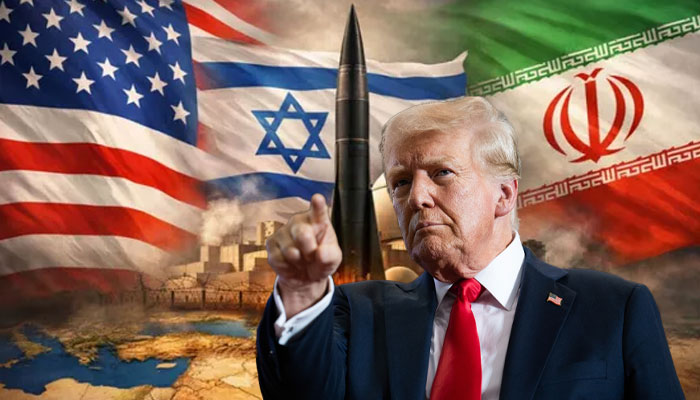
Trump Rejects Ceasefire Until Hormuz Reopens
Drone and missile strikes were reported in the United Arab Emirates, Kuwait, Bahrain, and Saudi Arabia.

Washington / Tehran (Web Desk) – US President Donald Trump said Wednesday that Iran had requested a ceasefire in the ongoing conflict, but insisted that no truce would be considered until the strategic Strait of Hormuz is reopened.
The White House announced that Trump will deliver an “important” national address at 9:00 pm, marking his first prime-time speech since the war began. Earlier, Trump suggested the conflict could end within “two to three weeks.” On his Truth Social platform, Trump claimed that Iranian President Masoud Pezeshkian had requested a ceasefire. However, Tehran denied any ongoing negotiations, stating that it would only agree to a truce if guarantees are provided to prevent future hostilities. Trump responded by saying the United States would only consider a ceasefire once the Strait of Hormuz is “open, free, and clear,” warning that military action would continue otherwise.
China praises Pakistan’s bold push to end Iran-US Conflict
Fighting intensified across the region as large explosions were reported in Tehran following Israeli airstrikes. Iranian missile attacks struck Israel, injuring civilians, including children. In Beirut, Israeli strikes killed at least seven people, including a senior Hezbollah commander. At the same time, Iran-backed Houthi forces in Yemen launched additional missile attacks toward Israel, further widening the conflict.

The violence also spread to Gulf nations, with Iran targeting countries it accuses of supporting US operations. Drone and missile strikes were reported in the United Arab Emirates, Kuwait, Bahrain, and Saudi Arabia. A civilian was killed in the UAE by falling debris from intercepted drones, while fires broke out at fuel facilities and industrial sites across the region. In Iraq’s Kurdistan region, drone strikes triggered major fires near Erbil, with residents reporting constant aerial activity disrupting daily life.
The conflict, which began after US-Israeli strikes on February 28, has already caused thousands of deaths across the region, including more than 1,300 in Lebanon alone. Beyond the human toll, the war has triggered a severe global energy crisis due to the closure of the Strait of Hormuz, a key route for about one-fifth of the world’s oil supply. Oil prices remain significantly elevated, while gasoline prices in the United States have surpassed $4 per gallon for the first time in four years. Inflation has surged in Europe and other regions, prompting governments to introduce emergency measures as protests over rising fuel costs emerge.
International efforts to contain the crisis are ongoing. French President Emmanuel Macron has ruled out direct military involvement, while the United Kingdom is preparing to host talks with around 35 countries aimed at reopening the Strait of Hormuz. Despite reports of indirect communication between US and Iranian officials, both sides continue to deny that formal negotiations are taking place.
Although Trump’s remarks have raised some hope for a potential resolution, continued military operations and Iran’s refusal to reopen the Strait of Hormuz indicate that tensions remain high, with no immediate end to the conflict in sight.

Comments are closed, but trackbacks and pingbacks are open.