
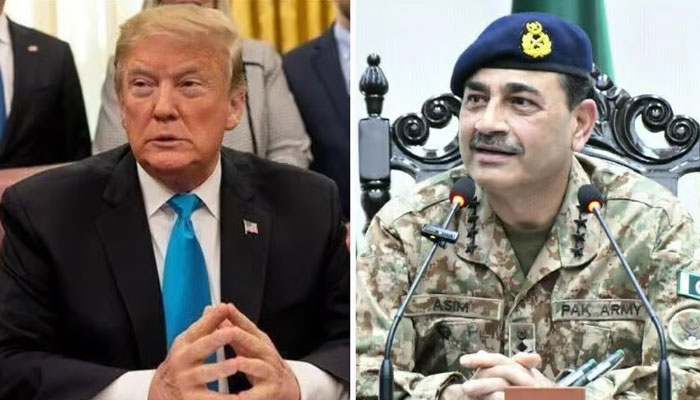
Trump Again Praises Pakistan’s General Munir as ‘Highly Respected’
This is not the first time Trump has made such assertions.

FLORIDA – Former US President Donald Trump has once again claimed credit for preventing a nuclear conflict between Pakistan and India, while singling out Pakistan’s Chief of Army Staff, Field Marshal Syed Asim Munir, for high praise.
Speaking to reporters in Florida on Monday alongside former officials Pete Hegseth and John Phelan, Trump stated, “We stopped a potential nuclear war between Pakistan and India.” He specifically referred to Pakistan’s army chief as a “highly respected general” and a “field marshal,” adding that the Prime Minister of Pakistan had credited him with saving millions of lives.
“You know, eight planes were shot down. That war was going to rage,” Trump said, alluding to a military confrontation earlier this year. He further claimed to have “stopped eight wars so far.”
Read more: Trump Signs Order to Reclassify Marijuana, Expanding Medical Research

This is not the first time Trump has made such assertions. Tensions between the nuclear-armed neighbours escalated dramatically in May following an attack on tourists in Indian-occupied Kashmir. India blamed Pakistan, leading to several days of cross-border hostilities. Pakistan’s military later described its defensive response as Operation Bunyanum Marsoos, claiming to have downed several Indian aircraft.
The conflict de-escalated after approximately 87 hours with a ceasefire reportedly brokered by US mediation.
In October, at the APEC summit in South Korea, Trump again commended Field Marshal Munir, calling him a “great fighter,” and also praised Pakistani Prime Minister Shehbaz Sharif. He balanced his remarks by expressing “great respect and love” for Indian Prime Minister Narendra Modi.
Pakistan and India have fought three major wars since independence and remain deeply divided over the Kashmir region. Trump’s repeated claims highlight the persistent fragility of relations between the two South Asian powers and the perceived role of US diplomacy in crisis management.

Comments are closed, but trackbacks and pingbacks are open.