
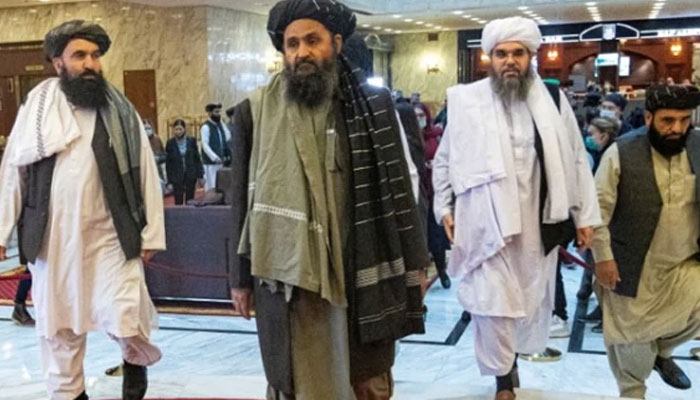
The Sense of Superiority and Arrogance of the Afghan Taliban
By Professor Imran Ismail Chohan

Observing the recent political situation in Afghanistan and the behavior of the Taliban government, one thing becomes increasingly evident: the Afghan Taliban appear to have developed a strong sense of superiority and political arrogance. The wars fought in Afghanistan over the past several decades against global powers have created a perception among some Taliban leaders that they alone defeated the world’s greatest powers. As a result, they consider themselves entitled to a unique status in the region.
It is true that Afghanistan has remained a battlefield of global politics for nearly forty years. The country witnessed long wars against the Soviet Union and later against the United States and NATO forces. However, it would be historically inaccurate to assume that Afghan fighters fought these wars entirely on their own. In reality, the Afghan Mujahideen received immense political, diplomatic, and military support from regional and international actors, particularly Pakistan.
If we look further back into history, another important reality emerges: Afghanistan has not always emerged victorious in its confrontations with global powers. Before the creation of Pakistan, several wars were fought between the British Empire and Afghanistan. During those conflicts, Afghanistan faced immense military pressure and lost significant territory. The region from Ali Masjid to Torkham and much of what is now Khyber Pakhtunkhwa came under British influence. Moreover, Afghanistan’s foreign policy remained under strong British control for a considerable period.
After the creation of Pakistan, the Cold War transformed Afghanistan once again into a battleground between competing global powers. In 1979, the Soviet Union invaded Afghanistan, triggering a resistance movement by the Afghan Mujahideen. Pakistan played a central role in supporting this resistance. It not only hosted millions of Afghan refugees but also facilitated the training of Mujahideen fighters, provided logistical support, and extended diplomatic backing.
Even several former Western intelligence and military officials have acknowledged in their books and public statements that the defeat of the Soviet Union in Afghanistan was not solely the achievement of Afghan fighters. Instead, it resulted from a coordinated effort involving Pakistan, the United States, and other international allies who provided strategic, financial, and military assistance.
Later, when the United States and NATO forces entered Afghanistan following the events of 2001, they also remained engaged in a prolonged war that lasted nearly twenty years. Eventually, they withdrew from Afghanistan. Yet even during this period, Pakistan’s role remained extremely complex and difficult. Pakistan faced intense international pressure while simultaneously bearing the burden of hosting millions of Afghan refugees. Furthermore, Pakistan itself suffered enormous losses due to terrorism, both in terms of human lives and economic damage.
Despite these sacrifices, the current Afghan leadership sometimes displays an unnecessary coldness and even hostility toward Pakistan. Among certain circles within the Taliban government, there appears to be a perception that they alone represent the true guardians of Islam, while anyone who disagrees with them is somehow inferior or distant from the faith. Such a mindset is not only unrealistic but also contrary to the teachings of Islam, which emphasize humility, justice, and tolerance rather than arrogance and claims of superiority.

In the realm of foreign policy, Afghanistan has made several decisions that appear to increase tensions in the region. One example is its attempt to cultivate closer relations with India in order to counterbalance Pakistan. However, the reality is that India has never provided Afghanistan with the kind of strategic or economic support that could replace Pakistan’s role.
Afghanistan is a landlocked country whose trade largely depends on access through neighboring states. For decades, Pakistan has served as the most significant trade route for Afghanistan. Whenever tensions arise between the two countries, the greatest damage is suffered by Afghanistan’s own economy and people.
In recent times, rising tensions between Pakistan and Afghanistan have affected cross-border trade, placing additional pressure on Afghanistan’s fragile economy. Afghanistan does have an alternative route through Iran, but regional tensions have also complicated that option. As a result, Afghanistan risks facing increasing economic isolation.
At this point, an important distinction must be understood: there is a vast difference between guerrilla warfare and governing a state. Guerrilla warfare focuses primarily on resistance and conflict. Running a country, however, requires careful management of the economy, diplomacy, education, healthcare, trade, and public welfare.
For twenty years, the Taliban operated as a resistance movement engaged in armed struggle. Today, however, they are the rulers of an entire country. As leaders of a state, they bear the responsibility of making realistic, balanced, and forward-looking decisions rather than relying on emotional or ideological impulses.
If Afghanistan’s current leadership fails to adopt a more pragmatic and balanced approach, the greatest harm will ultimately fall upon Afghanistan itself and its people. Arrogance, a sense of superiority, and unnecessary confrontation cannot lead any nation toward stability or prosperity.
Afghanistan and Pakistan are neighboring Muslim countries with deep historical, cultural, and economic ties. Their interests are closely interconnected. Therefore, it is essential that both nations develop relations based on mutual respect, trust, and cooperation.
In conclusion, it can be argued that if Afghan leadership adopts humility, realism, and constructive engagement with regional partners, it could open the door to a more stable and prosperous future—not only for Afghanistan but for the entire region.

Comments are closed, but trackbacks and pingbacks are open.