
The Reality of Hammalah Magic: A Critical Inquiry
Exploring the Dark Roots of Hammalah Magic and Its Growing Influence in Pakistani Society

Professor Imran Ismail Chohan
The concept of magic and sorcery has existed throughout human history. Almost every civilization has reflected some belief in supernatural practices. In South Asia, terms like “black magic” and “witchcraft” are commonly used, while another lesser-known term, “Hammalah Magic,” is also discussed in certain circles. This column explores its meaning, historical roots, perceived effects, and its broader implications—especially in the context of Pakistani society.
Historically, belief in magic was deeply embedded in ancient civilizations such as Egypt, Mesopotamia, and China. In these societies, magic was not merely superstition; it was often intertwined with religion and daily life. Ancient Egyptian texts like the Book of the Dead contained spells intended to guide souls in the afterlife. Similarly, Greek and Roman societies used magic to influence outcomes, often to harm enemies. In Arab culture, magic was referred to as sihr and was widely acknowledged.
The term “Hammalah Magic” is derived from two words: Hammalah, meaning “one who carries a burden,” and magic, referring to supernatural practices. Some scholars interpret it as a severe form of black magic that weighs heavily on a person, affecting them mentally, physically, and spiritually. It is often described as one of the most dangerous forms of sorcery.
Magic is generally categorized into two types: white magic and black magic. White magic is sometimes perceived as beneficial, aimed at protection or healing. In contrast, black magic is associated with harm, manipulation, and destruction. Hammalah magic is typically placed within the category of black magic due to its alleged intensity and harmful effects.
The reported impacts of such magic are often psychological in nature. Individuals who believe they are affected may experience anxiety, depression, fear, insomnia, and paranoia. They may feel watched or threatened even in safe environments. Physical symptoms are also sometimes claimed, though these lack strong scientific validation.
On a social level, belief in magic can be deeply damaging. Families may fall apart due to baseless suspicions, relationships may deteriorate, and individuals may blame magic for personal or financial failures. This tendency to externalize problems prevents people from addressing real-life issues rationally.
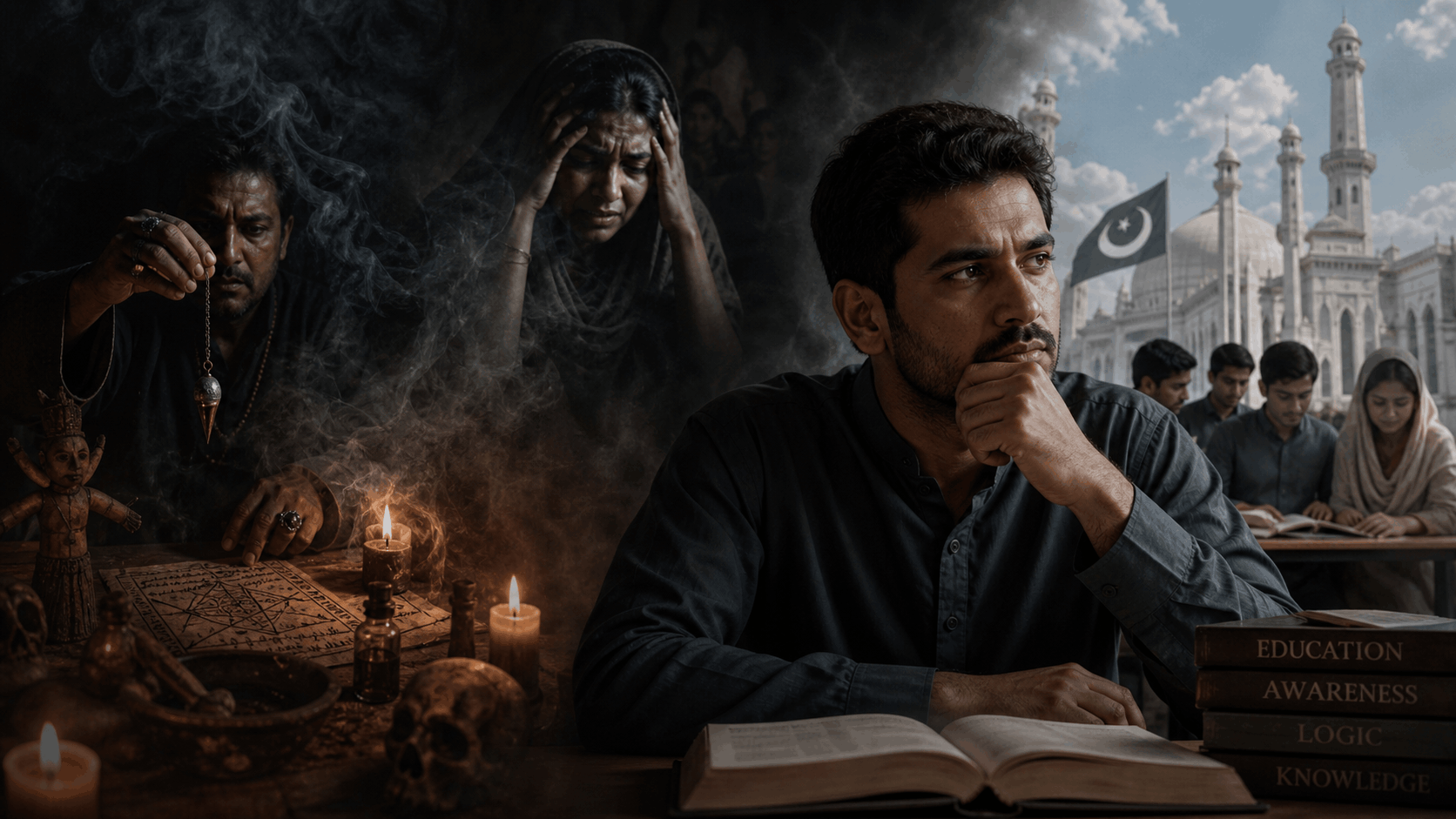
In Pakistan, the influence of such beliefs is particularly concerning. A significant portion of society still turns to so-called spiritual healers, amulets, and black magic practitioners for solutions to their problems. This trend reflects not only a lack of awareness but also a deeper societal issue. When a society begins to rely on superstition rather than education, logic, and lawful means, it becomes a sign of intellectual and moral decline.
Indeed, the widespread belief in magic and reliance on fraudulent practitioners can be seen as a symptom of a degenerating (zawal pazeer) society. Instead of confronting challenges through hard work, knowledge, and institutional systems, people seek shortcuts in the form of supernatural solutions. This mindset weakens critical thinking, promotes exploitation, and hinders progress.
There are numerous reports in Pakistan and neighboring countries where individuals have been financially exploited or psychologically manipulated by fake spiritual leaders. Vulnerable people, especially women and the uneducated, are often the primary victims. In extreme cases, crimes have been committed in the name of magic, highlighting the dangerous consequences of unchecked beliefs.
From a religious perspective, all major religions strongly discourage magic. In Islam, sihr is considered a grave sin, and the Qur’an explicitly warns against it. Similarly, Christianity and Judaism condemn sorcery as an act against divine will. Even in Hinduism and Buddhism, harmful magical practices are discouraged. The common thread across religions is clear: reliance on magic leads one away from moral and spiritual truth.
An important question arises: does magic actually have real effects? Religious texts acknowledge its possibility but emphasize that nothing occurs without divine will. On the other hand, modern science attributes most such experiences to psychological, environmental, or social factors. Fear, suggestion, and stress can produce symptoms that people mistakenly attribute to supernatural causes.
The idea of Hammalah magic, therefore, must be approached with caution. While cultural and religious narratives give it a certain weight, its practical implications often lie in human psychology and social behavior rather than in verifiable supernatural phenomena.
The real danger lies not in magic itself, but in the belief system surrounding it. When people become convinced that unseen forces control their lives, they lose agency and responsibility. This mindset fosters passivity, fear, and dependence on others—often leading to exploitation.
For Pakistani society, the way forward lies in awareness and education. People must be encouraged to seek solutions through knowledge, medical help, counseling, and lawful means. Religious teachings should be understood in their true spirit—promoting faith, patience, and rational action rather than fear and superstition.
In conclusion, Hammalah magic, like many similar concepts, reflects more about human fears and societal conditions than about reality itself. Its growing influence in society is not a sign of spiritual awareness but rather an indicator of intellectual and moral decline. A progressive society is built on reason, education, and ethical values—not on fear-driven beliefs.
May we be guided towards truth, wisdom, and clarity, and may we be protected from all forms of deception and harm.
Comments are closed, but trackbacks and pingbacks are open.