
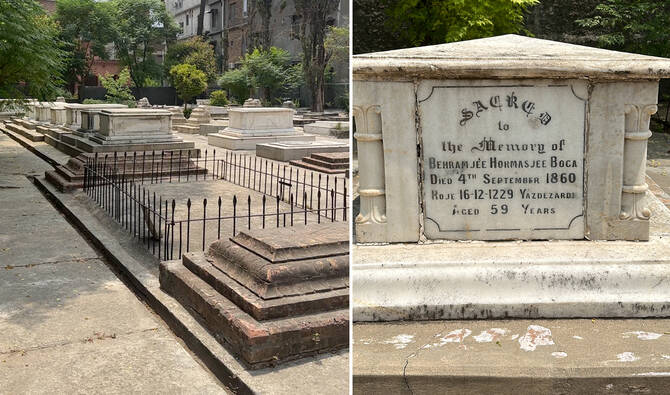

Rawalpindi – (Staff Reporter/Web Desk) – Tucked behind shops on Rawalpindi’s busy Murree Road sits a burial ground few notice. Yet this Parsi cemetery Rawalpindi carries a story stretching back over a century. It marks the last visible sign of a community that once played a big role in the city’s trade and culture.
The cemetery was founded in January 1898. Two respected Parsi merchant families set it up as a resting place for their people. It has outlasted Partition, political change, and the constant growth of the city around it.
Old headstones line the grounds. Many date back to before Pakistan even became a country in 1947. Some names on these stones belong to families that no longer have any relatives left in Pakistan. The site has quietly turned into a record of people who are mostly gone now.
Parsis follow the Zoroastrian faith. Their roots trace back to ancient Persia, the land known today as Iran. They are officially recognized as a non-Muslim minority group in Pakistan. Their faith is considered one of the oldest in the world, built on the teachings of the prophet Zarathustra.
Long ago, many Zoroastrians left Persia and settled across the Indian subcontinent. There, they became known for business success and generous giving back to society. Rawalpindi’s Parsi families were mostly traders. They used the city as a link between northern India, Kashmir, and Afghanistan.
Even though the community was always small in size, it left a strong mark. Parsis helped build schools, hospitals, and other public places across the region, not just in Rawalpindi.
Today, very few Parsis remain in the city. A member of Pakistan’s National Assembly, who also looks after the cemetery, shared that only around 14 or 15 Parsis are left in Rawalpindi now. Before Partition, the number stood at a couple thousand.
Most graves in the cemetery are decades old. Some go back 80, 90, or even 100 years. Very few burials have taken place in the last ten to fifteen years, showing how much the community has shrunk over time.
Zoroastrian funeral customs are unique. Traditionally, bodies were left in special towers so birds could naturally return them to nature. This practice avoided contact between the dead and the earth, water, or fire, which are seen as sacred elements.
However, changing times have forced adjustments. Vulture numbers have dropped sharply, making the old system hard to continue. Karachi still has two such towers, but Rawalpindi and Lahore never had any. So, local Parsi families adopted regular burial instead, similar to Islamic tradition.
Pakistan’s overall Parsi population has fallen a lot over the years. Once numbering between 15,000 and 20,000, only about 900 remain in Karachi today, with a small handful scattered elsewhere.
This drop matches a global pattern. Even India, home to the largest Parsi population worldwide, has seen steady decline for decades.
Those who still care for the Rawalpindi Parsi cemetery history believe it deserves protection. They see it as shared heritage, not just a religious site, and hope it could even draw visitors interested in learning about Pakistan’s diverse past.
Comments are closed, but trackbacks and pingbacks are open.