

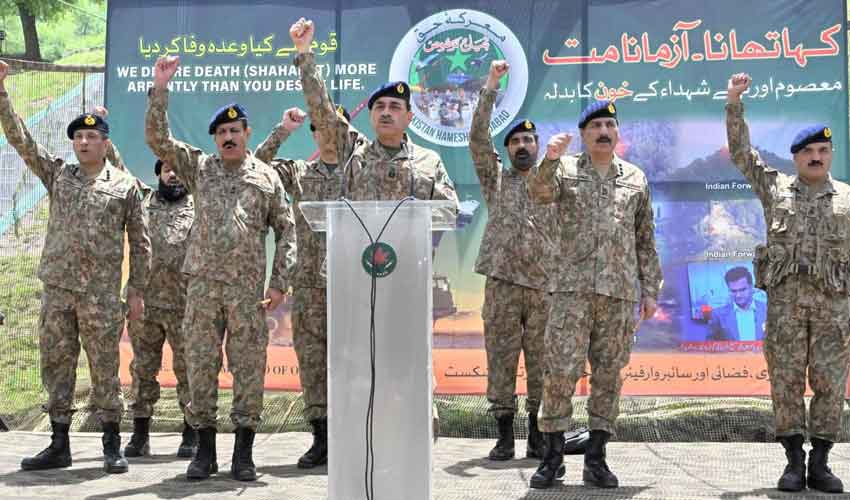
Pakistan’s Rising Role in Global Peace: Diplomatic Success Under the Leadership of Field Marshal Asim Munir

By Shaukat Ali Malik
At a time when the world once again stood on the edge of a dangerous escalation, with tensions between the United States and Iran moving dangerously close to open confrontation, Pakistan emerged as a responsible and proactive player on the global stage. In this delicate geopolitical moment, Pakistan’s leadership, alongside the military establishment—particularly under the leadership of Field Marshal Asim Munir—has been widely recognized in political and strategic circles for its diplomatic engagement and behind-the-scenes efforts aimed at de-escalation.
What makes this development particularly significant is not just the outcome, but the profile of the actor involved. Pakistan, a developing country facing its own internal and external challenges, has increasingly positioned itself as a voice of balance and restraint in an otherwise polarized international environment. This shift reflects not a sudden change, but rather a gradual evolution driven by coordinated state policy, professional military leadership, and strategic diplomatic alignment.
PM Shehbaz, Field Marshal Asim Munir Review Progress of Pakistan’s Mediatory Efforts
The Pakistan Army has historically played a role that extends beyond traditional defense responsibilities. Under the leadership of Field Marshal Asim Munir, the institution has continued its counterterrorism operations while also contributing to broader regional stability efforts. In recent years, Pakistan’s security establishment has reportedly engaged in discreet diplomatic channels aimed at reducing tensions between rival states, including efforts related to the US-Iran standoff, according to regional diplomatic observers.
International mediation is never granted lightly. It requires credibility, trust, and the perception of neutrality. Pakistan’s ability to maintain balanced relations with multiple global actors has strengthened its position as a potential facilitator in sensitive geopolitical matters. Both Washington and Tehran, despite deep-rooted differences, have historically engaged with intermediaries perceived as reliable and non-aligned in critical moments.
A key feature of Pakistan’s approach has been the use of quiet diplomacy and backchannel communication. Rather than seeking publicity, this method relies on confidentiality, strategic patience, and trust-building. In this context, coordination between political leadership and military institutions has played a crucial role in presenting a unified and consistent diplomatic posture.
As a result, Pakistan’s international image has gradually shifted. Once viewed primarily through a security lens, the country is increasingly being acknowledged as a state capable of contributing to peacebuilding efforts. This emerging identity aligns with Pakistan’s broader aspiration to be seen not only as a security-focused state but also as a responsible stakeholder in global stability.

However, such developments have not been without criticism or skepticism. Certain segments of regional media, particularly in India, have reacted strongly to reports of Pakistan’s diplomatic involvement. These narratives often portray Pakistan’s role as overstated or strategically motivated for influence-building purposes. Such reactions are reflective of the competitive nature of regional geopolitics, where diplomatic achievements are frequently interpreted through the lens of strategic rivalry.
Despite these criticisms, international observers emphasize that credibility in mediation is earned through action, not claims. In highly sensitive conflicts such as the US-Iran dispute, even limited facilitation or communication support is considered a meaningful contribution. Pakistan’s engagement in this space, whether formal or informal, highlights its growing relevance in global diplomatic networks.
Beyond diplomacy, the Pakistan Army continues to maintain its longstanding role in national defense, counterterrorism, and internal stability. Major operations against militancy have significantly improved the security landscape of the country. These efforts, combined with enhanced border management and surveillance systems, have strengthened Pakistan’s internal resilience.
The institution has also contributed to international peacekeeping missions under the United Nations, where Pakistani troops have served in various conflict zones around the world. These deployments have earned recognition for professionalism and discipline, further reinforcing Pakistan’s image as a contributor to global peace.
Additionally, the military’s response to natural disasters has remained a critical aspect of its domestic role. From floods to earthquakes, the armed forces have consistently been among the first responders, providing rescue, relief, and rehabilitation support to affected populations, particularly in remote and underserved regions.
In recent years, advancements in technology, cyber defense, and modern warfare capabilities have further transformed the operational capacity of Pakistan’s defense establishment. Joint exercises with allied nations and participation in multinational training programs have contributed to improving interoperability and strategic readiness.
Taken together, these developments reflect a broader transformation. Pakistan is increasingly positioning itself as a multidimensional state—one that combines defense preparedness with diplomatic engagement and humanitarian response. Under the leadership of Field Marshal Asim Munir, this integrated approach appears to be gaining greater coherence and international attention.
In conclusion, while debates and differing perspectives will continue in regional and global media, Pakistan’s evolving role in diplomacy and peace efforts cannot be ignored. Whether in counterterrorism, peacekeeping, disaster response, or diplomatic facilitation, the country is steadily expanding its footprint as a responsible global actor.
If sustained, this trajectory could further enhance Pakistan’s international standing and open new avenues for engagement in global conflict resolution.


Comments are closed, but trackbacks and pingbacks are open.