
Pakistan’s Economy Hits $452 Billion Despite Missing Growth Target

Fiscal consolidation remained a key highlight of the year

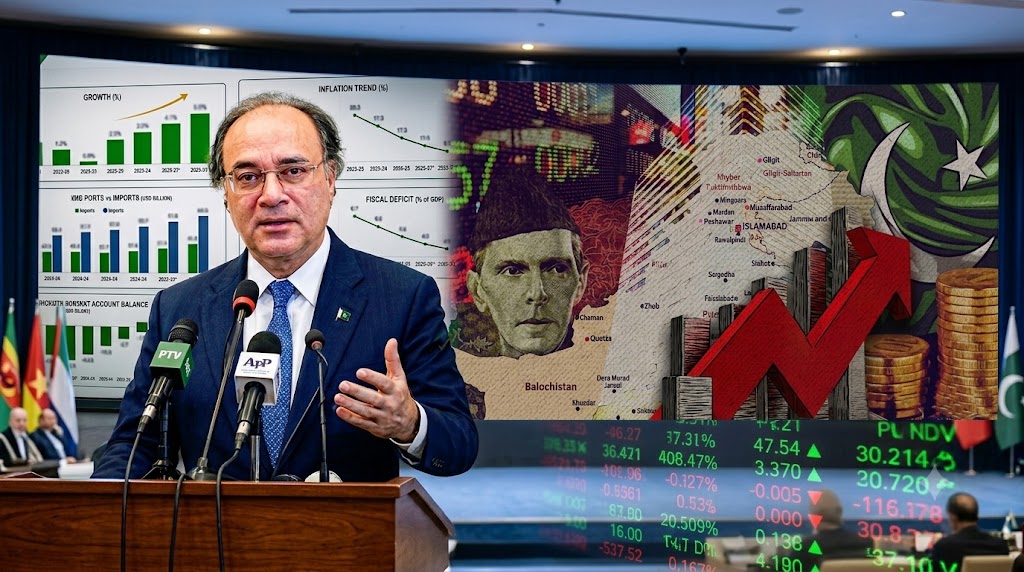
KARACHI (Web Desk) – Pakistan’s economy expanded to record $452 billion in FY2025-26, even as growth moderated to 3.7%, falling short of the government’s 4.2% target, according to the latest Economic Survey.

The year was shaped by a mix of external and domestic pressures including trade uncertainty, flood impacts, and regional tensions, yet key sectors such as services and manufacturing continued to post steady gains. Amid fiscal consolidation under the IMF programme, Pakistan also recorded stronger macro indicators, with rising per capita income and improved fiscal balance, signaling a gradual but uneven path to economic stabilization.

Finance Minister Aurangzeb linked shortfall to a series of external shocks, including global trade uncertainty linked to tariff negotiations, followed by severe flooding impacts, and later regional geopolitical tensions emerging from March onwards, describing them as key “exogenous constraints” on growth momentum.

The survey shows a mixed but stabilizing economic picture under the IMF-supported programme, with key sectors posting moderate gains. Per capita income rose 9% year-on-year to $1,901, reflecting a gradual recovery in household earnings alongside overall growth.

On the production side, agriculture grew 2.9%, demonstrating resilience despite flood-related damage. The industrial sector expanded 3.5%, supported by manufacturing and construction activity, while the services sector emerged as the strongest driver, growing 4.1% — a four-year high and maintaining its dominant 58% share of GDP.

A standout performance came from large-scale manufacturing (LSM), which surged 6.1%, with broad-based gains across industries. Out of 22 manufacturing segments, 16 recorded growth, including food processing, textiles, and apparel.

Fiscal consolidation remained a key highlight of the year. The fiscal deficit narrowed sharply to 0.7% of GDP (July–March), compared to 2.6% in the same period last year, while the primary surplus improved to 3.2% of GDP, reflecting what officials described as stronger fiscal discipline and tighter macroeconomic control.

On the external front, the finance minister stressed that strengthening exports and remittances remains critical for long-term stability. Pakistan’s remittance inflows rose 9% year-on-year to $33.9 billion (July–April FY26), continuing to serve as a vital buffer for the external account.

Aurangzeb lauded overseas Pakistanis, noting that remittances remain a structural pillar of the economy and are expected to stay central to external financing stability in the coming years, even as policymakers push to broaden export competitiveness.

May June 2026 Behter pak

Comments are closed, but trackbacks and pingbacks are open.