
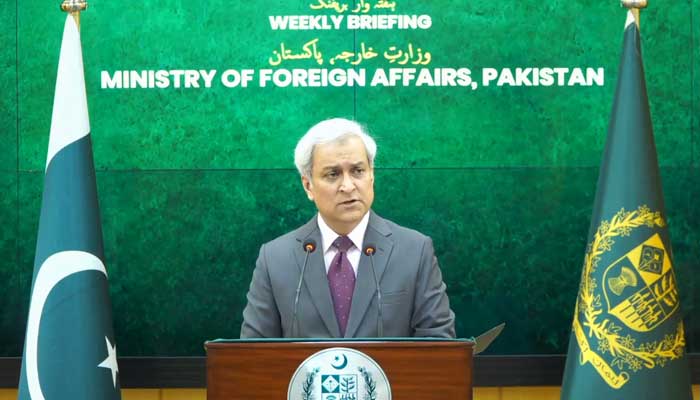

Pakistan – (Staff Reporter/Web Desk) – Pakistan has pushed back strongly against Amnesty International, urging the rights group and the wider world to focus instead on the Afghan Taliban’s terror patronage. The response came during a weekly press briefing in Islamabad, a day after Amnesty questioned recent Pakistani airstrikes carried out in Kabul.
Foreign Office Spokesperson Tahir Andrabi did not hold back. He called the Amnesty report unfair, saying it made serious claims without offering solid proof. According to him, this kind of one-sided reporting overlooks the real problem sitting across the border.
That problem, he explained, is Afghanistan’s ongoing support for armed groups. Andrabi named the banned Tehreek-e-Taliban Pakistan and the outlawed Balochistan Liberation Army as two of the main outfits still finding safe ground on Afghan soil. He added that other militant networks continue operating there too.
No country, he said, can stay quiet while its citizens and soldiers keep coming under attack. That line summed up Pakistan’s core argument at the briefing.
Andrabi also defended the airstrikes themselves. He described them as acts of self-defence, taken only when necessary and only as a last option. He was clear that the strikes targeted militants and their support camps, not ordinary Afghan civilians.
The spokesperson linked this violence to a wider concern. Pakistan believes its current wave of militant attacks is being fuelled by India, using Afghan territory as a launching pad. This claim has become a regular feature of Pakistan’s official statements in recent months.
Moving beyond the Afghan border, Andrabi turned to maritime security. He warned that any hostile move against Pakistani ships in the Red Sea would be seen as a direct threat to national security. Pakistan, he said, would respond quickly and firmly.
Weekly Press Briefing by the Spokesperson @TahirAndrabi
On Reponse to Alleged Civilian Casualties in Afghanistan. pic.twitter.com/3IQ5OW18dZ
— Ministry of Foreign Affairs – Pakistan (@ForeignOfficePk) July 23, 2026
He also condemned Houthi threats aimed at Saudi Arabia and commercial vessels passing through the region. Such actions, he noted, put shipping routes, trade, and regional stability at risk. Pakistan called on every side involved in Middle East tensions to show restraint and choose dialogue over conflict.
On defence ties, Andrabi confirmed Pakistan’s commitment to its agreements with Saudi Arabia, including mutual defence arrangements. He said these commitments remain a steady part of the two countries’ relationship.
The briefing also touched on trade. Andrabi welcomed the European Union’s fifth GSP Plus monitoring report, calling it encouraging. He said the report recognised Pakistan’s progress on legal reforms and its continued compliance with international conventions tied to the scheme.
He stressed that GSP Plus plays a big role in Pakistan’s economy. It supports exports, creates jobs, boosts women’s participation in the workforce, and helps reduce poverty. Pakistan, he confirmed, will keep working to meet the standards required to stay in the programme.
Comments are closed, but trackbacks and pingbacks are open.