
Pakistan Reject Claims of Cross-Border Action in Kunar Region
Will Not Compromise on Sovereignty: Atta Tarar

ISLAMABAD-(Mudassar Iqbal/News Desk/X)- Tensions along the Pakistan–Afghanistan border have intensified following a series of conflicting claims regarding alleged cross-border strikes, military responses, and accusations of misinformation by regional actors.
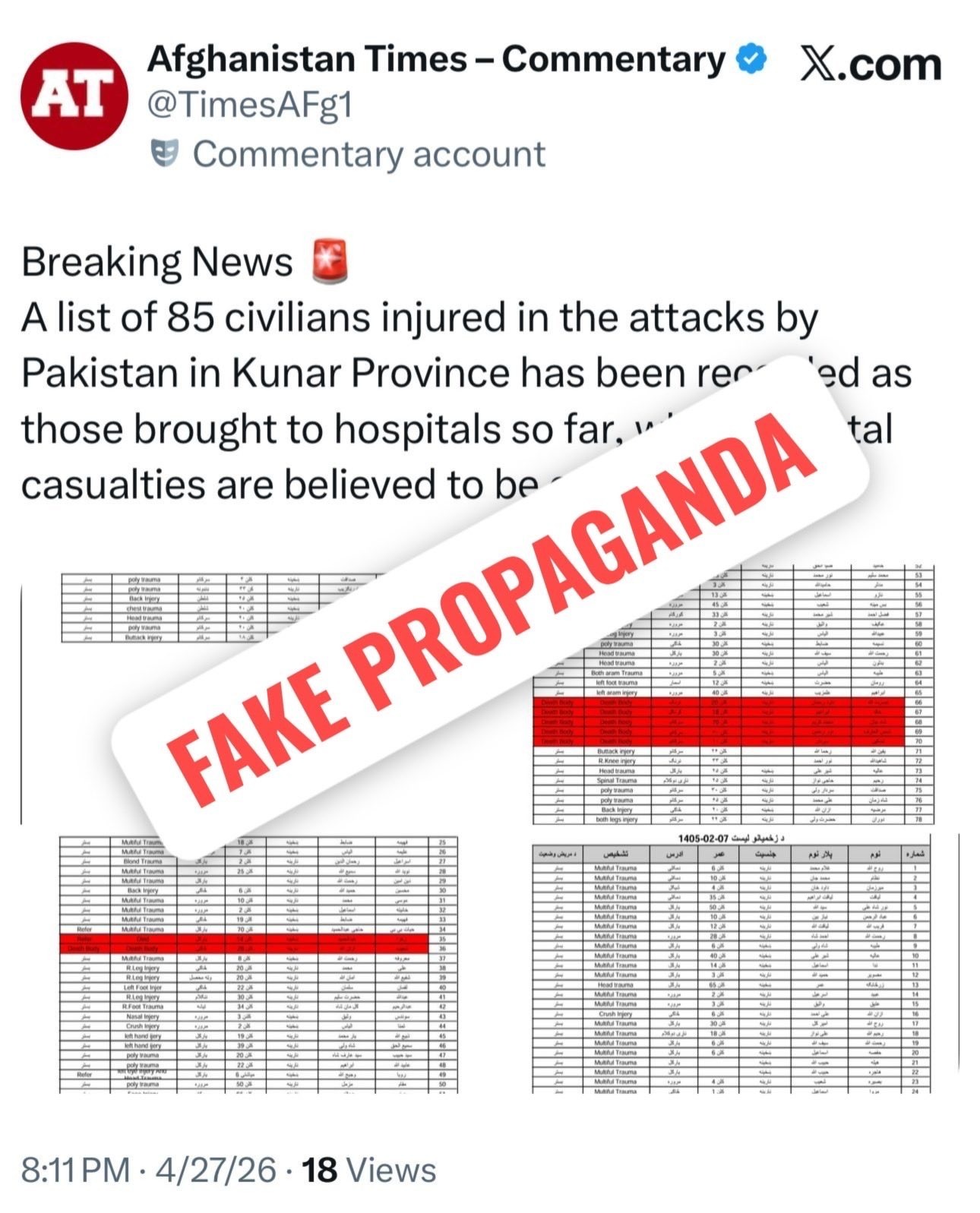
Officials in Pakistan have rejected reports circulating in sections of Afghan media regarding what have been described as “phantom strikes” in Kunar province. According to Pakistani authorities, these reports are part of a broader pattern of misinformation aimed at shaping public perception and deflecting attention from internal governance challenges.
Government sources maintain that any military action carried out by Pakistan across the border is conducted with clear intent, official acknowledgment, and supporting evidence. They emphasize that operations targeting militant infrastructure are neither covert nor ambiguous, but rather deliberate responses to security threats.
The recent escalation follows an incident near the Angoor Adda border area, where, according to Pakistani security officials, cross-border firing allegedly targeted civilian populations on the Pakistani side. Reports indicate that three civilians, including two women, were injured in the exchange and were transported to a medical facility in Wana for treatment.
In response, Pakistani forces reportedly carried out retaliatory actions in the Zalolkhail area, targeting positions believed to be linked to armed elements operating near the border. Officials claim that several posts were destroyed during the response, which they describe as proportionate and necessary to ensure civilian safety.
Local residents in the affected areas have expressed concern over the escalation and its impact on daily life. Some have called for stronger measures to prevent further incidents, while others have highlighted the need for stability and clear communication between the two sides to avoid misunderstandings.
Security analysts note that the border region has long been a point of friction, with both countries frequently exchanging allegations related to cross-border movement of armed groups. These dynamics are further complicated by differing narratives presented through official statements and media coverage in each country.
Adding to the complexity, Pakistani officials have also raised concerns about external influence in shaping regional narratives. They allege that certain actors are amplifying claims that lack verification, contributing to confusion and mistrust.
Meanwhile, in Islamabad, Federal Information Minister Attaullah Tarar addressed the media, outlining the government’s position on recent developments. He stated that Pakistan has responded firmly to threats while maintaining its commitment to national sovereignty and security.
Describing the country’s actions as measured and justified, Tarar emphasized that Pakistan would not compromise on its territorial integrity or the safety of its citizens. He added that the armed forces remain fully capable of responding to any external challenge.

The minister also referred to the broader regional context, including past incidents such as the Pahalgam attack, which has been a point of contention between Pakistan and India. He reiterated Pakistan’s rejection of allegations linking it to such incidents and called for independent and transparent investigations.
According to Tarar, Pakistan has consistently advocated for impartial inquiries into disputed events, arguing that such mechanisms are essential for establishing credibility and reducing tensions. He stated that Pakistan has presented its position at international forums and has received support from several countries for its stance on transparency.
He further claimed that India has not responded positively to calls for investigation and has instead faced criticism in certain diplomatic circles. These assertions reflect ongoing tensions between the two nuclear-armed neighbors, who have a long history of disputes and competing narratives.
Observers note that information warfare has become an increasingly prominent feature of regional conflicts, with governments using media platforms to influence both domestic and international audiences. In this environment, distinguishing verified facts from unconfirmed claims remains a significant challenge.
Experts suggest that the current situation underscores the importance of independent reporting and credible verification mechanisms. Without them, conflicting accounts can escalate tensions and contribute to instability on the ground.
Residents along the border continue to bear the brunt of these developments. Frequent reports of firing, movement of security forces, and uncertainty about the situation have disrupted normal life in several communities.
Humanitarian concerns are also emerging, particularly in areas where access to medical care and essential services is limited. Local authorities have urged both sides to exercise restraint and prioritize the safety of civilians.
At the diplomatic level, calls for dialogue and de-escalation are growing. Analysts argue that sustained communication between Pakistan and Afghanistan is crucial to addressing security concerns and preventing further incidents.
They also emphasize the need for broader regional cooperation to tackle the root causes of instability, including the presence of armed groups and the lack of coordinated border management.
As the situation continues to evolve, both official statements and media reports are likely to play a significant role in shaping public perception. In such a climate, the responsibility of accurate and balanced reporting becomes even more critical.
For now, the reality on the ground remains complex. While governments present their respective narratives, the people living in border regions continue to navigate uncertainty, hoping for a return to stability.
The coming days will be key in determining whether tensions ease through dialogue or persist amid competing claims and strategic positioning.
Comments are closed, but trackbacks and pingbacks are open.