
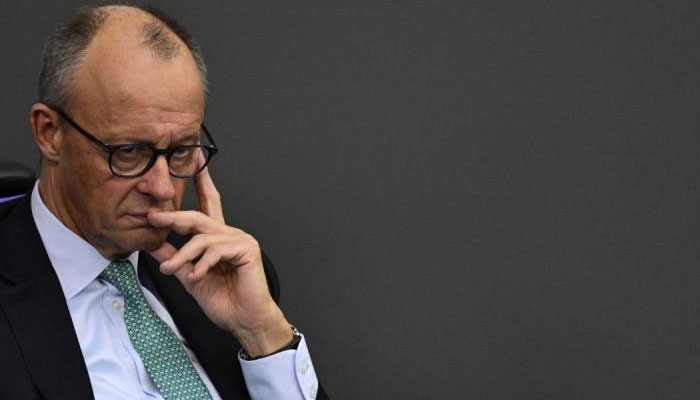
Merz Demands Further EU Budget Cuts Before Year-End Deal
EU Budget Talks Intensify as Merz Targets Year-End Agreement

BERLIN: (News Desk) – German Chancellor Friedrich Merz said Thursday that further reductions were needed in the European Union’s proposed seven-year budget, while stressing that he wanted member states to reach an agreement before the end of the year.
Ireland, which currently holds the EU’s rotating presidency, proposed cutting €141 billion ($157 billion) from the bloc’s next long-term budget over the weekend in an effort to bridge deep divisions among member states over spending priorities.
The proposal followed pressure from Germany, Europe’s largest economy, for substantial reductions to an earlier European Commission budget plan worth nearly €2 trillion.
Speaking in parliament ahead of an EU summit beginning Friday, Merz said the bloc had limited financial resources and would have to scale back spending across several areas.
“We will therefore not be able to avoid further reducing the current proposal in all areas,” he said, adding that the available funding would be lower than originally envisaged by the European Commission.
Merz also called for a clearer definition of the bloc’s spending priorities, arguing that limited resources must be directed towards the areas of greatest importance.
With negotiations entering what he described as a decisive phase, the German chancellor reaffirmed his determination to secure an agreement before the year ends.
Germany’s demand for tighter spending has brought it into disagreement with France, the EU’s second-largest economy. Paris maintains that the bloc needs sufficient financial resources to respond effectively to its growing economic and strategic challenges.
EU leaders are aiming to reach an agreement by Christmas, concerned that prolonged negotiations could spill into an election year and complicate efforts to secure consensus. Possible electoral gains for eurosceptic parties in France and elsewhere have added to concerns about the bloc’s ability to reach future agreements.
Merz and Macron Push for Stronger Trade Protection
Merz also revealed that he and French President Emmanuel Macron had put forward proposals to strengthen the EU’s trade protections, which are expected to be discussed at the summit.
Although he did not explicitly name China, his remarks came amid growing European concerns about competition from Chinese manufacturers across industries including automobiles and industrial machinery.
The German chancellor criticised trade practices involving heavy state subsidies, artificially undervalued currencies, excess production capacity and aggressive pricing, arguing that these measures could undermine European businesses.
“We will no longer stand idly by when other states harm our economy through high subsidies, artificially devalued currencies, overcapacity and aggressive pricing,” Merz said.
He warned that the EU was prepared to respond if other countries pursued trade confrontations with the bloc, signalling support for a firmer approach to protecting European industries and economic interests.
Comments are closed, but trackbacks and pingbacks are open.