


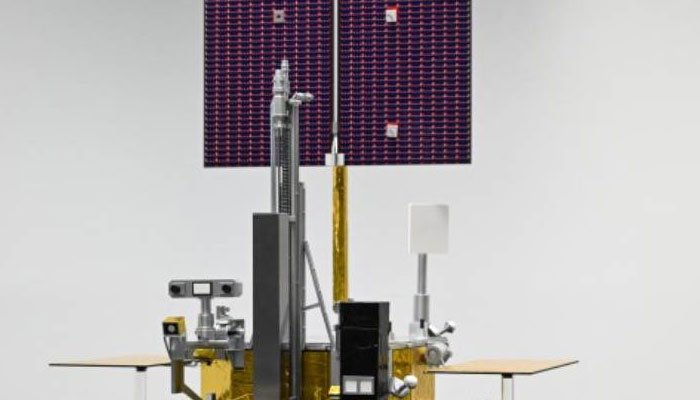
Japan Unveils Lunar Rover to Search for Water at Moon’s South Pole
New Japanese Rover Aims to Find Water and Produce Rocket Fuel

The Japan Aerospace Exploration Agency (JAXA) presented the rover’s four-legged test model to reporters in Tokyo on Wednesday. Scientists are evaluating its ability to navigate challenging lunar terrain, including climbing slopes, travelling on limited legs and operating under vacuum conditions.
Project manager Takeshi Hoshino said the mission’s long-term objective is to explore the possibility of producing rocket fuel using water found on the Moon. He explained that extracting and processing lunar water could support future space missions, including journeys back to Earth and potential expeditions to Mars.
The rover will be equipped to identify promising water-rich locations, drill into the lunar surface and collect samples. Researchers hope the findings will reveal the quantity and quality of available water and determine whether it can be used as a sustainable resource for future space exploration.
Under the Japan-India partnership, India will develop the lunar lander, while Japan will provide the rover. The collaboration follows India’s successful Chandrayaan-3 mission, which achieved a historic landing near the Moon’s south pole in 2023.
Japan has also strengthened its position in lunar exploration. In 2024, JAXA successfully landed its unmanned SLIM spacecraft on the Moon, making Japan the fifth country to achieve a lunar soft landing, although the spacecraft touched down at an unusual angle.
Meanwhile, Japanese private company ispace failed in its attempt to achieve a controlled lunar landing, highlighting the technical challenges facing commercial space exploration.
In another major development, JAXA recently launched a spacecraft on a pioneering mission to one of Mars’ moons to collect samples. The mission is expected to provide valuable insights into the formation of the Solar System and the origins of life on Earth.

Comments are closed, but trackbacks and pingbacks are open.