
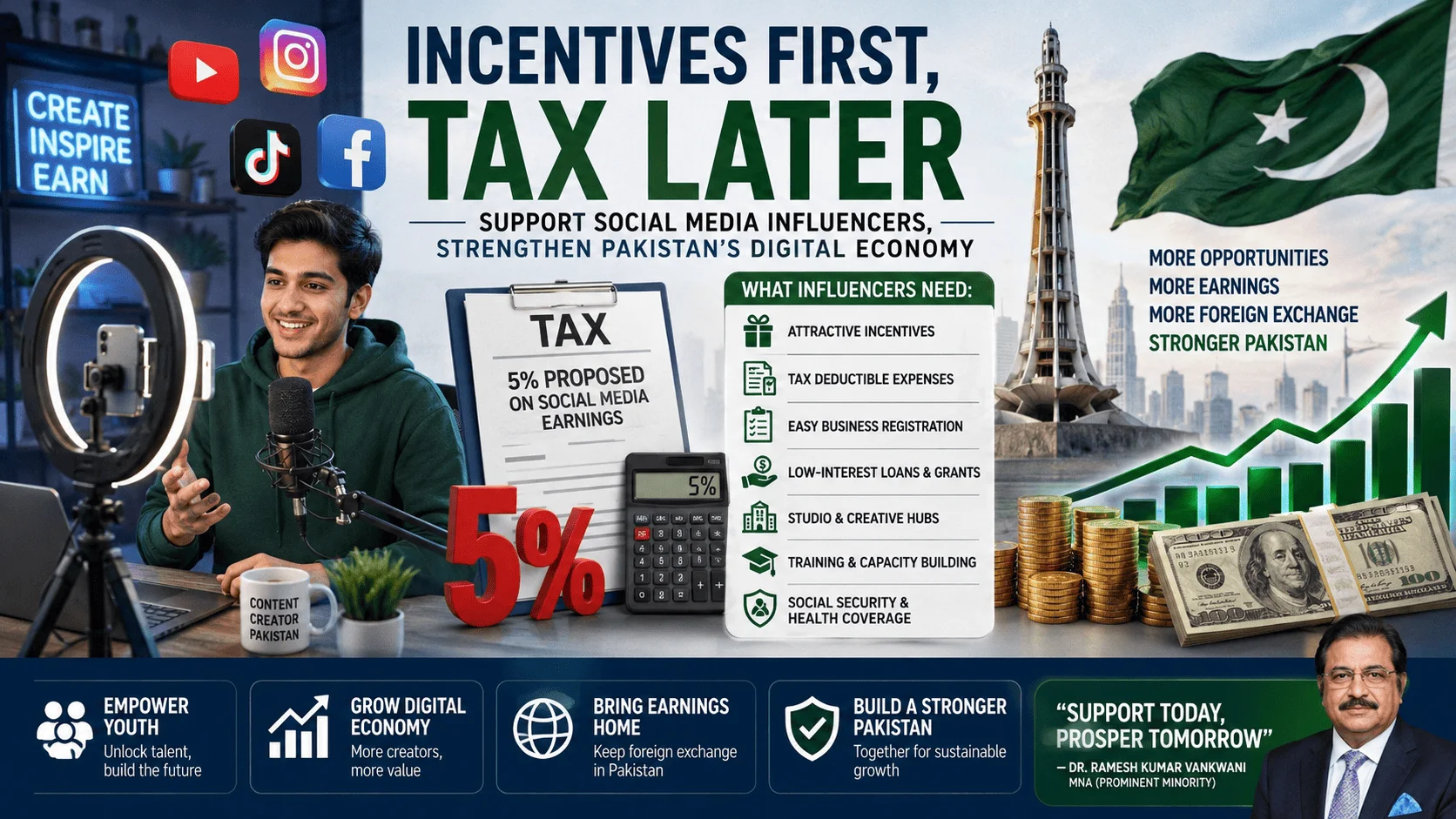
Introduce Attractive Incentives Before Taxing Social Media Influencers: Dr. Ramesh Kumar Vankwani
Ramesh Kumar Vankwani's social media tax remarks call for relief before new rules

Islamabad – (Special Correspondent / Web Desk) – Ramesh Kumar Vankwani social media tax comments have sparked fresh discussion in Islamabad this week. The well-known minority MNA says the government should first offer real support to online creators before placing new tax rules on their income.
He shared his views right after the Federal Budget 2026-27 proposed a 5 percent tax on earnings from social media. Dr. Vankwani believes platforms like YouTube, Facebook, Instagram, and TikTok have opened up fresh income paths for many young Pakistanis who had few other options.
He pointed out that Pakistan’s digital economy is still quite young. Adding a tax burden too soon, he warned, could discourage new creators who are already working hard without any government backing.
Dr. Vankwani also noted that taxing online income is becoming common worldwide. He mentioned that creators in the United States already pay federal and state taxes on what they earn online, and many other countries follow a similar path.
But he was quick to add that taxation abroad usually comes with strong support in return. In several countries, he said, creators can deduct costs like camera gear, studio rent, internet bills, and travel expenses from their taxable income.
He also brought up examples of nations that have built creative hubs, training programs, and funding schemes just for digital entrepreneurs. Some governments even offer easy loans, simple business registration, and grants to help creators grow.
In parts of Europe, he added, creators who join the formal tax system also get access to pension plans, health coverage, and social security. This kind of system, he believes, builds trust rather than fear among taxpayers.
Dr. Vankwani highlighted that Pakistan’s influencer community has grown fast in recent years. This growth has brought in valuable foreign income, much of it in US dollars, through local banks.
He cautioned that heavy taxes without any real benefits could push creators to keep their earnings in foreign accounts or digital wallets instead. If that happens, he said, the country could lose both expected tax revenue and much-needed foreign currency.
His final message was simple: support should come before strict taxation. Helping young creators grow their skills, he said, will do far more for Pakistan’s economy than taxing them too early ever could.
Comments are closed, but trackbacks and pingbacks are open.