

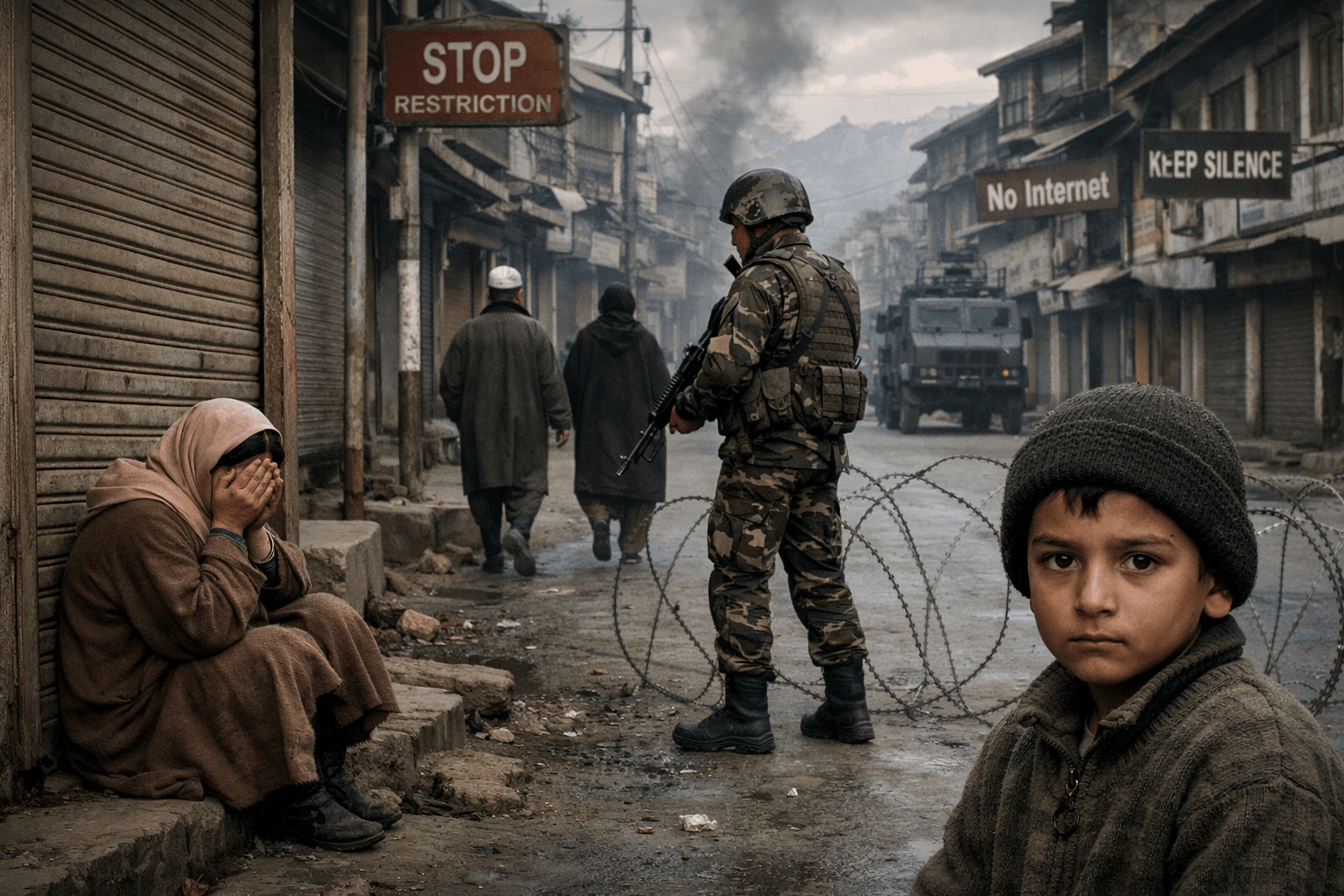

Jammu and Kashmir remains an internationally recognized disputed territory under United Nations Security Council resolutions adopted since 1948. The UN resolutions clearly state that the future of Kashmir must be decided through the democratic will of the Kashmiri people by means of a free and impartial plebiscite under UN supervision. Despite these international commitments, India continues to impose military control over the territory while subjecting Kashmiris to widespread repression, arbitrary detentions, and systematic human rights violations.
India has deployed more than 900,000 troops in Indian occupied Jammu and Kashmir, making it one of the most heavily militarized regions in the world. Under this military occupation, frequent crackdowns, raids, and arbitrary arrests have become a routine part of daily life for Kashmiris. Young men, political activists, journalists, women, students, and even ordinary civilians are detained without warrants or fair legal procedures under draconian laws such as the Public Safety Act (PSA), UAPA and the Armed Forces Special Powers Act (AFSPA). These laws grant sweeping powers to Indian forces with complete impunity.
One of the gravest violations the Kashmiri are facing in Indian occupied Kashmir are the practice of enforced disappearances and staged encounters. Numerous detained Kashmiris are taken to torture cells, subjected to severe physical and psychological abuse, and later transported to so-called “encounter sites” where they are killed in fake gun battles and falsely labeled as militants. Families are frequently denied information regarding the whereabouts of detainees. Such actions constitute serious violations of international humanitarian law and international human rights law.
The condition of Kashmiri detainees inside Indian prisons is pathetic. Kashmiri detainees are held in overcrowded and unhygienic cells lacking basic sanitation and ventilation. Prisoners often face inadequate food, unsafe drinking water, and denial of proper medical treatment. Even sick detainees are frequently deprived of urgent healthcare, while elderly prisoners and political detainees suffer from neglect and mistreatment. Under a planned policy Kashmiri detainees have been transferred to different prisons in India very far from Kashmir, making family visits almost impossible and increasing the psychological suffering of prisoners and their relatives.

International law clearly prohibits torture, arbitrary detention, and cruel or degrading treatment of prisoners. The Fourth Geneva Convention protects civilians living under occupation or disputed conditions and forbids unlawful confinement, torture, collective punishment, and violence against detainees. The International Covenant on Civil and Political Rights (ICCPR) also guarantees the right to liberty, fair trial, humane treatment in detention, and protection from arbitrary arrest. India’s repressive actions in occupied Kashmir, particularly custodial torture, fake encounters, prolonged detentions without trial, and denial of medical care, directly contradict these international obligations.
The Office of the United Nations High Commissioner for Human Rights (OHCHR) has documented serious concerns regarding excessive force, pellet gun injuries, arbitrary arrests, and impunity enjoyed by Indian forces in Kashmir.
Following India’s unilateral revocation of Article 370 and Article 35A in August 2019, Indian repression intensified further. Thousands of Kashmiris including women were detained, communication networks were suspended, and military restrictions paralyzed civilian life. India also introduced new domicile laws allowing outsiders to obtain residency rights and purchase land in the disputed territory, raising serious concerns regarding demographic engineering. Such demographic changes may violate Article 49 of the Fourth Geneva Convention, which prohibits an occupying power from transferring its civilian population into occupied territory.
The continued victimization of Kashmiri detainees represents not only a humanitarian crisis but also a serious challenge to international law, UN resolutions, and the universal principles of human dignity and justice. The international community must demand accountability, independent investigations into custodial killings and torture, protection of detainees, and implementation of UN resolutions for final disposition of longstanding dispute of Jammu and Kashmir.
The author is senior leader of All Parties Hurriyet Conference (APHC) and legal expert of international law. He can be reached at faiz.naqshbandi@gmail.com & at WhatsApp number 03335145416.
Comments are closed, but trackbacks and pingbacks are open.