
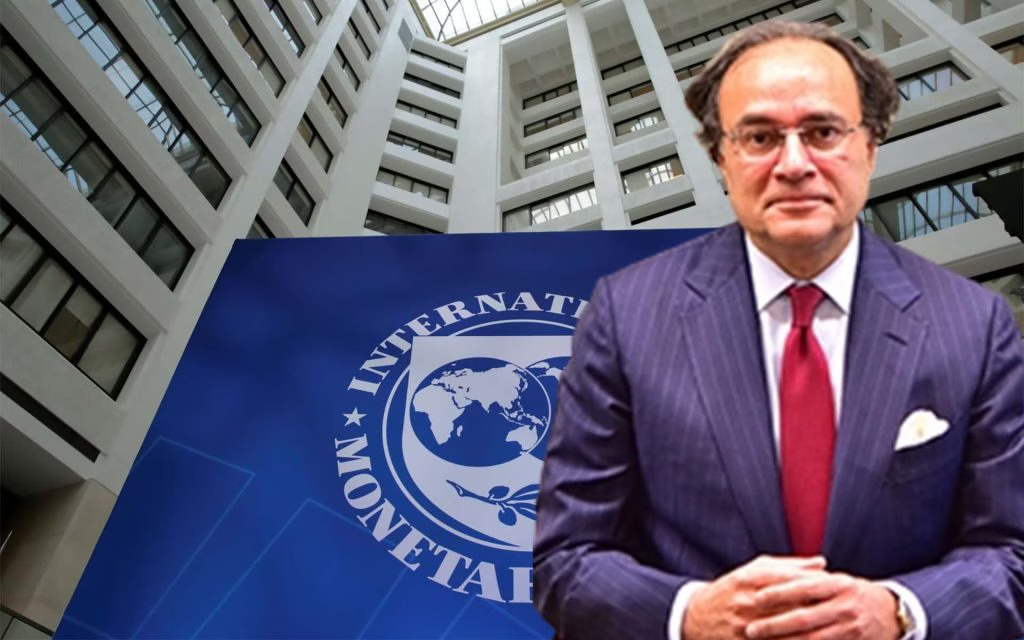

ISLAMABAD: Following approval of two loan tranches totaling $1.29 billion, the International Monetary Fund (IMF) has urged Pakistan to maintain a tight monetary policy, simplify and broaden its tax system, adjust power and gas tariffs, and implement structural reforms to stabilize the economy.
The IMF’s Executive Board completed the second review of the Extended Fund Facility (EFF), allowing Pakistan to access approximately $1 billion, and the first review of the Resilience and Sustainability Facility (RSF), enabling a draw of about $200 million.
IMF Deputy Managing Director and Acting EB Chair Nigel Clarke emphasized that accelerating reforms in the energy sector is critical to improving Pakistan’s competitiveness and safeguarding the sector’s viability. He noted that timely implementation of power tariff adjustments has helped reduce the stock and flow of circular debt. Clarke added that ongoing efforts should focus on sustainably lowering electricity production and distribution costs and tackling inefficiencies in the power and gas sectors.
Clarke also highlighted the importance of structural reforms to unlock growth potential and attract high-impact private investment. He welcomed the publication of the Governance and Corruption Diagnostic report and stressed that further work is needed on SOE governance, privatization, business environment improvements, and economic data enhancement.
The IMF praised Pakistan’s strong execution of its program despite the recent devastating floods, which has maintained macroeconomic stability and improved financing and external conditions. Policy priorities continue to focus on macroeconomic stability, fiscal strengthening, competition, productivity, social safety nets, SOE reforms, and energy sector viability.
The IMF also stressed the urgency of advancing climate-related reforms to build resilience against frequent natural disasters. The RSF supports these efforts, aiming to reduce vulnerabilities and improve economic and climate resilience.
The completion of the reviews allows immediate disbursement of about $1 billion under the EFF and $200 million under the RSF, bringing total disbursements under both programs to roughly $3.3 billion.
The 37-month EFF aims to build resilience and foster sustainable growth through macroeconomic stability, reserve rebuilding, tax base expansion, competition enhancement, productivity improvement, SOE reforms, and better public services. Pakistan’s efforts under the EFF have stabilized the economy, improved fiscal performance, and rebuilt confidence despite global challenges and recent floods. Fiscal performance remained strong, with a primary surplus of 1.3% of GDP in FY25, while gross reserves increased to $14.5 billion, up from $9.4 billion the previous year.
Read more: IMF Approves $1.2 Billion Loan Program for Pakistan
The 28-month RSF supports measures to strengthen disaster resilience, improve public investment efficiency, enhance water resource management, and coordinate federal-provincial disaster responses.
Clarke highlighted that Pakistan’s EFF program has helped maintain macroeconomic stability amid recent shocks, with accelerating GDP growth, anchored inflation expectations, and moderated fiscal and external imbalances. He advised the country to continue prudent policies to sustain stability while implementing reforms for private sector-led, sustainable growth.
He further noted that Pakistan’s commitment to the FY2026 primary balance target, even while responding to severe floods, demonstrates fiscal credibility. Simplifying and broadening the tax system is key for fiscal sustainability, creating space for climate resilience, social protection, human capital development, and public investment.
Clarke underscored that a tight monetary policy remains crucial to controlling inflation, with improved central bank communication supporting effective implementation. He also recommended that the State Bank of Pakistan deepen the interbank forex market while allowing exchange rate flexibility and emphasized strong financial regulation and capital market development to expand financing options for public and private sectors.


Comments are closed, but trackbacks and pingbacks are open.