
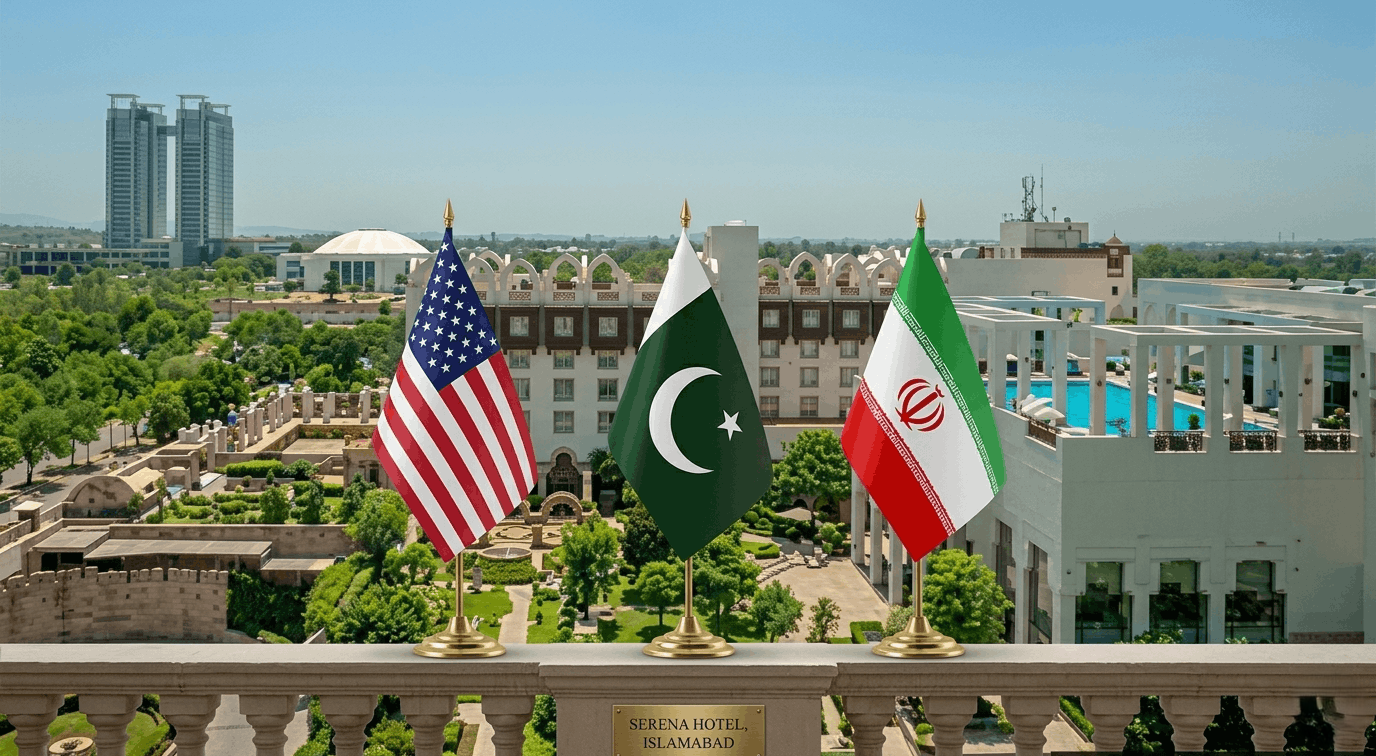
Five key points about US-Iran talks in Islamabad
Pakistan steps into the spotlight as Washington and Tehran meet face to face for the first time since the war began.

Islamabad – (Web Desk) – For the first time in years, top American and Iranian officials are sitting down together — not on a battlefield, but in the calm, tree-lined streets of Pakistan’s capital. Islamabad is hosting what may be the most consequential peace talks of our time, as both sides try to turn a shaky two-week ceasefire into something real and lasting.
It started on February 28, when the US and Israel launched a wave of strikes on Iran — killing Supreme Leader Ali Khamenei and targeting military and nuclear sites, leaving more than 2,000 people dead in just five weeks. Iran’s response was swift and painful for the world: it effectively shut down the Strait of Hormuz, the narrow waterway through which roughly one-fifth of the world’s oil and gas flows. Energy prices shot up, global trade took a hit, and the pressure to find a way out grew by the day.
On April 8, Pakistan helped broker a two-week ceasefire between Washington and Tehran. The clock is ticking — it expires on April 22.
Honestly, not many people saw this coming. Pakistan has long been in the headlines for turbulent politics and economic struggles, not shuttle diplomacy. Yet here it is, playing host to one of the biggest diplomatic events in recent memory.
It turns out Pakistan is uniquely placed to play this role. Iran was the very first country to recognise Pakistan after independence in 1947. The two nations share a 900-kilometre border, a rich cultural heritage, and deep religious connections — Pakistan is home to over 20 million Shia Muslims, the second-largest such community in the world after Iran itself. At the same time, Pakistan enjoys warm ties with Washington, Riyadh, and Beijing.
China, it seems, also played a quiet but crucial part. Trump himself told AFP that Beijing helped bring Iran to the table. A senior Pakistani official put it simply: “While our efforts were central, we were falling short of a breakthrough — which was ultimately achieved after Beijing persuaded the Iranians.”
The Americans have reportedly put forward a 15-point plan covering Iran’s uranium enrichment, ballistic missiles, sanctions relief, and the reopening of the Strait of Hormuz. Iran has fired back with its own 10-point proposal — demanding control over the strait, a toll on passing ships, an end to all regional military operations, and a full lifting of sanctions.

Lebanon is adding another layer of tension. Israel continued striking Hezbollah targets there even after the ceasefire began. Iran’s President Pezeshkian said those strikes made the whole process feel “meaningless,” adding pointedly: “Our hands remain on the trigger.” VP Vance, to his credit, tried to cool things down, suggesting there may have been an honest misunderstanding about whether Lebanon was covered by the truce.
Pakistan calls for ceasefire, backs US-Iran diplomacy
On the American side, Vice President JD Vance is leading the charge, flanked by special envoy Steve Witkoff and Jared Kushner. It is the most senior US engagement with Iran since Secretary of State John Kerry negotiated the 2015 nuclear deal.
Iran is expected to be represented by Parliament Speaker Mohammad Bagher Ghalibaf — a former IRGC commander — and Foreign Minister Abbas Araghchi, who had previously met Witkoff in earlier Oman-mediated rounds before the war disrupted everything.
The city is on lockdown — but in the most organised, almost eerie way. Armed security personnel line the streets, checkpoints dot every major road, and the government declared a two-day public holiday. The Serena Hotel, tucked next to the Foreign Ministry in Islamabad’s high-security Red Zone, quietly asked its guests to pack up and leave earlier this week.
Pakistan grants visas on arrival to all delegates and journalists.
The talks themselves are expected to be indirect — the two delegations in separate rooms, with Pakistani officials walking proposals back and forth between them, much like the earlier Oman rounds. Islamabad, already one of the quieter capitals in the region, feels quieter still.
Comments are closed, but trackbacks and pingbacks are open.