
EU Supports Gilgit-Baltistan’s First Carbon Action Plan
EU Backs New Climate Strategy For Gilgit-Baltistan’s Sustainable Development

GILGIT: (Staff Reporter) – The European Union has expressed support for Gilgit-Baltistan’s first Carbon Strategy and Action Plan, aimed at addressing climate change, protecting the region’s fragile environment and promoting sustainable economic development.
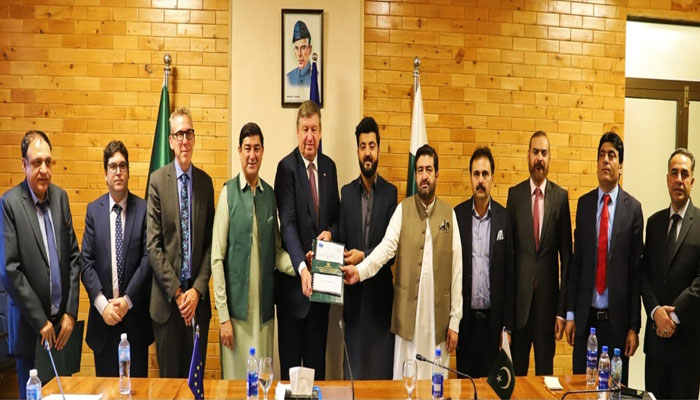
Speaking at the launch ceremony at the Secretariat Complex in Gilgit, EU Ambassador to Pakistan Raimundas Karoblis said climate action, environmental protection and sustainable development in Gilgit-Baltistan remain among the EU’s key priorities.
The Carbon Strategy and Action Plan has been prepared for the Government of Gilgit-Baltistan with support from an EU policy assistance project.
Ambassador Karoblis said the EU remained committed to helping Gilgit-Baltistan respond to the growing effects of climate change. He added that following the completion of the policy formulation phase, the EU plans to expand technical and financial cooperation with the regional government to support implementation of the strategy.
The ceremony was attended by Minister for Planning and Development Syed Jalal Ali Shah, Minister for Forests and Wildlife Raja Nasir Ali Khan, Minister for Local Government and Rural Development Zulfikar Ali Murad, Secretary Forest and Wildlife Sibtain Ahmed, Secretary Local Government and Rural Development Kashif Mohammad Ali Hashmi and other senior officials.
During the event, Ashab Ullah Baig, Team Leader and Carbon Expert of the EU Policy Support Project, briefed participants on the strategy’s main features and priorities.
He said the plan aims to transform Gilgit-Baltistan into a low-carbon and climate-resilient mountain economy while promoting sustainable development and safeguarding its vulnerable ecosystems.
According to the baseline assessment presented at the ceremony, Gilgit-Baltistan produces an estimated 1.123 million tonnes of greenhouse gas emissions annually, measured in carbon dioxide equivalent.
Fuelwood consumption and road transport account for approximately 84.2 percent of the region’s total gross emissions.
The strategy therefore focuses on reducing reliance on fuelwood through cleaner cooking and heating technologies, improving biomass efficiency, promoting electric vehicles and cleaner transportation, and increasing the use of hydropower and solar energy.
It also proposes institutional and governance reforms, including the establishment of a GB Carbon Cell to improve carbon governance, monitoring, reporting and verification.
The proposed Carbon Cell would also help Gilgit-Baltistan access international climate financing and participate in emerging carbon markets.
The strategy further recommends establishing a Climate Observatory to monitor climate and environmental impacts associated with development activities.
It also calls for greater participation of local communities and stakeholders in the benefits generated through carbon finance and carbon credits.
The provincial ministers and senior officials thanked the European Union for its technical and financial support in developing the strategy and reaffirmed the Government of Gilgit-Baltistan’s commitment to its implementation.
[…] (News Desk) – Ford Motor Co. has suspended production of its best-selling F-150 pickup truck at a Detroit-area plant for nearly a week, according to a company memo reviewed by […]