

Deadly measles outbreak spreads as Bangladesh struggles with vaccine gaps
A delayed vaccine drive and low coverage have left Bangladesh's youngest children exposed to a deadly and fast spreading measles outbreak.

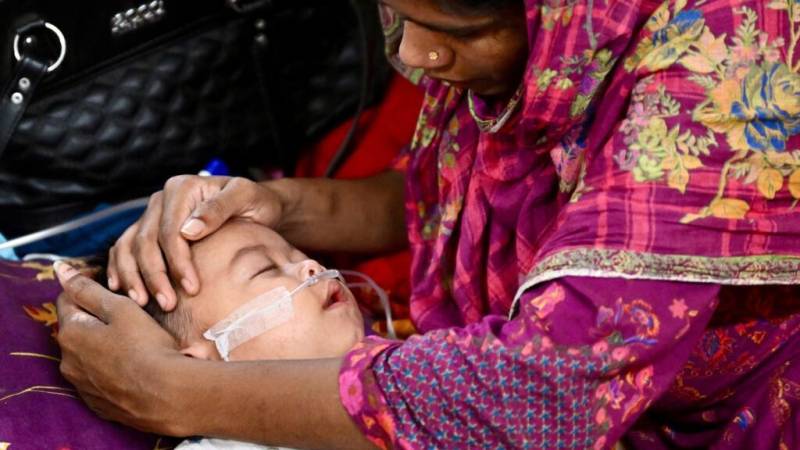
Bangladesh – (Web Desk) – Rubia Akhtar Brishti is only 18 years old. But she has already watched her baby boy almost die. She sat holding little Minhaz in her arms. Rocking him gently. Wiping the sweat from his burning forehead. Her son was just one year old when measles hit him hard.
“The boy had high fever and found it hard to breathe,” she said. “His whole body had rashes.”
Bangladesh is going through its worst measles outbreak in 20 years. Since March 15, at least 143 people have died. Most of them were children. More than 12,000 cases have been reported so far.
Brishti came all the way from her village to Dhaka. She was desperate for help. Hundreds of families like hers rushed to DNCC Hospital in Mohakhali. The hospital was first built for Covid patients. Now it is packed with sick children.
Inside the ward it is heartbreaking. Babies cough and cry. Mothers press nebulisers over their little ones’ mouths just so they can breathe. Tiny bodies covered in red rashes. The sounds of pain fill every corner.
Measles spreads very easily. A single cough or sneeze can pass it on. It hits children the hardest. In serious cases it can cause brain swelling and breathing failure.
Nusrat Jahan lost her vaccination cards. Because of that her two babies never got their shots. Now both of them are sick and admitted in the same hospital on different floors.
“One is on the first floor and another is on the second floor,” she said quietly. “I am caught in between as both the children cry for me.”
She keeps moving up and down the stairs. Torn between two crying babies. Alone.
– Vaccine drive –
Bangladesh has made significant advancements in vaccinations to tackle infectious diseases.
But a measles drive due in 2024 was delayed by the deadly uprising that toppled the autocratic government of Sheikh Hasina.

Many of the families with sick children in the ward say they come from areas where vaccine coverage was limited.
Yasmin Khatun, grandmother of one-year-old Safwan, said she had tried to get the baby protected.
“We took him to the centre but there were no vaccines available for measles,” she said.
Health authorities are scrambling to stop the spread and roll out vaccination campaigns.
Health authorities launched an emergency measles-rubella campaign on April 5, alongside UN agencies, aiming to protect more than 1.2 million children.
Vaccines work the best when all are covered.
Government health services spokesperson Zahid Raihan said that among the affected children, 17 percent had received a single dose, while 11 percent had received two doses.
Pakistan’s Diplomatic Triumph: History, Agency, and a Global Vision in Action
“In the absence of herd immunity, children can still get infected even after vaccination,” Raihan said, saying 95 percent coverage of children was needed to ensure that.
“Last year, the coverage was only 59 percent,” he said.
Golam Mothabbir, from Save the Children Bangladesh, said the hardest hit places included the crowded capital Dhaka, as well as the densely packed refugee camps of Cox’s Bazar, home to more than a million people.
“We know that if not enough vaccines are administered or if the vaccine campaign isn’t sustained, the outbreak will continue to spread, and paediatric wards will continue to fill,” Mothabbir said.

Comments are closed, but trackbacks and pingbacks are open.