

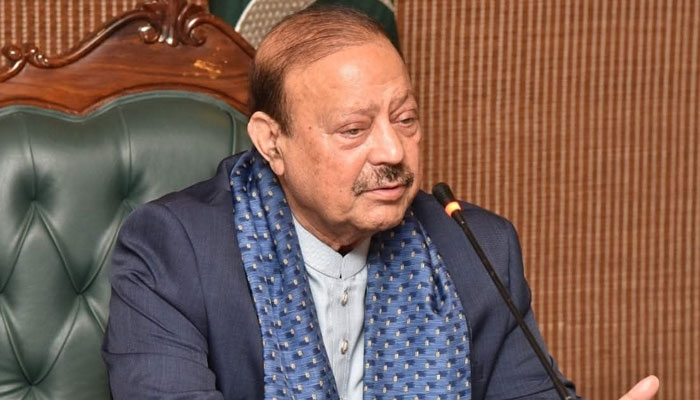

When the news of Barrister Sultan Mahmood Chaudhry’s passing emerged yesterday, it did not feel like the loss of an individual alone; rather, it felt as though a significant chapter of history had suddenly fallen silent. He departed this world while serving as the President of Azad Jammu and Kashmir, a fact that deepens the sense of tragedy. For Azad Kashmir, Pakistan, and Kashmiris living across the world, this was a profound shock—one that weighed heavily on hearts and brought tears to eyes. He was not merely a politician; he was an era—an era founded on principles, steadfastness, and an unwavering commitment to the Kashmir cause.
Barrister Sultan Mahmood Chaudhry was among those rare leaders who not only attained every major constitutional office in Azad Kashmir’s politics but discharged each with dignity and grace. At the time of his passing, he was serving as President of the State; earlier, from 1996 to 2001, he served as Prime Minister of Azad Jammu and Kashmir, and he also played a strong, vocal, and courageous role as Leader of the Opposition. Whether in power or in opposition, a consistency of principles was the hallmark of his politics.
His entire political life revolved around a clear and unwavering mission. For him, politics was not merely a means of accessing corridors of power; it was a national responsibility, a trust, and a continuous struggle. He never allowed politics to become a tool for personal gain, temporary advantage, or opportunism. This is why his personality inspired pride among friends and commanded respect even from opponents.
The Kashmir issue was the very soul of Barrister Sultan Mahmood Chaudhry’s politics. He viewed Kashmir not simply as a territorial dispute but as a living issue intertwined with human rights, global justice, and United Nations resolutions. Whether as Prime Minister, Leader of the Opposition, or President of the State, he kept Kashmir at the center of his political vision. The right of self-determination for the Kashmiri people remained the constant focus of his discourse and struggle.
His role in highlighting the Kashmir issue at the international level is unforgettable. From European capitals to American think tanks, he presented the Kashmir case with seriousness, reason, and dignity. He understood that the international community is persuaded not by emotional slogans alone, but by strong legal and moral arguments. This is precisely why his voice was heard—and taken seriously.
As a barrister, his greatest strength was his legal insight. He possessed a deep understanding of international law, United Nations resolutions, and global human rights principles. His speeches were not mere political rhetoric; they took the form of well-structured and comprehensive legal arguments. On Kashmir, his voice came to be regarded internationally as a serious and credible reference.

In the politics of Azad Kashmir, Barrister Sultan Mahmood Chaudhry emphasized institutional stability and constitutional supremacy during his tenure as Prime Minister. As Leader of the Opposition, he confined his criticism to civility, reason, and parliamentary norms. And as President of the State, he endeavored to serve as a symbol of constitutional dignity and unity. He viewed dissent as a strength of democracy, not a weakness.
A defining trait of his personality was his steadfastness. He was not a politician who changed colors with changing circumstances. Political loss, criticism, or isolation—nothing could compel him to retreat from his stance. It was this very consistency that elevated him from a transient political figure to a lasting character in history.
At a time when our politics appears to revolve around interests, maneuvering, and short-term gains, the passing of Barrister Sultan Mahmood Chaudhry powerfully reminds us how rare principled politicians have become. His departure is not only a loss for Azad Kashmir but a political, moral, and intellectual void for the entire nation.
For the younger generation, his life conveys a clear message: if intentions are pure, politics can become an act of service—even worship; if intentions are corrupt, it becomes mere commerce. He demonstrated that one can uphold a position without shouting, without hatred, and without personal attacks. This is his true legacy.
Barrister Sultan Mahmood Chaudhry is no longer among us, but his voice endures. Whenever Kashmir is discussed, his reference will arise. Whenever the right of self-determination is mentioned, his struggle will be remembered. History will recall him as a leader who remained true to his principles—both in power and in opposition.
In the end, it can be said that the passing of Barrister Sultan Mahmood Chaudhry is not merely the death of an individual, but the fall of a strong pillar of ideological politics. Yet ideologies do not die; they live on in the consciousness of nations.
May Allah Almighty grant Barrister Sultan Mahmood Chaudhry a place in His mercy, forgive him, elevate his ranks, and grant patience and fortitude to those he leaves behind. Ameen.

Comments are closed, but trackbacks and pingbacks are open.