

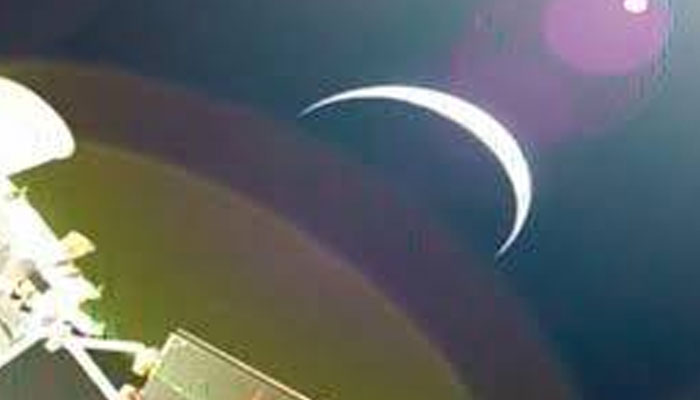
Artemis astronauts enter Moon’s gravity for historic flyby
NASA Artemis crew reaches lunar sphere, first flyby since 1972

WASHINGTON: (Web Desk) – The NASA Artemis crew has entered the final phase of their journey toward a lunar loop, marking a historic milestone as the Moon’s gravity now exerts more pull on their Orion capsule than Earth.
The astronauts, comprising three Americans and one Canadian, are set to become the first humans to travel farther from Earth than any in history while completing the first lunar flyby since 1972. At the start of the lunar sphere of influence, the crew was about 39,000 miles (63,000 kilometers) from the Moon and 232,000 miles from Earth, according to NASA’s livestream.
The mission includes several historic firsts. Victor Glover will become the first person of color to fly around the Moon, Christina Koch is the first woman, and Jeremy Hansen will be the first non-American to accomplish the feat alongside mission commander Reid Wiseman.
Trump’s $1.5T defense boost funded by slashing NASA, EPA

During the flyby, the crew will document lunar features never before seen by human eyes. Early images released by NASA include the Orientale basin, a massive bullseye-shaped crater, marking the first time the entire formation has been observed directly. Koch described it as the Moon’s “Grand Canyon,” expressing excitement while speaking to Canadian children via a live Q&A.
The astronauts will also witness a solar eclipse from the far side of the Moon and conduct tests on the Orion crew survival system suits. These orange suits, designed for launch and reentry, provide up to six days of breathable air and will be evaluated for pressurization speed and emergency use.
Though the crew will not land on the lunar surface, they are expected to break the record for the farthest distance from Earth during a lunar mission. NASA Administrator Jared Isaacman emphasized the importance of data collected during this flyby, which will inform subsequent missions, including Artemis 3 in 2027 and the lunar landing planned for Artemis 4 in 2028.
The astronauts have also completed a manual piloting demonstration, reviewed their lunar flyby objectives, and prepared to capture surface images and analyze lunar features while monitoring the spacecraft’s life support and ecosystem systems—the first time humans have flown on Orion, making these observations critical for future exploration.

Comments are closed, but trackbacks and pingbacks are open.