
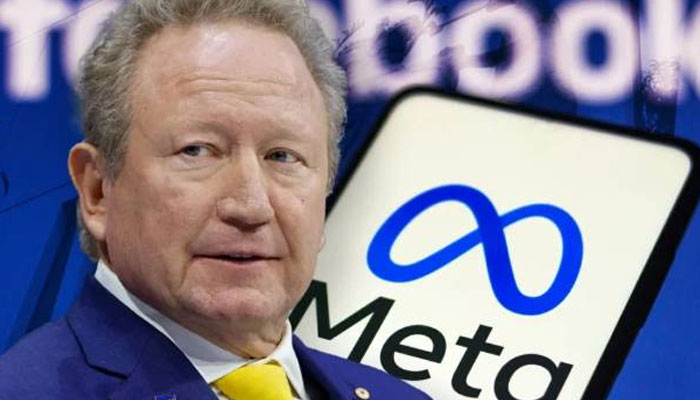
Andrew Forrest challenges Meta over scam ads
Andrew Forrest sues Meta over scam ads using likeness

SYDENY: (Web Desk) – Australian mining billionaire Andrew Forrest has taken legal action in a US federal court in Silicon Valley, aiming to hold Meta responsible for scam advertisements that allegedly misuse his identity without consent.
Forrest’s legal team is urging the court to rule that Meta cannot rely on Section 230 of the Communications Decency Act, a law that typically shields online platforms from liability for user-generated content. According to his lawyer, Simon Clarke, this case could set an important precedent—especially in California—by arguing that such legal protection was never meant to apply to advertising operations.
A recent court hearing focused on claims that Meta may have failed to preserve key evidence, which could weaken its ability to claim immunity under Section 230. A decision on this matter is expected soon.
Meta, however, maintains that it did not create the fraudulent ads and insists it took reasonable steps to retain relevant data. The company continues to defend its position that it should not be held accountable for content posted by advertisers.
Meta unveils Muse Spark AI model globally
Earlier this year, a Los Angeles jury found Meta and YouTube liable in a separate case involving harm caused by the addictive design of their platforms. That ruling centered on how these platforms are built and operated, rather than the specific content shared on them.
Using a similar legal approach, Forrest’s lawyers argue that Meta’s advertising system—including its AI-driven tools—actively contributed to the creation and spread of scam ads. The lawsuit claims that for years, fraudulent promotions featuring Forrest’s image have circulated widely on Facebook, often promoting fake cryptocurrency schemes and deceiving thousands of users.
The legal complaint further alleges that Meta’s algorithms amplified and targeted these ads, making the company more than just a passive host. In a related development, Massachusetts’ highest court recently ruled that Section 230 does not shield Meta from claims tied to Instagram’s allegedly addictive design for younger users.
Comments are closed, but trackbacks and pingbacks are open.