

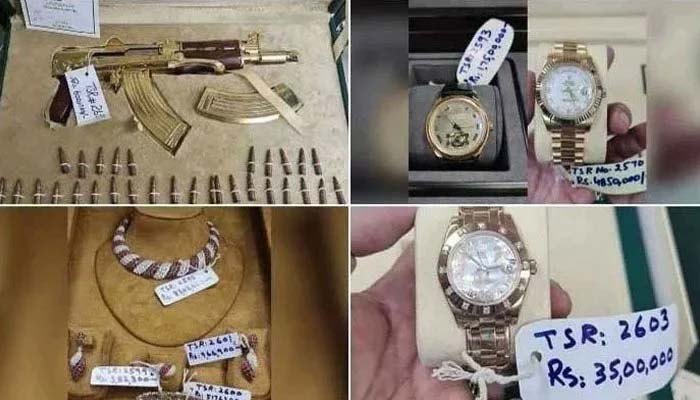
Toshakhana New Rules End Costly Gift Retention, but Committee Holds Exemption Power
The updated framework brings open auctions, stricter valuation checks and monthly public records, but a high-level committee will still decide which valuable gifts stay out of auction.

ISLAMABAD – (Choudhry Mudasser) – The Toshakhana new rules have shut the old door that let public office holders keep gifts worth up to $300 after paying their assessed value. The 2026 framework replaces the 2023 procedure and sets a stricter path for every gift a government official receives.
Officials say a side-by-side look at both documents shows a clear change. Under the 2023 policy, gifts above $300 already became state property. The new rules go further and spell out how those gifts must be deposited, valued and sold.
Gifts that cannot be refused for diplomatic or cultural reasons must now be placed in the Toshakhana. Items that are eligible for disposal will be sold in open auctions.
The most important part is about gifts that will not be sold. Antiques and items of cultural or historical value are excluded from auction. High-value gifts, and those seen as diplomatically or internationally sensitive, can also be exempted.
That call will not be made by one person. A committee headed by the cabinet secretary will decide. It will include senior representatives from the Finance, Foreign Affairs, Law and Culture divisions.
This creates a clear line between gifts that are sold and gifts that stay outside the auction. An exemption does not mean a recipient can take the gift home. Still, the committee’s decisions will shape how valuable presents are treated.
The 2023 procedure also had limits. It barred private retention of gifts above the $300 mark and left out antiques and items of historical value. Gifts that were not suitable for retention, donation or display were to be sold in periodic public auctions.
The Toshakhana new rules add stronger checks on pricing. The Federal Board of Revenue and a private-sector evaluator will each assess a gift’s market value.
If their figures differ by more than 25 percent, a third evaluator will step in. A valuation older than three months cannot be used to set the reserve price. The reserve price also cannot fall below the assessed market value.
Auctions must be open to the public. Public office holders and their family members are not allowed to take part. The rules also call for live media coverage of the process.
Transparency is another focus. Records of gifts will be shared on an online portal that is updated every month. These records will include assessed values, reserve prices and final auction prices.
There is one limit on openness. The names of the dignitaries who gave the gifts, and their countries, will not be shown on the portal.
The framework also asks for a yearly audit by a third party. It will cover the gifts received and the gifts disposed of through the Toshakhana.
Money raised from auctions will go into a separate account. It will be used for primary education for girls in the country’s least developed areas.
A source in the bureaucracy said the real question is not whether the rules allow officials to keep costly gifts, because they do not give such a general right. The test, the source said, is how fairly the exemptions are applied and how openly the government explains gifts kept outside the auction.
Comments are closed, but trackbacks and pingbacks are open.