
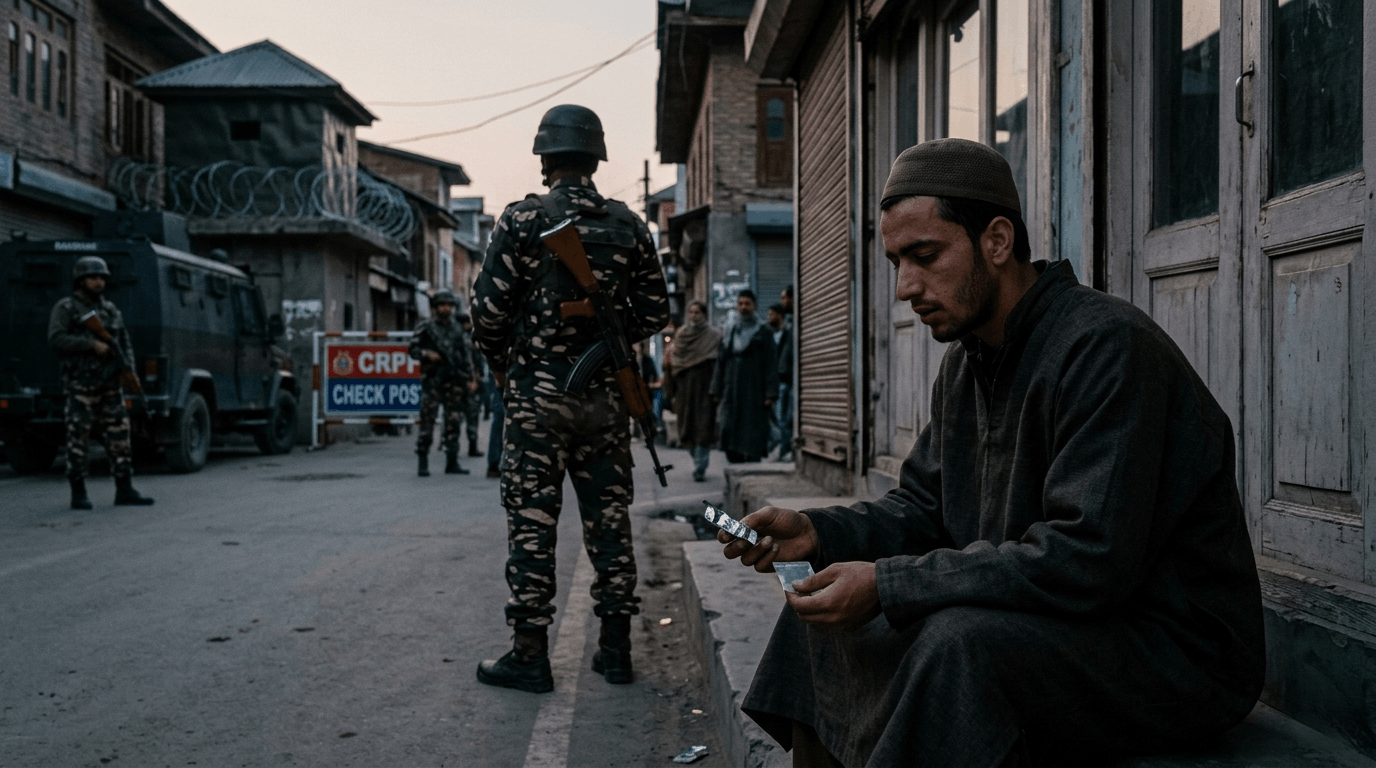

The term security in strategic studies generally means the defense of a state’s territory and people against external dangers. However, in Indian Illegally Occupied Jammu and Kashmir (IIOJK), the very instruments of state security – the military, the paramilitary armies and draconian laws – have been turned into instruments of collective punishment against the entire civilian population. This inversion has resulted in strategic analysts, international observers and the Kashmiri people themselves describing IIOJK as the “world’s largest open-air jail”—an allegation that has enormous significance for regional stability, international law and the South Asian strategic balance.
The Architecture of the Open-Air Jail
Indeed, the “open air jail” is no exaggeration but a tactic based on four “strategies of repression.
The Military Occupation. The first is the permanent military occupation of the territory as this is the most visible one. Currently, IIOJK has over 500,000 security forces permanently stationed throughout the valley, or 1 soldier to every 24 civilians. Today, IIOJK is primarily a military camp, rather than a civilian settlement, because more than one million security personnel are employed in permanent positions. The Armed Forces Special Powers Act (AFSPA) gives immunity to security forces to shoot on sight, raid people’s homes without warrants and arrest people on a mere suspicion. Most deadly weapon of the jailer is to kill without any consequences.
The Legal framework of Control. Article 370 and Article 35-A of the Indian Constitution were withdrawn on 5th August 2019 and Jammu and Kashmir was made a normal state of the Indian Union by taking the decision unilaterally. By this constitutional coup, a semi-autonomous region would be transformed into a Union Territory to come under the control of the Centre, essentially putting the political fate of 12 million Kashmiris behind the constitutional fence. From then on, legal weapons were added to the strategic arsenal of Indian policy makers and it became a practice dubbed as “lawfare” by strategic analysts. Arbitrary and without trial political leaders, activists and journalists have been jailed under the draconian Public Safety Act (PSA).
The Digital Siege. IIOJK is a nation with the dubious record of maximum Internet shutdowns in the world. During June 2026, mobile internet services were suspended throughout the region.The digital lock-down has two strategic objectives – one is to stop anyone from getting a glimpse of human rights violations and the other is to keep the Kashmiri people cut off from information, thereby cutting them off from the rest of the world.
The Human Cost. Indian soldiers have martyred 2,108 Kashmiris including 46 women since Burhan Wani, the youth leader, was killed in extrajudicial manner in 2016. Of these, 364 were murdered in police custody or in apparent staged fake encounters. Bullets, pellets and teargas shells have injured at least 30,318 people, and caused the loss of sight in 115.
The July 2026 Crisis: A Month of Escalation
By July 2026, the Kashmir issue has been radically ratcheted up on several fronts, making the ‘open-air jail’ extremely volatile.
Escalation of Military Operations. In July, Indian troops intensified cordon and search operations in various districts of the IJF including Rajouri, Doda, Udhampur, Poonch, Kupwaraand Baramulla. Troops searched from house to house, harassing women and children, breaking appliances in the houses. Indian police killed a youth, Aarif Hussain in cordon and search operation in Doda district on July 21. Two days later on July 23, three more Kashmiri youths were killed in Islamabad district. The search operation entered its 15th day in Rajouri without any hindrance in the day-to-day life of the people.
Political Persecution and Court harassement. A Delhi court on July 25 sentenced Kashmiri political leader Aasiya Andrabi to life imprisonment and her two associates to 30 yearsimprisonment. Pakistan strongly rejected the ruling and said it was part of a ‘broader pattern of politically motivated prosecutions aimed at silencing dissenting voices.

The Diplomatic Front. India and Pakistan had a bristled exchange of words at the United Nations Security Council on July 23-24. India’s Permanent Representative, however, reiterated that Jammu and Kashmir “has always been, is and will remain an integral and inalienable part of India. The Pakistani mission replied that Jammu and Kashmir was not a part of India and it was not an internal matter of India, pointing out that “Security Council resolutions do not have an expiry date”.
International Scrutiny. On 23rd July, the human rights of IIOJK was once again discussed in the UK House of Lords, during which Lord Qurban Hussain appealed to the UK Government regarding its stance in the wake of the report by ‘Genocide Watch’ that was released earlier this year. In another development, the All Parties Hurriyat Conference (APHC) expressed concern about over 3000 Kashmiris being illegally detained by the Indian administration.
Strategic Consequences: A Framework for Analysis
The “open-air jail” label provides some important lessons from a defence and strategic studies point of view.
The Securitization Dilemma. The Indian response to Kashmir is a classic example of the “securitization dilemma” – a paradox that the use of military means as a solution to a political problem only ends up compromising security. India has mishandled the Kashmiri struggle as a military rather than political issue, which has turned into a generational conflict and resulted in more than 96,000 deaths since 1989.
The Nuclear Dimension. The Kashmir issue has deep nuclear connotations. The “Credible Minimum Deterrence” doctrine and the changing military doctrine of India has created a menacing security scenario. The fact that both sides are armed with nuclear weapons makes every Kashmir issue a potential nuclear flash point, which has been highlighted by the aerial skirmishes and cross border firing in July 2026.
The Accountability Gap. The Kashmir issue remained on the agenda of the United Nations Security Council and a number of resolutions were passed calling for a plebiscite to put the final decision on Kashmir to the people. But India has said that it is a domestic matter. This situation has placed us in what scholars call an “accountability gap,” meaning that there is systematic violations of human rights without any real international accountability.
Conclusion
But it isn’t a rhetorical device, it’s a strategic fact, that IIOJK is the “world’s largest open-air jail” – a place where the weapons of State security have turned into the weapons of collective punishment for an entire civilian population. The heightened military activity, political repression and tensions at the UN Security Council during these events in July 2026 illustrate the volatile nature of this conflict, and the potential for it to escalate into a larger regional conflict.
The lesson from a defence and strategic standpoint is very clear – security cannot be achieved by systematically breaching human rights and political freedoms. A peaceful solution to the Kashmir dispute for South Asia is not by keeping an “open-air jails”, but by finding a just resolution to the conflict in line with international law, UN’s Security Council resolutions and aspirations of Kashmiri people. In the absence of this resolution, the people of IIOJK will remain stuck in what remains, sadly, the world’s largest open-air prison—and South Asia will continue to stagger on the precipice of a crisis that could have potentially far-reaching and devastating consequences in terms of regional and global security.
About Author holds a BS in Political Science from The Islamia University of Bahawalpur and is Research associate at the Kashmir Institute of International Relations (KIIR). His research focuses on defence and strategic studies, governance, regional security and policy-making, with a particular emphasis on IIOJK, Azad Jammu and Kashmir and Gilgit-Baltistan.
Comments are closed, but trackbacks and pingbacks are open.