
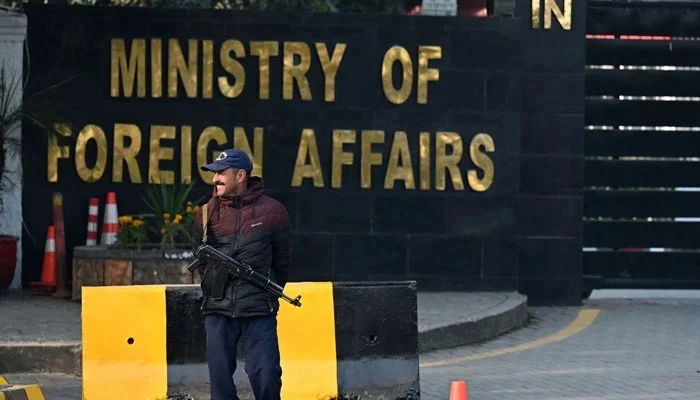
Pakistan Foreign Office Statement Rejects India’s ‘Baseless’ Kashmir Claims
Islamabad hits back at India, calls Kashmir a disputed region under UN law

Pakistan – (Staff Reporter/Web Desk) – Pakistan has firmly rejected India’s fresh claims about the map of the disputed Jammu and Kashmir region. The Pakistan Foreign Office statement said these claims go against facts that the world already knows and accepts.
The statement came from Foreign Office spokesperson Sajjad Haider Khan. He said India cannot change the true status of Kashmir just by making new maps or taking one-sided steps.
According to Khan, India’s actions in the region are illegal under international law. He said no map made by India alone can change what the world already recognizes as a disputed area.
This reaction came right after India’s foreign ministry asked other countries and groups to show Jammu, Kashmir, and Ladakh only in the way India’s own official map presents them. Pakistan quickly pushed back against this demand.
The spokesperson explained that United Nations maps are still the only correct way to show Kashmir’s real legal position. These UN maps clearly mark the region as disputed, not as settled territory.
Khan added that India’s own maps and claims of full ownership hold no real weight. He said such claims do not change the facts already accepted by the international community.
The Kashmir issue remains one of the oldest problems still sitting on the agenda of the UN Security Council. It has stayed unresolved for many decades despite several attempts at dialogue.
Pakistan says the final settlement of this issue must follow old UN Security Council resolutions. These resolutions call for a free and fair vote, known as a plebiscite, held under UN watch.
This vote is meant to let the Kashmiri people decide their own future. Pakistan believes this right has been delayed for far too long.
The Foreign Office also asked the world to pressure India into stopping human rights abuses in the region. Pakistan refers to this area as Indian Illegally Occupied Jammu and Kashmir, or IIOJK.
Khan urged global powers to remind India of its promises. He said India must support the right of Kashmiri people to choose their own path, as UN rules demand.
This fresh war of words between the two neighbors adds to years of tension over Kashmir. Both sides have long disagreed on how the region should be shown on maps and treated in policy.
Meanwhile, a separate but interesting development took place at the United Nations. On September 4, the UN General Assembly voted to adopt a new world map design.
This new design, called the Equal Earth projection, shows Africa as larger while making North America and Europe appear smaller. The change aims to give a more accurate picture of the true size of continents.
A total of 164 countries supported this new map. The United States voted against it, while six other nations chose to abstain from the vote.
The UN said this updated map corrects old distortions in how the world has been shown for years. Experts believe this shift may influence how future maps, including disputed regions like Kashmir, get discussed on global platforms.
[…] holds close ties with India’s ruling nationalist party, currently led by Prime Minister Narendra Modi. The group’s temple […]