
Cyborg Cockroaches Could Deliver Medicine to Disaster Survivors
Australian Scientists Develop Cyborg Cockroaches for Future Disaster Rescue Missions

BRISBANE: (News Desk) — Australian researchers are developing “cyborg cockroaches” that could one day help search-and-rescue teams deliver emergency medication to people trapped inside collapsed buildings or other dangerous environments.
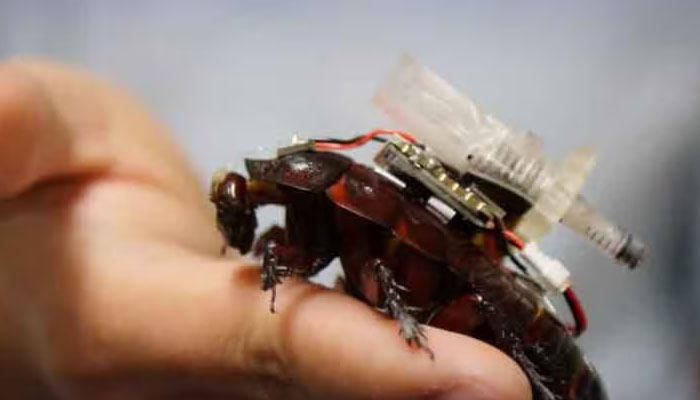
Scientists from the University of Queensland and the University of New South Wales have created miniature “paraborgs” by equipping giant burrowing cockroaches with tiny backpacks containing drug-delivery systems and cameras.
Researchers believe the insects could potentially provide basic medical assistance to victims of earthquakes, building collapses and other disasters while rescue teams work to reach them.
PhD candidate Hai Nhan Le, a co-author of the study published in Advanced Science, said that although the idea of a giant cockroach approaching a trapped person might sound frightening, such an insect could potentially make a critical difference when someone is injured and help is still far away.
Cockroaches Controlled Through Implants
The research team used North Queensland giant burrowing cockroaches, which can grow to around 8.5 centimetres and are among the world’s heaviest cockroach species.
The insects were fitted with lightweight backpacks containing syringe mechanisms and cameras. Researchers said cockroaches were selected because of their ability to move through difficult terrain, survive harsh conditions and operate with extremely low energy requirements—advantages that conventional robots may struggle to replicate in confined spaces.
Tiny electrodes implanted into the insects’ nervous systems allow researchers to remotely influence their movement.
Biorobotics engineer and study co-author Thang Vo-Doan explained that the insects were anaesthetised during the implantation process. Electrical signals are then used to stimulate their nervous systems and guide their movements.
The experiment involved two types of cockroaches. One served as an observer, carrying a camera to help operators identify targets, while another carried medication that could be remotely released.
Promising Laboratory Results
During controlled experiments, the cyborg cockroaches achieved a 100% success rate in reaching designated checkpoints. The overall medication-delivery success rate was 72%.
Researchers found that when the insects were positioned within 15 centimetres of a target, the drug-delivery success rate increased to as much as 95%.
Scientists believe the technology could eventually have applications in situations where rapid medical intervention is crucial, including cases involving snake bites, severe allergic reactions and other life-threatening emergencies.
The long-term goal is to deploy swarms of the insects inside collapsed structures, allowing multiple devices to search simultaneously and help rescuers locate victims more quickly.
More Testing Needed
Despite the promising results, the technology remains at an early research stage. The experiments were carried out under controlled laboratory conditions using silicone targets and pig skin rather than human patients.
Researchers say extensive additional testing is needed before the system could be considered for real-world rescue operations.
Potential challenges include navigating complex and unpredictable environments, maintaining communication signals inside collapsed buildings and ensuring that medication can be delivered safely and accurately.
The study also noted that ethical standards for insect research are not yet fully standardised. Researchers said the cockroaches involved in the experiments were kept in suitable living conditions and fed dry gum leaves and apples.
If further testing proves successful, scientists envision networks of remotely controlled cyborg insects working together to locate and assist disaster victims in spaces too dangerous or inaccessible for conventional rescue equipment.
Comments are closed, but trackbacks and pingbacks are open.