
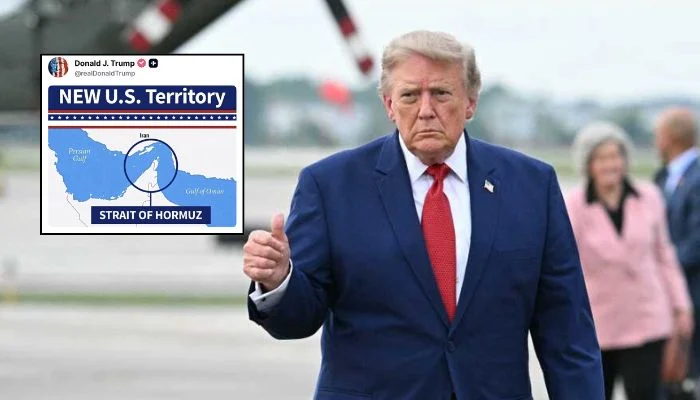
Trump Hormuz Territory Map Labels As US Territory, Sparks Iran Anger
Iran calls Trump's map claim a "delusion" as tension over the Strait of Hormuz deepens

Trump – (Staff Reporter/Web Desk) – The Trump Hormuz territory map has caused a fresh stir online. On Tuesday, US President Donald Trump posted a graphic on his Truth Social account. The image showed the Strait of Hormuz circled in red, white, and blue colors. Above it, bold letters read “NEW U.S. Territory.”
The post came without any extra words or context. Trump simply shared the map and let it speak for itself. But the message was loud and clear to those watching the ongoing war with Iran.
This is not the first time Trump has made this claim. He said something similar just days earlier during a speech in New York. Speaking to police officers in Garden City, he told the crowd that once Iran is fully defeated, he plans to call the strait American land.
He said the US already controls the area through its naval blockade. In his words, no ships pass through the strait unless the US allows it. He called this blockade a strong wall that cannot be broken.
The Strait of Hormuz sits between Iran and Oman. It links the Persian Gulf to the open ocean. This narrow water path carries about one-fifth of the world’s oil supply. Any disruption here can shake global energy markets within hours.
Since the war between the US and Iran began earlier this year, this strait has turned into a major flashpoint. Iran has kept it mostly shut, hurting oil and gas shipments meant for buyers around the world.
The US Navy has responded by setting up its own blockade in the same waters. This move aims to squeeze Iran’s economy further. Trump has often bragged about this blockade, calling it a major win for his administration.
Soon after Trump’s post went live, Iran fired back. Iran’s Deputy Foreign Minister Kazem Gharibabadi responded on social media. He mocked the president’s claim and called it a delusion. He added that Trump’s fantasy about owning the strait would soon be corrected.
— The White House (@WhiteHouse) August 18, 2026
Iran’s tone stayed firm and defiant. Officials in Tehran made it clear that no map or online post changes who controls the waterway. They said the strait remains under Iranian watch, not American ownership.
Iranian Parliament Speaker Mohammad Bagher Ghalibaf also spoke out. He told lawmakers that the strait will stay closed. He listed several demands before any reopening could happen. These include lifting the naval blockade, ending regional wars, returning frozen Iranian assets, and dropping oil sanctions.
His statement showed that Iran is not backing down anytime soon. The country continues to link the strait’s status to broader peace terms with Washington.
This tension arrives just as a 60-day negotiation window between the two nations has come to an end. That deadline was tied to an earlier agreement signed back in June. So far, no lasting peace deal has been reached.
Trump has said he is not in a rush to close a deal. He has claimed there is a hidden line of talks between his team and Iran’s Revolutionary Guard Corps. Iran, however, denies any such talks are happening.
Adding to the drama, Trump also warned Oman this week. Oman has been trying to help settle the dispute over the strait. Trump said if Oman moves ahead with side talks involving Iran, there could be serious consequences.
Just hours after his map post, Trump shared another message. This time, he claimed the strait was fully open. He said all water mines placed in the area had been removed or set off safely.
Energy Secretary Chris Wright offered a different picture, though. He told reporters the strait remains a conflict zone. He explained that ship tracking systems have been switched off due to safety concerns. This makes it hard to know exactly how much shipping traffic is really moving through.
Reaction to Trump’s territory claim has been mixed across social media and news outlets. Supporters view it as a bold display of strength against Iran. They see it as proof that Trump is serious about winning this long conflict.
Critics, however, see things differently. Many point out double standards in how the US treats other countries accused of similar actions. Some question whether declaring ownership of shared international waters is even legally possible.
History offers one useful example here. The US once controlled the Panama Canal for nearly a hundred years. That control came through a signed treaty, not through war or a social media post. Eventually, full ownership was handed back to Panama in 1999.
No such treaty exists for the Strait of Hormuz. Iran and Oman share legal claims over parts of the waterway. Experts say neither the US nor Iran fully controls the entire strait today.
Despite this, Trump continues pushing the narrative that America now owns the passage. His recent comments hint that formal moves may follow soon, though he has not shared any real plan.
As tensions rise, oil markets are already feeling the pressure. Prices have climbed in recent days, reaching levels not seen since earlier this summer. Traders are closely watching how this standoff develops in the coming days.
For now, the Trump Hormuz territory map remains more symbolic than official. But symbols carry weight in global politics. This latest move adds one more layer to an already complicated and dangerous standoff between two nations locked in conflict.
Comments are closed, but trackbacks and pingbacks are open.