

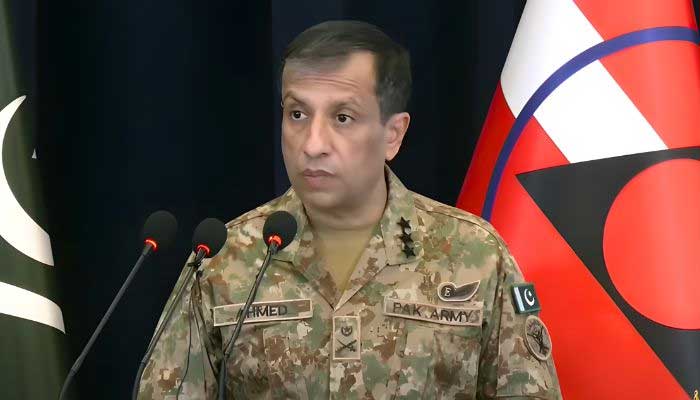

ISPR – (Staff Reporter/Web Desk) – ISPR statement Operation Sindoor response has firmly pushed back against India’s latest attempt to reshape the story of last year’s military standoff. Pakistan’s Inter-Services Public Relations wing says New Delhi is using a dramatic new documentary to rewrite what actually happened during the four-day conflict, rather than accepting the real outcome on the ground.
The statement, released on Monday, accuses India of refusing to accept facts more than a year after the clash known in Pakistan as Marka-e-Haq. Instead of admitting the operation did not go as planned, Pakistan says India has chosen to present a version of events that suits its own narrative.
A Documentary Built on Drama, Not Facts
According to the military’s media wing, Indian content creators produced a heavily dramatized account of what India calls Operation Sindoor. The production reportedly features top political and military figures, along with cinematic storytelling techniques more common in movies than in factual reporting.
Pakistan’s ISPR did not hold back in its criticism. The statement describes the documentary as confused in tone, mixing serious claims with exaggerated presentation. Officials say selective editing, emotional music, and movie-style reconstructions were used to change how the public understands what really took place.
The statement also points to what it calls major inconsistencies within the documentary itself. These contradictions, Pakistan argues, reveal that the film was made later on to build a story Indian audiences would accept, rather than to present an honest record of events.
Questions Over Timeline and Motive
One of the sharpest criticisms in the ISPR statement Operation Sindoor rebuttal involves timing. The documentary reportedly links a speech given by Pakistan’s Army Chief in mid-April 2025 to an attack that occurred in Pahalgam just days later. Pakistan calls this connection baseless, describing it as an attempt to invent a conspiracy without any real evidence.
There is a bigger problem with the timeline, according to Pakistan. India has said the individuals blamed for the Pahalgam attack were tracked down and killed in late July 2025, nearly three months after the military action in May. Yet the documentary presents the May operation as direct payback for Pahalgam.
Pakistan’s military wants an explanation. If the people responsible were only dealt with in July, officials ask, then who exactly was targeted during the strikes carried out in early May. This gap in the timeline, Pakistan argues, undermines the entire justification presented in the documentary.
Disputing the Claim of Full Success
India’s documentary reportedly describes its military campaign as a complete success. Pakistan strongly disagrees. According to the ISPR statement, Pakistani forces stopped Indian aggression during the conflict and brought down eight military aircraft in the process.
Pakistan also highlights its own response, known as Operation Bunyanum Marsoos. During this operation, Pakistani forces used precision rockets, missiles, air force munitions, and long-range strike systems against dozens of military-linked targets. These targets reportedly included facilities connected to activity against Pakistani citizens.
The statement notes something else worth pointing out. Even within the Indian documentary, military leaders admit that Pakistani missile and drone activity was significant. They also acknowledge sustained fighting along the Line of Control and the activation of Indian air-defense systems. Pakistan says these admissions do not match a story of complete Indian dominance.

How the Fighting Actually Stopped
Another key point in the ISPR statement Operation Sindoor response concerns how the conflict ended. The documentary itself reportedly confirms that hostilities stopped after military officials from both countries communicated directly and agreed to halt operations.
Pakistan argues this detail alone weakens India’s claim of a one-sided victory. A ceasefire reached through dialogue, and supported by international involvement, cannot later be reframed as an unconditional win for one side, the statement says.
Officials also flagged what they see as contradictions in how the documentary talks about the fighting. At times, it emphasizes surprise attacks, deep strikes, and complete military control. At other points, it claims India deliberately held back and gave Pakistan room to de-escalate. Pakistan says these two claims cannot both be true, suggesting the film was shaped more for domestic audiences than for accuracy.
Pakistan Says the Record Speaks for Itself
The ISPR statement is direct in its conclusion. It says India has not shared real facts, but instead built a promotional video meant to turn a military setback into something that looks like a win.
According to Pakistan, no amount of editing or cinematic style can change what actually happened. The timeline of events, the aircraft that were lost, the casualties involved, and the actual military engagements remain unchanged regardless of how the story is presented on screen.
Pakistan’s military insists it does not need to create its own version of events. Officials say the facts, diplomatic records, and even India’s own later statements already tell the real story, and that this account is recognized internationally.
Pakistan Reaffirms Its Position
The ISPR statement closes by restating Pakistan’s commitment to peace and regional stability. At the same time, it makes clear that the country’s armed forces remain ready to defend its territory and sovereignty if needed.
Officials warned that any future act of aggression would receive a firm and decisive response. The statement adds that no amount of scripted storytelling will allow India to avoid the real outcome of the 2025 conflict.
Background on the Conflict
The tension between the two nuclear-armed neighbors erupted into open conflict in May 2025. Fighting lasted four days after India launched strikes inside Pakistani territory on May 7, following a deadly attack on tourists in Indian-administered Kashmir weeks earlier.
India named its military campaign Operation Sindoor. Pakistan responded with Operation Bunyanum Marsoos on May 10. The confrontation came to an end that same day, after then-US President Donald Trump announced that both sides had agreed to a ceasefire.
Comments are closed, but trackbacks and pingbacks are open.