
Ali Şahin’s 2023 Vision and the 2026 Makkah Defence Pact
From Türkiye-Pakistan security cooperation to a wider trilateral framework with Saudi Arabia

By Shabana Ayaz, Ankara
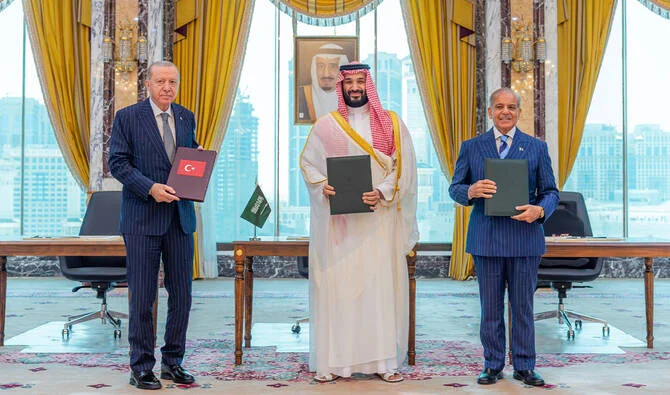
ANKARA: The signing of a trilateral defence agreement between Türkiye, Pakistan and Saudi Arabia in Makkah on August 7 has added a new dimension to the security relationship among the three countries.
The development has also brought renewed attention to a vision articulated by Turkish parliamentarian Ali Şahin over the past three years, particularly his calls for stronger Türkiye-Pakistan defence cooperation and for Muslim countries to develop their own mechanisms for peace and security.
Şahin, a member of the Turkish Parliament, the NATO Parliamentary Assembly and Chairman of the Türkiye-Pakistan Parliamentary Friendship Group, has been a consistent advocate of closer ties between Türkiye and Pakistan.
His connection with Pakistan is also personal. Having studied at the University of Karachi, he has frequently spoken about his attachment to the country and has described himself as a “son of Pakistan”. His engagement has covered political, parliamentary, defence and people-to-people relations.
The 2023 vision
On August 14, 2023, Şahin spoke about the need for Türkiye and Pakistan to play a greater role in addressing challenges confronting the Muslim world.
He described Türkiye and Pakistan as the “twin sons” of the Muslim world and argued that Muslim countries should develop their own mechanisms to address regional problems rather than relying entirely on security arrangements shaped by outside powers.
He particularly emphasised the possibility of a Türkiye-Pakistan security mechanism that could contribute to peace and stability in the Middle East and other regions.
The idea was broader than military cooperation. Şahin also referred to issues including Islamophobia, anti-Muslim hatred and the need for greater political and diplomatic influence for Muslim countries.
At the time, the proposal was primarily a political vision. Over the following years, however, the discussion increasingly moved towards practical defence and security cooperation.
The Gwadar proposal
On September 20, 2025, a further proposal linked to this approach focused on defence technology cooperation between Türkiye and Pakistan.
The concept included the possibility of establishing a joint SİHA/UCAV and air-defence centre at Gwadar Port.
The proposal brought together Türkiye’s growing expertise in unmanned aerial systems and defence technology with Pakistan’s military capabilities and Gwadar’s strategic location.
Although the proposal did not itself constitute a government-to-government agreement, it reflected the broader direction in which Türkiye-Pakistan defence relations have been developing, with increasing emphasis on technology, joint capabilities and defence production.
A reference to Türkiye, Pakistan and Saudi Arabia
The regional dimension became more visible on February 5, 2026, when Şahin, speaking on Kashmir Solidarity Day, again referred to the principle of Muslim countries developing their own mechanisms.
He summed up the idea in a brief phrase:
«“The problems of the Muslim neighbourhood should be solved by the children of the Muslim neighbourhood, through Muslim mechanisms — Türkiye, Pakistan, Saudi Arabia…”»
The reference was significant because it placed Saudi Arabia alongside Türkiye and Pakistan in the context of a broader regional security concept.
At the time, it was a political argument. Months later, the three countries would formally enter a new phase of defence cooperation.
The Makkah agreement
The August 7 agreement in Makkah has now placed Türkiye, Pakistan and Saudi Arabia within a formal trilateral defence framework.
The agreement comes at a time of growing security concerns in both the Middle East and South Asia and represents an important development in the strategic relations of the three countries.
Pakistan and Saudi Arabia already had a longstanding defence relationship, while Türkiye and Pakistan have steadily expanded cooperation in defence, military training and defence technology.
Türkiye’s growing indigenous defence industry, particularly its unmanned systems, Pakistan’s military capabilities and strategic position, and Saudi Arabia’s economic and geopolitical importance give the three countries complementary strengths.
The practical significance of the new agreement will depend on how the three governments translate it into concrete areas of cooperation, including defence planning, training, technology and other security-related mechanisms.
From an idea to a new regional equation
It would be too early to describe the Makkah agreement as a direct implementation of Ali Şahin’s proposals. The agreement is a sovereign decision by the governments of Türkiye, Pakistan and Saudi Arabia, and its development involves a much wider strategic process.
There is nevertheless a clear similarity between some of the principles Şahin has advocated since 2023 and the direction of the latest trilateral cooperation.
His repeated emphasis has been on stronger cooperation among Muslim countries, greater indigenous defence capability and regional mechanisms for dealing with security challenges.
The Makkah agreement now provides a practical framework in which those ideas can be viewed from a new perspective.
The next question is how far the three countries take this cooperation.
If the agreement develops into sustained military, technological and institutional collaboration, it could become an important component of the emerging security architecture linking South Asia and the Middle East.
For Şahin, who has consistently advocated closer Türkiye-Pakistan relations and a greater role for Muslim countries in addressing their own security challenges, the latest development represents a significant moment.
His 2023 call for Muslim-led security mechanisms and his subsequent references to Türkiye, Pakistan and Saudi Arabia now stand against the backdrop of an actual trilateral defence agreement signed in Makkah.
Whether this develops into a broader and lasting regional security framework will ultimately be determined by what comes next.
Comments are closed, but trackbacks and pingbacks are open.