

Sindh Presents Rs3.56 Trillion Budget for FY2026-27, No New Taxes Imposed
Murad Ali Shah Announces Tax-Free Budget Focused on Development

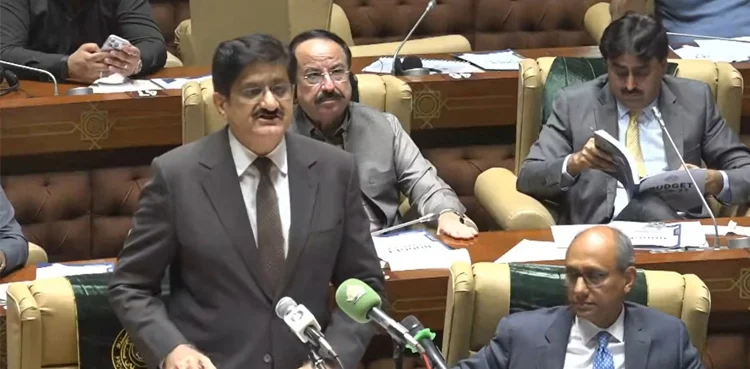
Karachi: (Web Desk) – Sindh Chief Minister Murad Ali Shah on Tuesday presented a Rs3.562 trillion budget for the fiscal year 2026-27, announcing that no new taxes would be imposed and that relief measures had been introduced for the public and business community.
Presenting the budget in the Sindh Assembly, the chief minister announced a 7 percent increase in salaries and pensions for government employees. He also announced the merger of ad hoc relief allowances and raised the minimum monthly wage for workers from Rs40,000 to Rs43,000.
A major focus of the budget is the development of Keti Bandar, which the provincial government aims to transform into an international maritime, logistics, industrial, and energy hub. Murad Ali Shah said the project would be linked with the Dhabeji Special Economic Zone and Thar coal resources, positioning Keti Bandar as Pakistan’s next major economic gateway after Port Qasim.
The chief minister also announced Pakistan’s largest solar energy initiative under the vision of Bilawal Bhutto Zardari. The government plans to distribute 275,000 free solar home systems at a cost of Rs18 billion and introduce subsidized solar financing schemes for middle-income households.
Murad Shah Praises Pakistan Defense On Marka-e-Haq Anniversary
For Karachi, the budget includes 816 development projects with a total estimated cost of Rs644.3 billion. More than Rs100 billion has been allocated for the city during the next fiscal year, covering infrastructure, transport, water supply, sanitation, education, healthcare, and solid waste management.
Major allocations include funding for new flyovers, underpasses, water supply schemes, storm-water drains, road rehabilitation, the Karachi Red Line and Yellow Line BRT projects, Safe City initiatives, and the modernization of the city’s fire brigade and forensic facilities.
The government has also earmarked funds for healthcare and education projects, including the Sindh Infectious Diseases Hospital, a new medical college in Karachi, the Bilawal Bhutto Engineering College in Lyari, and the expansion of public universities.
On the taxation side, the chief minister announced relief for the agricultural sector by increasing the agricultural super tax exemption threshold from Rs150 million to Rs500 million and reducing the tax rate from 10 percent to 8 percent.
The Annual Development Programme (ADP) for FY2026-27 has been set at Rs400 billion. The largest allocation of Rs121.6 billion has been reserved for local government and municipal infrastructure projects, followed by public health engineering, transport and communications, irrigation, education, health, and agriculture sectors.
Murad Ali Shah said the budget focuses on economic growth, renewable energy, public welfare, and infrastructure development while avoiding any additional tax burden on citizens.


Comments are closed, but trackbacks and pingbacks are open.