

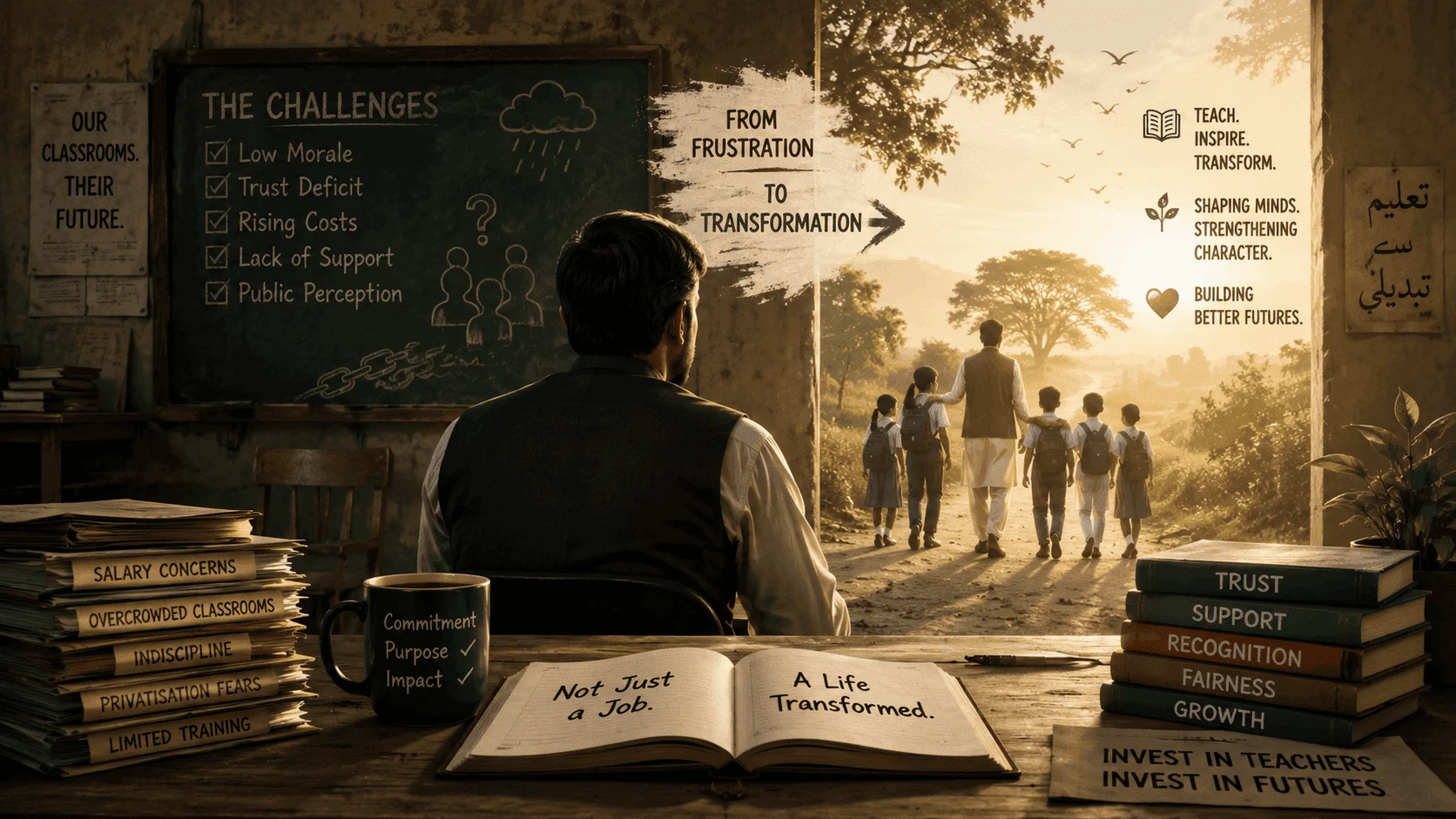
Teaching: A Quiet Privilege We Forget
Teaching in Pakistan's Public Schools: Privilege, Frustration, and the Responsibility We Owe Our Classrooms

By Muhammad Rabnawaz Awan
Long before my transition into education, reading foreign media was part of my professional routine. I regularly followed English-language newspapers from the UK and the USA.
During those days, I came across an article in The Guardian. It spoke about growing discontent within the teaching community and a sense of ingratitude towards the profession.
I remember being genuinely surprised. How could a teacher feel ungrateful? At the time, I could not fully understand it.
Years later, standing in a public-school classroom myself, I understand it all too well.
In the modest staffroom of a public school in rural Punjab, I often hear colleagues voicing their frustrations. Their concerns include salary adjustments, privatisation drives, and indiscipline among students.
Other common complaints involve overcrowded classrooms and limited opportunities for meaningful capacity building. Many of these concerns carry weight and deserve attention.
Yet, at times, the reasoning behind them appears either weak or altogether absent. I try to persuade my colleagues — though not always successfully — that a persistent focus on limitations can quietly undermine our own effectiveness.
One of the most troubling aspects is the deepening trust deficit. A culture of suspicion has taken root within the profession.
Even constructive policy measures are often viewed through a lens of doubt. Consider, for instance, the public-private partnership initiatives introduced for struggling educational institutions.
These efforts were designed to revive underperforming schools without displacing teachers. They had the potential to be genuinely transformative.
Yet, despite assurances and safeguards, they struggled to gain acceptance within segments of the teaching community.
Capacity building occupies an important place in our narrative of victimhood. There is a frequent call for more training, more opportunities, and more institutional support — and rightly so.
However, a quieter contradiction often follows. When the government invests in our professional growth through MPhil and PhD programmes, along with financial incentives, some among us begin to distance themselves from the very classrooms we are meant to serve.
Teaching in public schools — particularly those serving underprivileged communities — is sometimes perceived as less aligned with newly acquired academic status.

Yet it is precisely these classrooms that justify such investments in the first place. These are the students who rely most on dedicated instruction.
This raises a deeper question of responsibility. If public resources enable our growth, then public classrooms must remain at the centre of our commitment.
At the same time, not all concerns raised by teachers are misplaced. Many warrant serious attention, thoughtful remedies, and meaningful reform.
Beneath the surface of routine complaints lie genuine struggles. Rising living costs, limited institutional support, and a gradual erosion of professional respect cannot be dismissed lightly.
A system that expects excellence must also listen with sincerity and respond with fairness.
One practical step could be the development of structured medical facilities for teachers. Similar provisions already exist for the armed forces and other essential services.
Access to reliable healthcare, improved working conditions, and targeted professional development would address legitimate concerns. More importantly, it would help restore confidence within the profession.
Teaching remains an extraordinary profession. It may not always bring recognition, reward, applause, or public acknowledgment.
Yet it consistently offers something far rarer and deeper. It offers the opportunity to shape a life in ways that may never be fully seen or measured.
A teacher often works in silence, planting seeds of thought, character, and confidence. These seeds may take years to bloom.
The impact is not always immediate, nor always visible, but it is enduring. Teaching is not merely a profession of instruction. It is a quiet act of transformation that extends far beyond the classroom walls.
The call, therefore, is simple yet demanding. We must not allow frustration to overshadow meaning.
Let constructive critique refine us rather than harden us. Let reform inspire growth rather than lead to exhaustion or disillusionment.
And above all, let us return — again and again — to the quiet conviction that what we do in classrooms is not routine work.
It is transformative work. It shapes minds, strengthens character, and influences futures in ways we may never fully witness — but will always matter.
The author is an educator, social awareness advocate, and the voice behind several impactful online campaigns aimed at reviving empathy and moral consciousness among youth. He regularly writes on issues of social decay, educational reform, and the urgent need for character-building in modern societies. He tweets at @ToleranceAdvocate.
Comments are closed, but trackbacks and pingbacks are open.