
Fuel Price Hike Pakistan — 395 Rupees Per Litre and a Nation Losing Its Breath
How the fuel price hike in Pakistan is slowly eating away the dignity, health, and hope of millions of ordinary citizens

By: Aasi Islamabad
It was not just a number displayed on a fuel pump board. It was not merely an economic indicator or a routine adjustment in fuel pricing. It was something far more brutal, far more personal — it was the reflection of a nation slowly losing its ability to breathe.
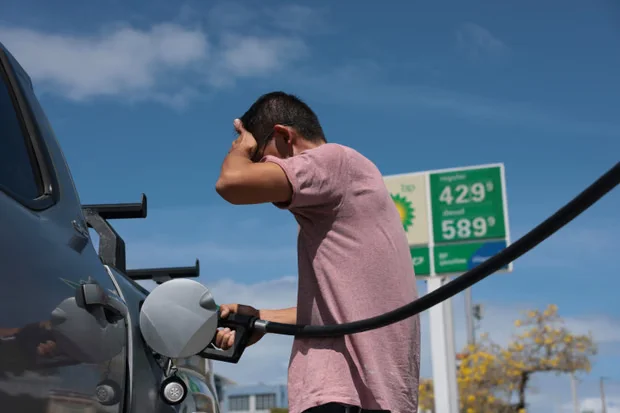
Standing at the petrol station, holding 1,550 rupees in my hand, I believed for a moment that it would at least bring some relief, some reasonable quantity of fuel to keep life moving. But when the nozzle stopped and the meter froze, reality struck without mercy: 3.93 litres. That was it. A full tank of disappointment wrapped in numbers.
For a few seconds, everything felt suspended. The noise of the station faded, the movement of people blurred, and the only thing that remained was a heavy silence pressing against the mind. It felt as if time itself had paused just to allow reality to sink deeper.
And then came the thought that has now become a permanent shadow over ordinary lives in this country: Is this survival, or is this punishment disguised as living?
The worker at the petrol station looked at me and casually said something that sounded almost routine to him, but devastating to me: “Sir, it will become even more expensive… it may reach 560 rupees per litre in a few days.” That was not a warning. That was a declaration of economic collapse for the ordinary citizen.
From 395 to 560 rupees per litre represents an approximate increase of 42 percent. But in economies like ours, petrol is never just petrol. It is the heartbeat of everything. When fuel rises, everything rises with it — transport, food, electricity, medicine, rent, education, and ultimately, despair.
In Pakistan’s energy system, electricity generation is heavily dependent on fuel costs. When fuel prices rise, power production becomes expensive, and the burden is passed directly to consumers through fuel adjustment charges. A household paying 10,000 rupees could soon face bills between 12,500 and 14,000 rupees — without consuming a single extra unit of electricity. Usage remains the same, but punishment increases.
Gas pricing follows a similar trajectory. Increased transportation and import costs directly impact domestic energy prices. For many households, cooking is already a carefully managed daily decision. Rising gas costs turn even basic meals into financial calculations. A stove no longer represents comfort — it represents cost.
Public transport, goods transportation, and logistics depend entirely on fuel. When petrol rises, mobility becomes expensive for everyone. A journey that once cost 100 rupees may soon cost 150 rupees or more. For daily wage earners, students, and low-income workers, this is not inflation — it is restriction of movement. When movement becomes expensive, freedom quietly shrinks.
The kitchen is always the first battlefield of inflation. Flour, rice, pulses, vegetables, cooking oil — these are not luxury goods. These are survival items. Yet they behave like luxury commodities under economic pressure. The kitchen, once a place of nourishment, becomes a space of negotiation.
Milk production depends on livestock feed, transport, and energy costs. As these inputs rise, dairy prices follow inevitably. For families with children, milk is not optional. It is essential. When essentials become expensive, poverty becomes nutritional.
Medicine prices are influenced by import costs and supply chain expenses. This transforms illness into financial crisis. Treatment becomes delayed, and prevention becomes unaffordable. In such an environment, health is no longer a right — it becomes a privilege.
As transport and construction costs rise, housing becomes increasingly unaffordable. People do not just pay rent anymore — they pay uncertainty for shelter.
What is most alarming is not just the economic data, but the psychological impact. Within minutes, an ordinary mind begins calculating survival probabilities: if petrol increases, then transport increases, then food increases, then bills increase, then income remains the same. This chain of thought does not bring clarity. It brings pressure.
In the middle of this mental storm, a thought arises — simple yet grounding: there is a Creator who provides sustenance. A reminder that beyond systems, governments, and policies, there exists a divine order of provision not controlled by human inefficiency. But even that spiritual reassurance does not remove the worldly question: why does the system that distributes resources create such imbalance?
This is not merely a fuel crisis. It is a structural economic failure. When petrol prices rise, supply chains become expensive, inflation spreads rapidly, public purchasing power declines, and economic inequality deepens. The state issues notifications, but citizens bear consequences. Policy remains on paper. Pressure remains in homes.
In this system, farmers produce but suffer inflation. Workers labour but remain underpaid. Salaried individuals pay taxes but receive no relief. The burden distribution is inverted. Those who contribute most to society absorb the highest cost of instability.
Whether in government or opposition, political narratives often revolve around power rather than people. Promises change, slogans change, but the daily struggle of citizens remains unchanged. The public becomes a statistic, not a priority.
There is an old story of a king who imposed tax on a bridge. People protested not by resisting, but by adjusting their suffering. They even requested an increase in executioners so that punishment could be completed faster. This was not humour. It was resignation. And resignation is the final stage of societal exhaustion.
Today, society stands at a similar point. Earlier, oppression was visible. Now, it is gradual and normalized. Inflation does not explode — it accumulates. Silently. Daily. Relentlessly.
Are we truly progressing as a society? Or are we simply learning to survive within increasing economic pressure? When survival becomes the goal, progress becomes irrelevant.
395 rupees per litre is not just fuel pricing. It is a measurement of collective endurance. A number that represents how long a nation can keep functioning under increasing pressure without breaking completely. And if this trajectory continues, the question will no longer be about fuel prices. It will become:how long can people continue to breathe under such conditions?
This is not just an editorial. It is a record of emotional, economic, and social strain experienced by ordinary citizens. A silent testimony of a society where every number has turned into a burden, and every rise in price has become a drop in hope. And perhaps one day, this silence will transform into change. Or it will remain the final language of endurance.
Comments are closed, but trackbacks and pingbacks are open.