
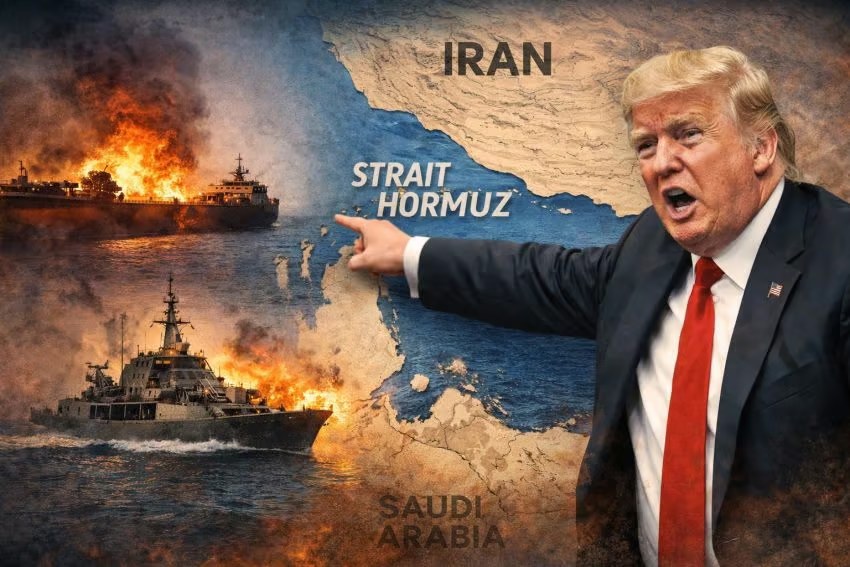
Trump refuses ceasefire extension with Iran, raises risk of renewed conflict

Islamabad/Washington/Tehran-(Mudassar Iqbal/X/Web Desk)-Donald Trump said Tuesday that he is unwilling to extend the ongoing ceasefire with Iran, cautioning that the United States may restart military operations if an agreement is not reached soon.
In an interview with CNBC, Trump stated that Washington is negotiating from a position of strength and is ready to escalate if necessary. When asked about prolonging the truce, he replied that time is limited and he prefers to push for a decisive outcome, adding that he expects the U.S. to secure what he called a “great deal.”
He also indicated that military action remains a real possibility if talks collapse. Trump suggested that adopting a tougher stance could strengthen the U.S. position, noting that the military is fully prepared to act if required.
Meanwhile, the United States Central Command confirmed that U.S. forces had seized an Iran-linked oil tanker in international waters as part of enforcement measures. The vessel, named the Tifani, was boarded without resistance. It can carry up to two million barrels of crude oil and was last tracked near Sri Lanka, with Singapore listed as its destination.
The command said such operations are aimed at disrupting networks accused of supporting Iran and enforcing sanctions globally, regardless of location.
Trump further alleged that Tehran has repeatedly breached the ceasefire, although he did not provide specific evidence. Iranian authorities have not immediately responded to the tanker seizure, but the incident may further strain diplomatic efforts. Tehran has previously argued that restrictions on its ports violate the truce and has maintained it will not engage in negotiations while such measures remain in place, With the final hours of the two-week ceasefire approaching, uncertainty continues to surround a possible new round of talks in Islamabad. Washington has expressed confidence that negotiations will proceed, while an Iranian official said Tehran is still considering participation.
Iranian sources told Reuters no final decision has been made, although there are indications of momentum. Pakistani officials said delegations, if they attend, are not expected before Wednesday, leaving limited time to reach an agreement before the truce expires.
Trump has warned he could restart military operations, including strikes on civilian infrastructure, if Iran refuses US terms. A previous round of talks held 10 days ago ended without agreement, with Tehran opposing further discussions amid the ongoing blockade and the seizure of Iranian-linked vessels.
Still, a Pakistani source involved in the process said talks could resume as early as Wednesday, with JD Vance expected in Islamabad. An Iranian official said Tehran was “positively reviewing” participation but was waiting for its conditions to be addressed, including recognition of its right to enrich uranium.
Markets reacted cautiously to the diplomatic signals. Oil prices eased slightly after rising about 6% a day earlier, while Asian stocks recovered on expectations that talks might proceed.
A senior Iranian military commander warned of an “immediate and decisive response” to any renewed US action, according to Tasnim news agency. Meanwhile, senior Iranian figure Mohammad Baqer Qalibaf accused Trump of increasing pressure through the blockade and attempting to force concessions.

Iran said one of its tankers had successfully entered territorial waters from the Arabian Sea with naval support despite US warnings. At the same time, Tehran has largely closed the Strait of Hormuz to foreign vessels, reversing an earlier decision to reopen it after Washington refused to lift sanctions.
The closure has disrupted the flow of roughly 20 million barrels of oil per day, intensifying concerns over global energy supplies and economic stability.
“Leave Now: Iranian Analyst Issues Evacuation Advice for Gulf Residents”
A key sticking point remains Iran’s nuclear programme. Trump has insisted any agreement must prevent Tehran from developing nuclear weapons and has called for it to relinquish its stockpile of highly enriched uranium.
Iran, which maintains its nuclear activities are for peaceful purposes, is seeking sanctions relief while preserving elements of its programme. Analysts say Tehran may be leveraging its control over the Strait of Hormuz to strengthen its negotiating position.
The ceasefire, initially announced on April 7, is expected to expire late on April 22, with only a narrow window left for diplomacy. The conflict has already caused significant casualties and sent shockwaves through global energy markets, raising fears of wider economic fallout.
Pakistan has stepped up preparations to host the talks, deploying nearly 20,000 security personnel across Islamabad amid the uncertainty. While,US Vice President JD Vance’s visit to Islamabad has been put on hold after Iran failed to respond to Washington’s negotiating positions, the New York Times quoted a US official as saying.
The official said that the diplomatic process was “in effect paused” due to a lack of response from Tehran.
However, Vance’s trip to Islamabad has not been cancelled and could be back if Tehran responds positively to Washington, the official added. Earlier,The formal response from Iran regarding the confirmation of its delegation for the upcoming Islamabad Peace Talks is still awaited.
Pakistan, acting as a mediator, remains in continuous contact with Iranian officials and is actively pursuing a diplomatic and dialogue-based approach to facilitate progress.The current ceasefire is set to expire at 4:50 a.m. PST on April 22. Iran’s decision to participate in the talks before the end of the two-week ceasefire period is considered crucial for maintaining momentum in the peace process.
Pakistan has made sustained and sincere diplomatic efforts to persuade the Iranian leadership to attend the second round of negotiations, and these efforts are ongoing.
Comments are closed, but trackbacks and pingbacks are open.