
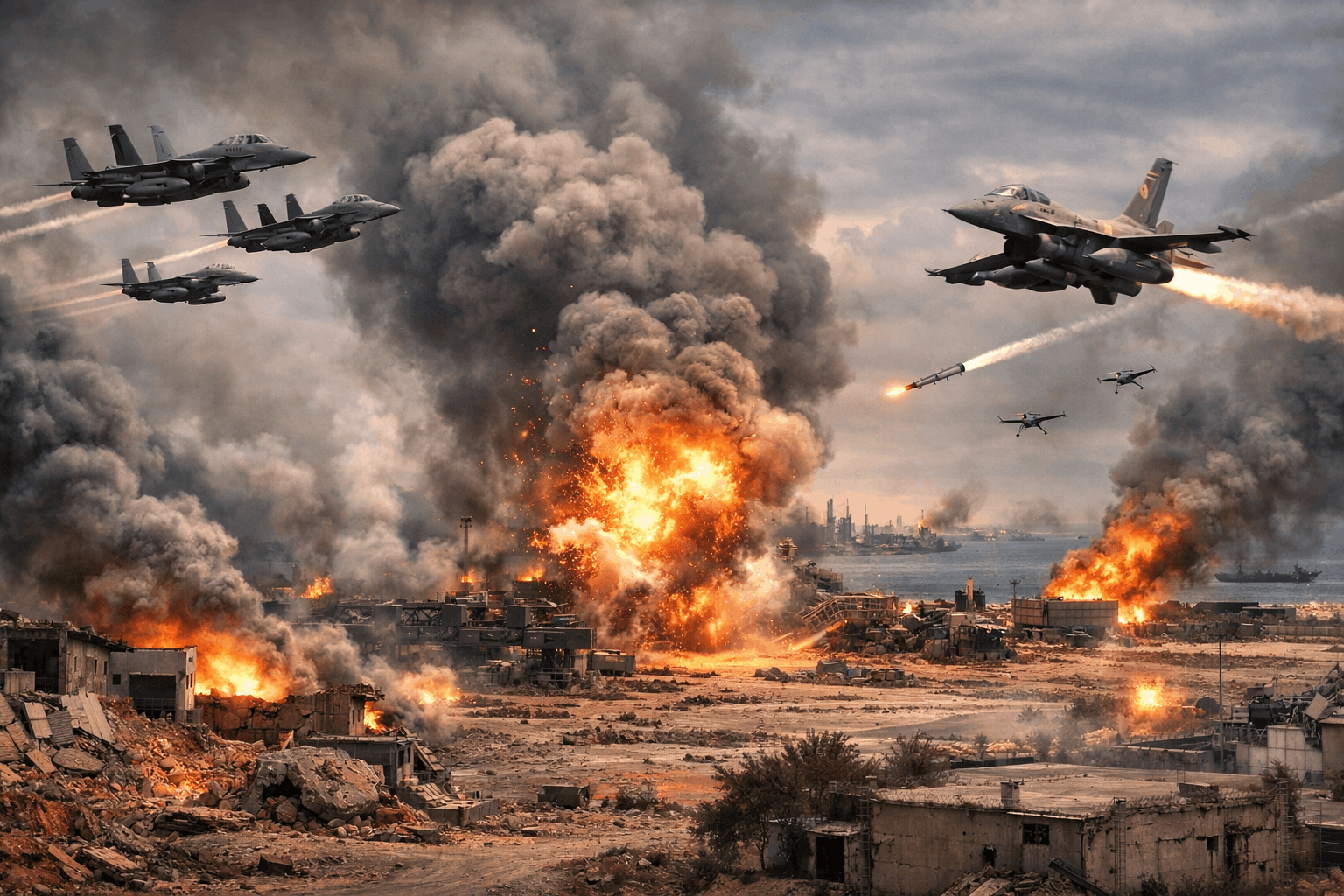

In global politics, there are moments when silence carries more weight than the roar of guns. The recent decision by Donald Trump to “Pause” escalating tensions with Iran may appear, at first glance, to be a routine diplomatic breather. Yet, beneath the surface, it reflects a deeper strategic recalibration. A sudden shift from ultimatums to restraint suggests that modern conflict is no longer confined to battlefields it is increasingly shaped by economics, energy flows, and global supply chains.
Iran’s approach in this crisis marks a clear departure from conventional military doctrine. Traditionally, wars are decided by air superiority, advanced weaponry, and strong alliances. However, Iran appears to have adopted a Hybrid strategy combining limited direct confrontation with calculated pressure on the arteries of the Global economy. At the heart of this strategy lies the Strait of Hormuz, one of the world’s most critical energy chokepoints.
Even minor disruptions in this narrow passage can trigger shockwaves across global markets. Sudden spikes in oil prices, increased shipping costs, and slowdowns in industrial production form a chain reaction that ultimately burdens ordinary citizens worldwide. By leveraging both missile capabilities and the strategic vulnerability of energy routes, Iran has managed to exert pressure not only on regional adversaries like Israel but also on global powers with vested interests in stability.
This evolving situation echoes the lessons of the Suez Crisis, when military gains by United Kingdom, France, and Israel were ultimately undermined by disruptions in supply lines and overwhelming international pressure. That episode reshaped global power dynamics, highlighting the limits of military force in the face of economic and geopolitical realities. Today’s tensions in the Middle East appear to be a modern-day iteration of the same principle.
The economic implications of the current standoff are already visible. Volatility in oil markets is fueling inflation, while financial markets reflect growing uncertainty. Pressure on U.S. bond markets, particularly long-term yields, signals wavering investor confidence turning financial indicators into measures of national credibility.

The impact is far from limited to the West. Countries such as Pakistan, India, Japan, and South Korea All heavily dependent on energy imports are especially vulnerable. Rising fuel costs translate into higher industrial expenses and increased pressure on household incomes, amplifying economic strain across developing and advanced economies alike.
Moreover, the crisis extends into the technological domain. Artificial intelligence, a cornerstone of the United States economy, depends heavily on semiconductor production. These semiconductors, in turn, rely on critical inputs such as helium gas much of which is supplied by Qatar. Any disruption in regional stability threatens to ripple through tech supply chains, potentially slowing innovation and economic growth far beyond the Middle East.
For Iran, the Strait of Hormuz has effectively become a strategic lever one that enhances its defensive posture while compelling global powers to reconsider escalation. This represents a new form of warfare, where geography, economics, and technology converge to redefine power.
Whether Iran is “winning” remains a matter of perspective. However, it is evident that the rules of engagement have shifted. Wars are no longer fought solely along borders; they now unfold across shipping lanes, financial systems, and supply networks.
Within the United States, Donald Trump’s policy stance is also facing scrutiny. Critics argue that the conflict serves the interests of Israel more than those of the American public, raising questions about the long-term costs of involvement. This internal pressure may well have contributed to the decision to step back At least temporarily.
Ultimately, this “Pause” may signify more than a tactical delay. It could be an acknowledgment that in the modern world, true power lies not only in military strength but in control over resources, markets, and supply chains. The coming days will determine whether this silence marks the beginning of de-escalation or merely the calm before a far greater storm.
Comments are closed, but trackbacks and pingbacks are open.