

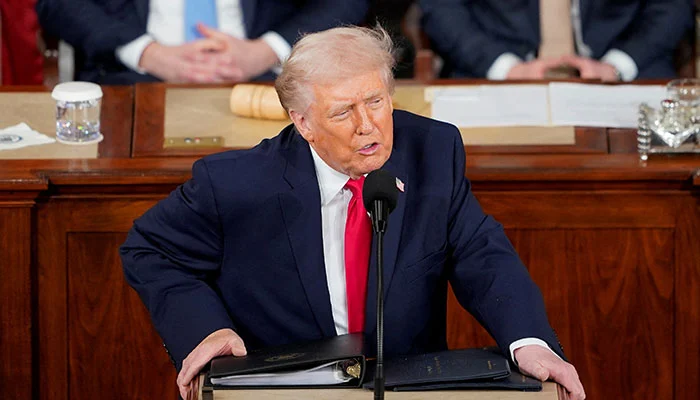

US President Donald Trump has claimed in a letter to Congress that armed tension with Iran has now ended. The following are the important facts and legal aspects behind this claim:
The War Powers Act (1973) Cycle:
This statement by the President is actually a legal defense. Under the ‘War Powers Act’, the President must seek Congress’s approval within 60 days for any military campaign. 60 days have passed since the war began on February 28, so the President took the position that, because the ceasefire has been in effect since April 7, the war is now over, and he does not need any approval from Congress.
Operation Epic Fury:
President Trump named this military campaign ‘Operation Epic Fury’ and said that he would continue to give instructions to the military as Commander-in-Chief to protect American interests.
Opposition reaction: Democrats and Senator Chuck Schumer have called the claim “nonsense” and illegal. They say thousands of US troops are still at risk and that the tension has not subsided as long as the Strait of Hormuz is closed.
Extension of ceasefire:
The president is using the indefinite extension of the ceasefire he extended on April 21 as the basis for the cessation of hostilities.
Significance for Pakistan:
Pakistan, which is currently mediating through the “Islamabad Talks”, sees President Trump’s claim as a positive opportunity to turn this temporary peace into a permanent peace agreement.
The next legal step of the US Congress.
After US President Donald Trump claimed that “tensions with Iran are over,
The US Congress, especially Democrats, is considering legal measures to limit the president’s powers:
War Powers Resolution (Joint Resolution):
Democratic leaders are preparing to introduce a joint resolution in the Senate and House of Representatives. Its purpose is to bind the president not to take any further military action against Iran without congressional approval. Although Trump can veto it, it would put intense political pressure on him.
Power of the Purse:
Congress has the power to control the defense budget. Lawmakers are proposing to block funds allocated for ‘Operation Epic Fury’ or limit their use only to defense purposes so that the president cannot restart the war at will.
Legal Challenge:
Human rights organizations (such as the ACLU) and some legal experts plan to take the matter to federal courts. They argue that the president’s claim that “the 60-day legal period clock stops during a ceasefire” is a clear violation of the War Powers Act of 1973.
Congressional Hearings:
The Senate Armed Services Committee has decided to subpoena Defense Secretary Pat Hegseth and other military officials to determine whether “hostilities have truly ceased” on the battlefield or whether the president is simply making this claim to avoid legal complications. National Security Powers Definition:
Finally, regarding the definition of national security powers:
Next turning point:
If Congress succeeds in blocking the funds, it will be difficult for President Trump to order another attack on Iran, which could bolster Pakistan’s mediation efforts. Following US President Donald Trump’s decision to ignore the War Powers Act, Democrats have developed a multi-pronged strategy to challenge the president’s military powers:
1. Legislation and new resolutions Democrats are planning to introduce a “No War Without Authorization” bill in the Senate and House of Representatives. It aims to clarify that a ceasefire does not legally mean an end to hostilities and that the 60-day period remains in effect.
2. Funding Strike Democrats, led by Senate Minority Leader Chuck Schumer, are proposing amendments to the upcoming defense budget that would block the use of funds for “aggressive military operations” in the Middle East. Only provide money for operations that are defensive in nature or that have been formally authorized by Congress.
3. Public pressure and investigative hearings. Democrats on the Senate Armed Services Committee (such as Jane Shaheen) are trying to prove through public hearings that the president’s claim that “the tension has subsided” is false. The closure of the Strait of Hormuz and the presence of US troops in the region still reflect an active war situation.
4. Judicial recourse;
Democratic legal experts and organizations like the ACLU are working to file petitions in federal courts to declare the president’s position that a ceasefire stops the 60-day “countdown clock” illegal.
5. Election narrative;
Democrats want to make this a major issue in the 2026 midterm elections, in which Trump will be portrayed as a president who is violating the Constitution and pushing the country into an “illegal war.”
Importance for Pakistan:
If Democrats succeed in pressuring the President, it will make it harder for President Trump to strike again, paving the way for a lasting peace deal through the Pakistan-led “Islamabad Talks.”The American public’s reaction to US President Donald Trump’s claim that “armed tension with Iran is over” is sharply divided, but according to recent polls, the majority seems to be against this military campaign.
The following are the salient aspects of the public reaction:
Majority disapproval: According to the latest Washington Post-ABC-Ipsos poll (May 2026), 61% of Americans believe that the use of military force against Iran was a mistake, while only 36% consider it the right decision.
Economic burden and inflation:
The main reason for the anger against this war among the American public is the economic impact. Gasoline prices have exceeded $ 4 per gallon, which has made life difficult for ordinary citizens.
Political division:
Republicans (MAGA base): The vast majority of Trump supporters (about 84%) still support his actions and the policy of “peace through strength”.
Democrats and Independents:
A majority of Democrats (88 percent) and independents (61 percent) have rejected the president’s actions as unconstitutional and dangerous.
Doubts about national security:
According to the Pew Research Center, 40 percent of Americans believe that the war has made the United States less safe in the long run, while only 22 percent see it as better for the country. Protest wave: On March 28, 2026, one of the largest civilian protests in American history took place, with millions of people chanting “Stop the war with Iran.” Workers in cities like Los Angeles and San Francisco have also called for a general strike on May 1. This public pressure has become a major political challenge for President Trump, as the majority of Americans now want an early end to the war rather than a long-term military intervention in the Middle East.
Next, key public figures have voiced opinions on the crisis:
Elon Musk:
In his comments on ‘X’, Elon Musk called the war “global supply chain suicide.” Musk warned that the closure of the Strait of Hormuz would stop the flow of not only oil but also raw materials used in the technology sector, setting the global economy back decades.
Bernie Sanders and Alexandria Ocasio-Cortez (AOC): These American politicians have called President Trump’s decision to ignore the ‘War Powers Act’ a “constitutional coup”. They say that workers’ tax money is being wasted on illegal wars while the people are suffering from inflation.
Angelina Jolie:
As a former UN ambassador, she expressed concern over the plight of workers and refugees stranded on the borders of Pakistan and Iran. She appealed to the international community to arrange safe passage for these innocent citizens.
Michael Moore:

The famous filmmaker called it an “oil war” and criticized President Trump for putting American troops and world peace at stake for his political interests.
Pakistani personalities:
Various social leaders and showbiz stars in Pakistan have praised the mediation efforts of Prime Minister Shehbaz Sharif and the military leadership. They say that Islamabad becoming a center of peace is indispensable not only for the region but also for the future of Pakistani workers living there.
The US media is currently divided over President Trump’s claim of escalating tensions with Iran and the legal complexities of the “War Powers Act,” while a large number of international journalists are in Pakistan to cover the “Islamabad Talks.”
Key Aspects of US Media Coverage:
President Trump vs. Media:
President Trump has sharply criticized outlets like CNN and The New York Times, calling them “seditious.”
He accuses these outlets of downplaying the successes of the US strikes on Iranian nuclear facilities.
Legal Debate (War Powers Act): Media outlets like Politico and NBC News are debating the legal point of whether the ceasefire that began on April 7 actually stops the 60-day constitutional clock or whether the president is simply calling it an “end of war” to avoid approval.
Islamabad Talks Coverage: The Washington Post and The New York Times have prominently covered the failure of the first round of talks in Islamabad and the stalling of the second round.
These reports specifically mention Pakistan’s role as a mediator and the presence of Vice President J.D. Vance. Focus on economic impact: Financial media outlets like Forbes and Reuters have focused their coverage on the impact of the closure of the Strait of Hormuz and the naval blockade on oil prices and the global supply chain.
Hardline media stance:
Analysts on Fox News have supported the president’s stance that the 60-day period ends in the event of a ceasefire, while MSNBC is calling it a violation of the Constitution by the president.
While this coverage by the US media is on the one hand revealing the internal political confrontation, on the other hand presenting Islamabad as the world’s most important diplomatic hub where the last hopes of resuming talks between the two rivals are pinned,Hashtag campaigns running on social media or detailed reports by international human rights organizations There are currently several major campaigns and reports circulating on social media regarding the Iran-US crisis and human rights.
:Trending hashtags on social media#StopTheWar / #NoWarOnIran: This is the biggest trend globally, with people demanding a permanent ceasefire from President Trump and the Iranian leadership.
#IslamabadTalks / #PeaceInIslamabad: These hashtags are among the top trends in Pakistan, where users are praising the mediation efforts of Prime Minister Shehbaz Sharif and the military leadership.
#JusticeForMigrants: This campaign is being run especially for the millions of Pakistani and Asian workers who are stranded or unemployed in the Middle East. #OpenHormuz: This hashtag is calling for the opening of the Strait of Hormuz to help the global economy and reduce oil prices. Reports from human rights organizations (Summary). International organizations such as Amnesty International and Human Rights Watch (HRW) have released their detailed reports in early May 2026: Labor exploitation. According to the report, under the guise of the crisis, many Gulf companies have stopped paying the salaries of Pakistani and Indian workers and are being fired without any notice.
Constitutional violation:
The human rights organization ACLU has called the US President’s position on the ‘War Powers Act’ a “legal fraud” and said that it is a clear violation of international law.
Medical crisis: The blockade has led to a severe shortage of medicines in Iran, with the Red Cross expressing concern and calling for an immediate humanitarian corridor.
Civilian casualties:
According to monitoring groups, hundreds of civilians and fishermen (including Pakistanis) have lost their lives in the recent tensions. In light of these reports, the Pakistani government is trying to include labor rights and humanitarian issues on the agenda during the Islamabad talks.
US President Donald Trump has claimed in a letter to congressional leaders that the armed conflict with Iran has now ended, so the legal period for obtaining permission from the legislature to continue the war no longer applies to him. In a letter to Congress, President Trump took the position that since the ceasefire has been in place since April 7, 2026, and there has been no exchange of fire with Iran, the hostilities that began on February 28 have now ended. This letter comes at a time when 60 days have passed since the attacks on Iran by the United States and Israel, and under the ‘War Powers Act of 1973’, the president was required to seek approval from Congress within 60 days. President Trump said in a letter to House Speaker Mike Johnson and Senator Chuck Grassley that he had launched ‘Operation Epic Fury’ to protect American interests and national security. Speaking to reporters while leaving the White House, he had called the War Powers Act completely unconstitutional. The president said that he has no intention of seeking approval from Congress for this military campaign because no one has ever asked for such permission before, so why are we apart? He further clarified that as commander-in-chief, he will continue to instruct the military to deal with threats in the region. On the other hand, Democrats and legal experts have severely criticized the president’s stance. Senate Minority Leader Chuck Schumer called it an “illegal war” and said that this is all nonsense, Republicans are participating in this illegal process that is endangering lives every day, and increasing the burden on the public. Senate Armed Services Committee member Jane Shaheen said that Trump’s announcement is contrary to reality because thousands of our soldiers are still in danger, and prices are skyrocketing due to the closure of the Strait of Hormuz.
The human rights organization ACLU has also written to the White House expressing serious concern that the president is waging an illegal war. According to the organization, the War Powers Resolution nowhere states that wartime should be stopped or restarted from zero during a ceasefire. In contrast, Defense Secretary Pat Hegseth testified in the Senate and supported the president’s position that the 60-day clock stops in the event of a ceasefire. Although President Trump has claimed that hostilities have ended, he also acknowledged that the threats posed by Iran are still significant and that the Pentagon will continue to change its military posture in the region as needed. Pakistan’s mediation in the ongoing dispute between Iran and the United States has entered a decisive phase. Important activities are expected on the diplomatic front in the next 48 hours, as Iran has formally submitted its draft of new proposals to Pakistan. The new proposals conveyed by Iran to Washington through Pakistan include several points that are aimed at breaking the diplomatic deadlock, but there are still big differences between the US and Iranian governments on them.
The most important “secret” points of the new proposals are as follows:
Partial restoration of the Strait of Hormuz:
Iran has offered that if the US lifts the naval blockade, Tehran will immediately open the Strait of Hormuz for global oil supplies.
‘Freeze’ on the nuclear program:
The Iranian proposal includes the point that it is ready to freeze its nuclear program at its current level, provided that it is provided with economic guarantees.
Exchange of prisoners and frozen assets:
Tehran has offered to exchange prisoners as a goodwill gesture. Exchanges and access to its frozen financial assets abroad have been stipulated.
Regional ceasefire guarantee:
The proposals made by Pakistan also state that Iran will prevent its allied groups from attacking US facilities if Washington commits to ceasing aggressive actions against Iran.
Islamabad peace framework:
Iran has suggested that all subsequent rounds of negotiations should be held in Islamabad so that Pakistan remains present as a guarantor.
US response: President Trump has described these proposals as “inadequate” because they do not contain a clear date for the complete cessation of the nuclear program
Behind this armed tension between Iran and the US, which began in 2026, there are several deep political, strategic, and economic realities that make this conflict more than just a border clash and a global crisis:
1. Nuclear program and the ‘red line’;
The biggest realistic motivator is Iran’s nuclear program. The United States and Israel claim that Iran is very close to developing nuclear weapons. According to President Trump, the United States is willing to go to any length to prevent Iran from becoming a nuclear power because he believes that Tehran will not hesitate to use these weapons.
2. The Strait of Hormuz and the global economy;
The Strait of Hormuz is the world’s most important ‘oil passage’. Iran has tried to take control of it and hold the global economy hostage. The United States wants to strategically keep this route open so that oil prices are controlled, while Iran is using it as its defensive shield.
3. Operation Epic Fury;
President Trump gave this military campaign a formal name to show that this is not an accidental clash but a well-thought-out military strategy aimed at crippling Iranian military capabilities.
4. The War Powers Act and domestic US politics;
A key fact behind the tension is President Trump’s struggle for his country’s internal constitutional powers. To avoid seeking approval from Congress under the ‘War Powers Act’, he is declaring the ceasefire as an “end of the war” so that he can make independent decisions as commander-in-chief.
5. Israel’s key role;
Israel is an active party in this tension. Since the joint attacks on February 28, Israel has been increasing pressure on the United States to target Iranian military installations, which has led to a diplomatic stalemate.
6. Pakistan’s mediation and regional stability;
An important fact is that both countries are using Pakistan as a “buffer zone” or diplomatic bridge instead of direct talks.
The talks in Islamabad are important because both sides want to find a middle ground to avoid a major catastrophic war.
In light of these facts, this conflict has become not just a rivalry between two countries but a complex battle over global energy, nuclear non-proliferation, and the supremacy of international law.
Comments are closed, but trackbacks and pingbacks are open.