
Urban Heat Islands: How Cities Are Becoming Hotter Than Nature
Asma Shahid Roll no: Bot-2205 Department: Botany Govt. Girl Degree College No.1 Dera Ismail Khan

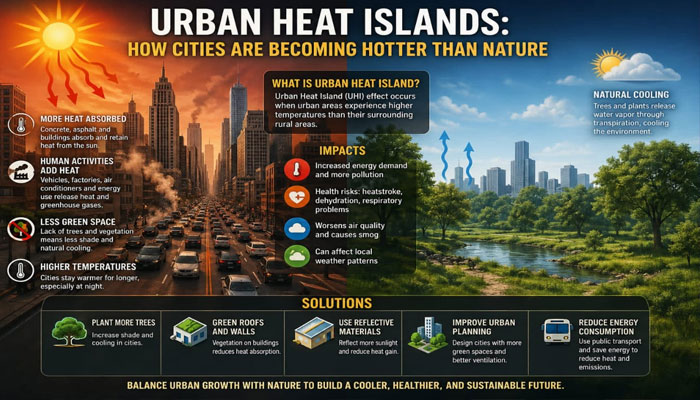
In today’s rapidly developing world, cities are expanding at an extraordinary rate. However, this urban growth has given rise to a serious environmental issue known as the Urban Heat Island (UHI) effect. This phenomenon occurs when urban areas experience significantly higher temperatures than their surrounding rural areas.
The main reason behind this effect is the replacement of natural land surfaces with concrete, asphalt, and buildings. These materials absorb and retain heat from the sun during the day and release it slowly at night, causing cities to remain warmer for longer periods. In contrast, natural landscapes with trees and vegetation help cool the environment through a process called transpiration.
Human activities further intensify the Urban Heat Island effect. Vehicles, air conditioners, factories, and energy consumption release large amounts of heat and greenhouse gases into the atmosphere. The lack of green spaces and trees in cities reduces shade and cooling, making the situation even worse.
The impacts of Urban Heat Islands are both environmental and social. Higher temperatures increase energy demand, especially for air conditioning, leading to more electricity consumption and further pollution. It also affects human health by increasing the risk of heat strokes, dehydration, and respiratory problems. Vulnerable populations such as children and the elderly are at greater risk.
Moreover, Urban Heat Islands contribute to worsening air quality and can even influence local weather patterns. Increased heat can lead to the formation of smog, which is harmful to both humans and animals.
To reduce this problem, cities must adopt sustainable solutions. Planting more trees, creating green roofs, using reflective building materials, and improving urban planning can help lower temperatures. Encouraging public transport and reducing energy consumption can also play an important role.
Conclusion: The Urban Heat Island effect is a growing environmental challenge directly linked to human development. If cities continue to expand without proper planning, this issue will become more severe. Therefore, it is essential to balance urban growth with environmental protection to ensure a healthier and more sustainable future.
Comments are closed, but trackbacks and pingbacks are open.