
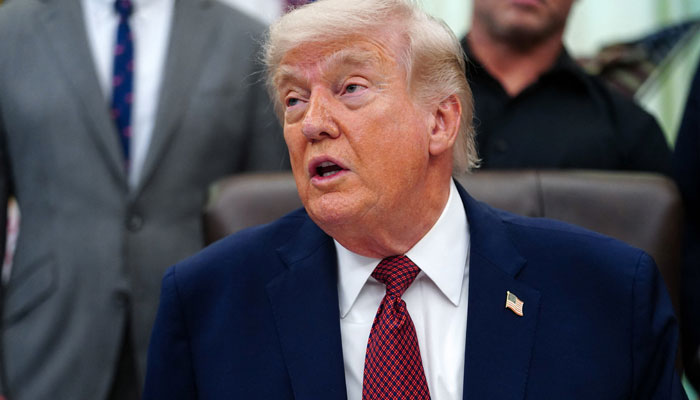
Trump Rejects Iran Terms Amid Rising Regional Tensions
President Donald Trump Rejects Iran Proposal As Middle East Tensions Escalate

WASHINGTON: (Web Desk) – Donald Trump has rejected Iran’s latest conditions for ending the ongoing Middle East conflict, calling Tehran’s response “totally unacceptable” and increasing fears of renewed escalation in the region.
The sharp exchange followed Iran’s reply to Washington’s recent peace proposal, delivered through Pakistani mediators. Tehran reportedly demanded guarantees regarding its enriched uranium stockpile and insisted on broader conditions linked to regional security and the continuation of fighting in Lebanon.
Posting on his Truth Social platform, Trump made clear he was dissatisfied with Iran’s response, although he did not disclose specific details about Tehran’s counteroffer.
Meanwhile, Benjamin Netanyahu stated that the conflict would not end until Iran’s enriched uranium is removed and its nuclear infrastructure dismantled. He said Israel remains determined to prevent Iran from maintaining nuclear capabilities.
Iranian President Masoud Pezeshkian maintained a defiant stance, declaring that Iran would never surrender under pressure. He stressed that diplomacy and negotiations should not be interpreted as weakness or retreat.
Trump Claims Iran Militarily Defeated NATO Called Paper Tiger Interview
According to Iranian state media, Tehran’s proposal focused on ending the conflict across multiple fronts, especially in Lebanon, where Israel continues military operations against Hezbollah. Iran also emphasized the importance of ensuring shipping security in the Gulf region.
The ongoing uncertainty rattled global energy markets, with Brent crude oil prices climbing sharply above $104 per barrel amid fears of instability in the Strait of Hormuz.
Reports indicated that Iran proposed diluting part of its highly enriched uranium while transferring the remainder to a third country under international guarantees. Tehran reportedly requested assurances that the uranium would be returned if future negotiations collapse or if Washington withdraws from any agreement.
Tensions also continued to rise in the strategically important Strait of Hormuz, through which a significant portion of the world’s oil supply passes. Iran warned that it would not tolerate foreign military interference in the area and threatened a swift response if additional Western naval forces entered the waterway.
Iranian Deputy Foreign Minister Kazem Gharibabadi stated that only Iran has the authority to guarantee security in the strait. Meanwhile, Emmanuel Macron clarified that France had not planned a military deployment there, but rather a coordinated security initiative.
Fresh security concerns emerged after reports of drone attacks in Gulf waters. The United Arab Emirates and Kuwait both confirmed intercepting hostile drones, while Qatar reported a cargo vessel arriving from Abu Dhabi was struck by a drone near its coast.
An Iranian parliamentary security spokesperson warned that Tehran’s “restraint is over,” threatening strong retaliation against American ships and military sites if Iranian vessels are targeted again.
Separately, Iranian Nobel Peace Prize laureate Narges Mohammadi was released on bail following concerns over her health and transferred to Tehran for medical treatment after hospitalization.
The Islamic Revolutionary Guard Corps also warned that any attacks on Iranian tankers or commercial vessels would lead to strikes on American facilities and ships in the region.
Comments are closed, but trackbacks and pingbacks are open.