

The Opium of the Oppressed: Narcotic Terrorism and the Psychological Erasure of Kashmir’s Youth
Kashmir's Silent War: How Drugs and Trauma Are Erasing a Generation

By Altaf Hussain Wani
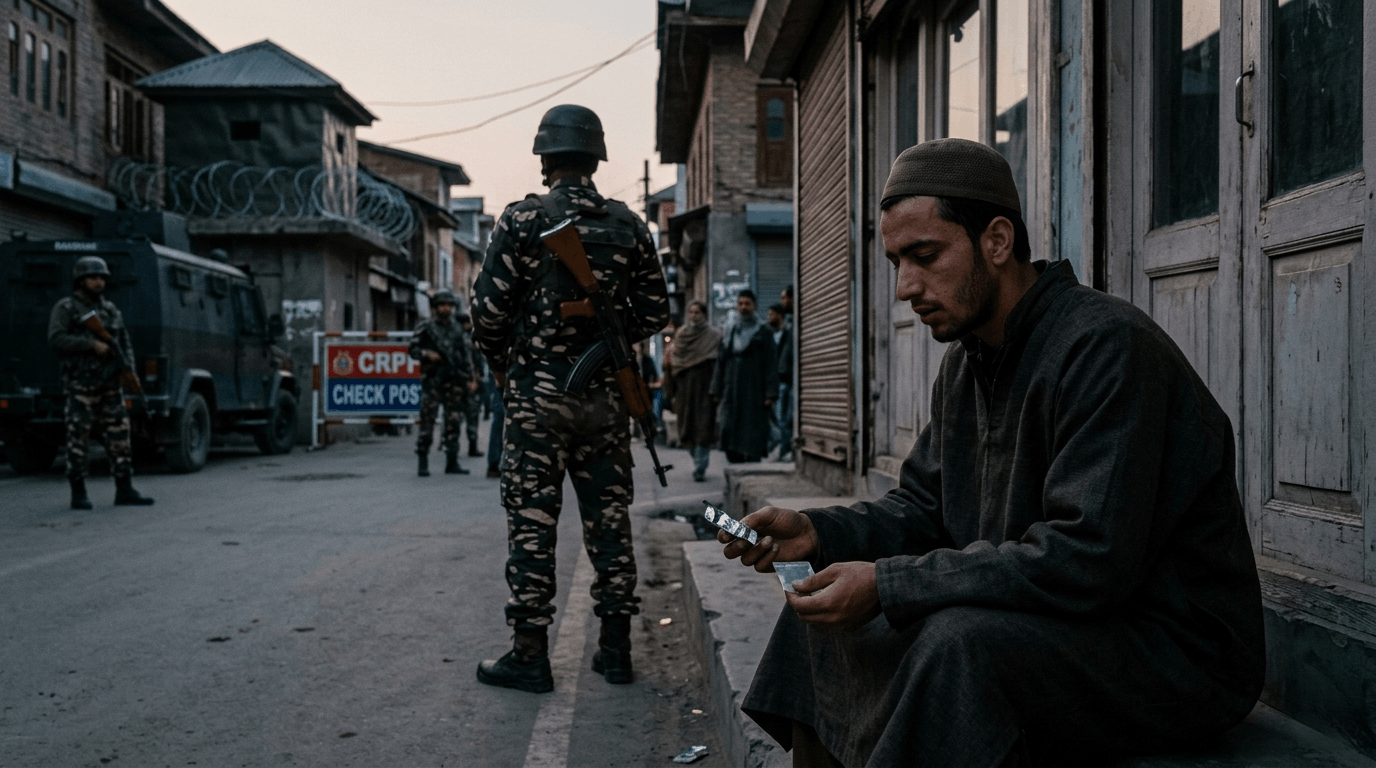
When the world looks at Indian-occupied Jammu and Kashmir, it sees a territorial dispute mapped out in geopolitical lines and military bunkers. But beneath the shadow of the gun lies a quieter, far more insidious war. The most lethal weapon deployed against Kashmiris today is not the bullet, but the deliberate, systematic destruction of the mind. For the Kashmiri youth, growing up under the world’s most dense militarization means inheriting a landscape of mass trauma and PTSD. However, this psychological crisis is no longer just a byproduct of conflict; it is being actively engineered through what can only be described as “narcotic state terrorism.”
To understand the Kashmiri psyche, one must first understand the architecture of their daily lives. A generation has been raised under the perpetual dread of the Armed Forces Special Powers Act (AFSPA), a law that grants soldiers the power to kill and arrest with absolute impunity. The checkpoints, the midnight raids, the crack of gunfire, and the sudden, suffocating internet shutdowns are not isolated incidents; they are the ambient noise of their childhood. Psychologists call it complex PTSD—a chronic state of hyperarousal where the brain is permanently wired for survival. When a child witnesses a father beaten, a neighbor disappeared, or a peer martyred, the fundamental architecture of their worldview shatters. Surveys have found that a staggering 45% of the adult population in Kashmir suffers from mental distress—a testament to the suffocating weight of the occupation. This collective trauma breeds a profound sense of hopelessness—a grim realization that they are educated enough to dream of a globalized future, but subjugated enough to be denied the basic freedoms required to pursue it. The state relies on this trauma to sustain its narrative. A traumatized, hyper-aggressive youth throwing a stone at an armored vehicle is easily framed as “terrorism,” providing the convenient justification for further crackdowns, more militarization, and deeper subjugation.
But in recent years, the state apparatus has evolved its tactics, moving from merely suppressing dissent to chemically neutralizing a generation. This brings us to the most horrifying, least discussed dimension of the conflict: narcotic state terrorism. There is a growing, chilling consensus in the valley that the flood of narcotics is not an accident of geography, but a deliberate instrument of subjugation. While authorities blame the region’s proximity to the “Golden Crescent” for the inflow of drugs, the sheer volume of hard substances flowing into the hands of local youth suggests a sinister turning of blind eyes by security forces at checkpoints. After all, these are the same checkpoints where a packet of milk or a newspaper is heavily scrutinized, making the unchecked flow of kilograms of narcotics logistically impossible without institutional complicity.
The logic of narcotic state terrorism is brutally simple: a population addicted to drugs is a population incapable of political resistance. By flooding the streets with cheap, highly addictive substances, the state is actively pacifying the youth, eroding their cognitive faculties, and dismantling their capacity to organize or demand their right to self-determination. It is a calculated attempt to shift the narrative. If the youth are dying not from bullets but from overdoses in alleyways, the state can wash its hands of the blood, framing a brutal political occupation as a localized public health crisis.
The statistics emerging from the ground are nothing short of catastrophic. Recent reports indicate that approximately 1.3 million people in the region are now affected by substance abuse—a figure that has nearly doubled from 600,000 in just three years. Roughly 90% of these drug users are aged between 17 and 33, precisely the demographic that has historically led political resistance. The shift from traditional cannabis to hard drugs has been deadly; heroin is now the most commonly used substance, with a horrifying 95% dependency rate among its users. This is a dual tragedy. First, the trauma of living under a brutal occupation drives these youths to seek any form of escape, leading to initial substance use as self-medication. Second, the state’s alleged facilitation of this drug supply ensures that this temporary escape becomes a permanent, fatal trap. The psychological wounds of conflict are being deliberately infected with chemical agents, turning a political grievance into a medical emergency.

The healthcare infrastructure is buckling under this engineered crisis. Hospitals like SMHS in Srinagar are overwhelmed, attending to an average of one drug-related patient every 12 minutes. Experts note a devastatingly low recovery rate—potentially as low as 1 in 100—because patients are simply discharged back into the exact same militarized, traumatic environments that broke them in the first place.
Families are being destroyed from the inside out. Mothers who once feared the midnight knock of the military now fear the violent withdrawals of their own sons. The social fabric of Kashmir, once defined by immense resilience and communal solidarity, is being frayed by the needle and the foil. This is a form of demographic engineering that requires no settlers; it merely requires rendering the existing population chemically inert.
US-Iran tensions rise after failed Pakistan talks
If the international community is genuinely committed to human rights, it must look beyond the body bags and start counting the broken minds and the poisoned veins. The psychological cost of this conflict is not collateral damage; it is the primary objective of a modern, insidious warfare designed to break a people from the inside out. Raising awareness for the Kashmir cause means loudly exposing narcotic state terrorism for what it truly is—a calculated, slow-motion crime against humanity. It means demanding independent international investigations into how these narcotics seamlessly cross one of the most heavily militarized zones on earth. The resolution of the Kashmir dispute cannot simply be about drawing lines on a map. Any political solution that ignores the psychological and chemical erasure of its youth is no solution at all. The fight for Kashmir’s future is, fundamentally, a desperate fight to save the minds of its children.
The writer is chairman Kashmir Institute of international Relations(KIIR) and can be reached at ; saleeemwani@hotmail.com and on X @sultan1913

Comments are closed, but trackbacks and pingbacks are open.