

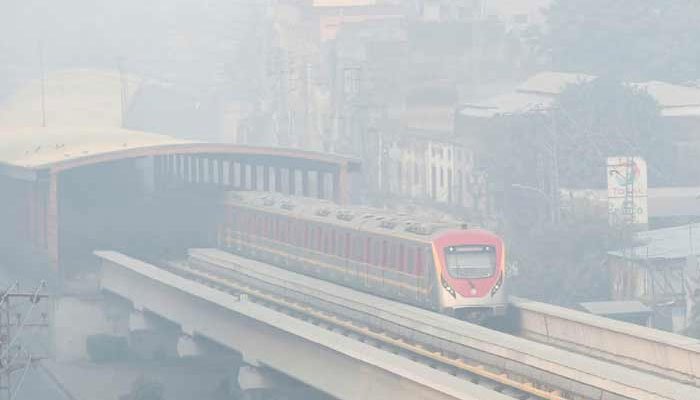

Dirty air works like an unbudgeted tax on wages, household savings, business output and public services. Its heaviest burden often falls on workers least able to absorb a sick day
For a daily-wage worker, the economics of smog needs no model. A day spent recovering from illness is a day without earnings. A clinic bill can consume money set aside for food or school fees. If a child becomes ill, another family member may also have to stop working. Add those shocks across households and businesses, and smog becomes much more than a change in the colour of the winter sky.
Pakistan recorded the world’s highest national annual average PM2.5 concentration in IQAir’s 2025 country comparison: 67.3 micrograms per cubic metre, or 13.5 times the World Health Organization’s annual guideline of 5. That annual figure is not a measure of winter smog alone, but it shows the depth of exposure underlying each seasonal emergency. As shown in Figure 1, this places Pakistan’s annual exposure far above the WHO guideline.
Figure 1. Annual average PM2.5 concentrations in 2025. IQAir combines regulatory monitors and validated low-cost sensors; country coverage and monitor density vary.
Electricity tariffs, taxation and borrowing costs recur in Pakistan’s economic debate because they are visible and relatively easy to count. Dirty air also raises the cost of making goods, moving people, learning and earning. Yet much of that burden is dispersed across clinic receipts, lost shifts, delayed deliveries, cancelled classes and reduced productivity. It rarely appears as a single line in a household budget or business account.
The broadest World Bank estimate illustrates the scale. It valued health damage from ambient and household PM2.5 in Pakistan at US$24.8 billion in 2019, equivalent to 8.9% of GDP. Ambient pollution accounted for US$11.9 billion and household pollution for US$12.8 billion; illness represented 18% of the total estimated cost, with premature mortality accounting for the remainder. These estimated losses are summarised in Figure 2.
That figure requires careful interpretation. It is a welfare estimate of mortality and morbidity, not a bill payable by the treasury, a forecast of current GDP, or a calculation confined to winter smog. Its value is to make visible a set of losses that conventional economic debate often misses.
Figure 2. World Bank health-damage valuation for 2019. The GDP-equivalent measure uses purchasing-power-parity methods; the dollar values shown are current US dollars
The immediate burden is intensely practical. A worker without paid sick leave faces a direct trade-off between recovery and income. Treatment, transport to a clinic and medicines arrive as cash expenses while earnings may be falling. A child’s illness can create a second shock when a parent or sibling stays home to provide care.
This is why the same pollution episode can have unequal financial effects. A salaried employee with sick leave, savings and access to remote work has more protection than a street vendor, loader, construction worker or driver. For households living close to their weekly cash-flow limit, even a short interruption can force spending cuts or new debt. Smog therefore acts not only as a health risk but also as a mechanism that can deepen financial insecurity.
“A sick day can mean lost wages; a child’s sick day can mean two incomes disrupted.”
For employers, the cost appears through absenteeism, lower productivity and interrupted operations. Outdoor workers face direct exposure, while poor visibility and emergency restrictions can complicate transport and commerce. Firms may also pay for masks, air filtration or altered shifts. Small businesses with thin margins and little spare labour have fewer ways to absorb these disruptions.
Punjab’s 2024 smog emergency showed how quickly health protection can spill into the working week. Authorities closed schools across affected districts and directed half of Lahore’s government employees to work from home. Doctors reported a surge in patients with respiratory complaints. Later in the same episode, officials said hospitals were receiving nearly 70,000 respiratory-related patients a day and deployed mobile clinics.
Closures and work-from-home directives can be necessary to reduce exposure; their disruption is not an argument against protecting health. It is an argument for treating cleaner air to avoid repeated emergency costs in the first place.
School closures protect children during hazardous episodes, but they can also interrupt learning and create childcare problems. When a child stays home, a caregiver may lose paid working hours. Households without reliable internet or suitable devices face additional barriers to remote learning. The resulting costs are distributed unevenly and may persist beyond the smog episode itself.
Schoolchildren walk through air pollution in Lahore. Image: Undark, 2018; rights remain with the original publisher.
The longer-term concern is the accumulation of health and educational setbacks. World Bank modelled estimates put Pakistan’s mean annual PM2.5 exposure at 58.4 micrograms per cubic meter in 2023—little changed from 58.5 in 1990. The series has fluctuated, but it shows no sustained convergence towards the WHO guideline. These modelled exposure estimates use a different methodology from IQAir’s monitor-based averages and should not be compared as like-for-like measurements.
Ultimately, smog is not only an environmental or public-health emergency; it is an economic burden that reaches into household budgets, workplaces, businesses and children’s education. The figures discussed above show the scale of the exposure and the health-related losses, while the everyday effects reveal how unevenly those costs are borne. Pakistan therefore needs to treat cleaner air as an investment in people’s health, productivity and economic security. Stronger pollution controls, better public transport, cleaner energy and sustained monitoring can help reduce the need for costly emergency responses. Protecting the air people breathe is ultimately part of protecting their ability to work, learn and build a more secure future.
Comments are closed, but trackbacks and pingbacks are open.