
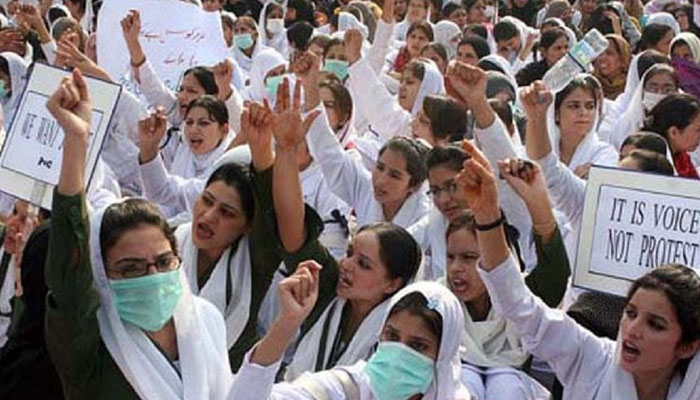
Punjab Ends Monthly Stipend and Free Hostel Facility for Nursing Students
Admissions will be offered on 3,100 seats in morning shifts across 45 public-sector nursing colleges.

LAHORE: In a major policy shift, the Punjab government has abolished the monthly stipend of Rs31,600 and the free hostel facility for nursing students, placing the full financial burden of education on families already struggling with rising living costs.
The drastic changes have sparked criticism, with many calling the move a setback to Chief Minister Maryam Nawaz’s vision of providing free and accessible nursing education for young women, especially those from underprivileged backgrounds.
According to officials, the recommendations for the new policy were prepared by Punjab Health Minister Khwaja Salman Rafique and Health Secretary Azmat Mahmood before being sent to the chief minister for approval.
Critics argue that Ms. Nawaz was not fully informed about the severe financial implications the new policy would have on the families of aspiring nurses.
Experts warn that the changes indicate a gradual shift toward the privatisation of nursing education, an approach that could lead to long-term challenges for Punjab’s already overstretched public health system, which faces an acute shortage of experienced nurses.
They fear the move may further compromise patient care in government hospitals.
Under the revised policy, the University of Health Sciences (UHS) Lahore has become the central admissions authority for the four-year BSN (Generic) programme.
Admissions will be offered on 3,100 seats in morning shifts across 45 public-sector nursing colleges.
Additionally, 1,400 new seats have been introduced for evening programmes in 15 nursing colleges, with each institution allocated 100 seats.

These include prominent colleges affiliated with Mayo Hospital/KEMU, Sir Ganga Ram Hospital/FJMU, Jinnah Hospital/AIMC, Lahore General Hospital/AMC, Allied Hospital Faisalabad, Nishtar Hospital Multan, and others.
The new guidelines clearly state: “There shall be no stipend for the students enrolled in the BSN Generic programme, in both morning and evening batches.”
Read more: Trump Says Democrats Who Urged Military to Refuse Orders ‘Should Be in Jail’
A senior official lamented that nursing education has now become “prohibitively expensive,” warning it might further widen the gap in the already limited pool of trained professionals.
He pointed out that most female nursing students come from low- or middle-income households and will now be forced to pay high hostel fees or seek costly private accommodation far from home, raising both financial and safety concerns.
For years, subsidised education enabled young women from disadvantaged backgrounds to pursue nursing as a stable and respected profession.
The withdrawal of government support has therefore created widespread frustration among students and their families.
The new policy also outlines updated eligibility criteria, scoring methods, and the admission process for nursing colleges.

Comments are closed, but trackbacks and pingbacks are open.